WEATHER ALERT

A look at the details of the new COVID-19 related travel restrictions

Advertisement

Advertise with us

OTTAWA - The federal Liberal government unveiled new restrictions on travel Friday designed to slow the spread of COVID-19. Here's a look at what they are.

Read this article for free:


By clicking the button above, an account will be created and you will begin to receive some of our recommended newsletters. You may opt out of any newsletter by visiting your Email and Communication Preferences page or by clicking "unsubscribe" at the bottom of any email.

or

Already have an account? Log in here »

To continue reading, please subscribe:

Digital Subscription

One year of digital access for only $1.44 a week*

  • Enjoy unlimited reading on winnipegfreepress.com
  • Read the E-Edition, our digital replica newspaper
  • Access News Break, our award-winning app
  • Play interactive puzzles

*Billed as $5.77 plus GST every four weeks. After 52 weeks, price increases to the regular rate of $19.95 plus GST every four weeks. Offer available to new and qualified returning subscribers only. Cancel any time.

To continue reading, please subscribe:

Add Free Press access to your Brandon Sun subscription for only an additional

$1 for the first 4 weeks*

  • Enjoy unlimited reading on winnipegfreepress.com
  • Read the E-Edition, our digital replica newspaper
  • Access News Break, our award-winning app
  • Play interactive puzzles
Start now

*Your next Brandon Sun subscription payment will increase by $1.00 and you will be charged $17.95 plus GST for four weeks. After four weeks, your payment will increase to $24.95 plus GST every four weeks.

Hey there, time traveller!
This article was published 29/01/2021 (2103 days ago), so information in it may no longer be current.

OTTAWA – The federal Liberal government unveiled new restrictions on travel Friday designed to slow the spread of COVID-19. Here’s a look at what they are.

Flights:

— as of Jan. 31 and until April 30, the government and Canada’s airlines have agreed to suspend all flights to and from Mexico and Caribbean countries.
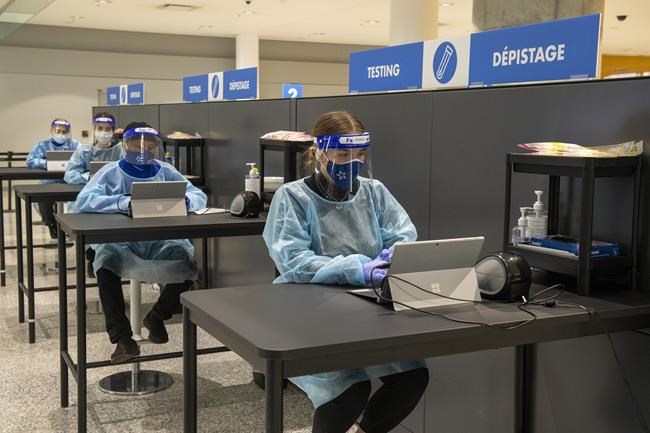
Workers prepare to greet passengers at the COVID-19 testing centre in the International Arrivals area at Pearson Airport in Toronto, Tuesday, Jan. 26, 2021. The federal Liberal government unveiled new restrictions on travel Friday designed to slow the spread of COVID-19. THE CANADIAN PRESS/Frank Gunn

— as of Feb. 3, all commercial international flights can only land at four airports: Montréal-Trudeau International Airport, Toronto Pearson International Airport, Calgary International Airport, and Vancouver International Airport. This includes flights arriving from the United States, Mexico, Central America, the Caribbean and South America, which had previously been exempted from rules of this kind.

Tests:

— air travellers who decide to travel for non-essential reasons will have to take a COVID-19 test on arrival, in addition to existing rules around pre-departure testing.

— a 72-hour pre-arrival testing requirement for travellers seeking entry at the land border will also be introduced, with limited exceptions such as commercial truckers.

Quarantine:— while they await the results of the test, they’ll have to stay at a government-approved hotel at their own cost for three nights while awaiting their results.

— the government has now hired security officers who will check on people supposed to be in quarantine to ensure they are complying.

This report by The Canadian Press was first published Jan. 29, 2021.

Report Error Submit a Tip

More Stories

Russian Olympic biathlon champion loses Sochi doping case

Graham Dunbar, The Associated Press 5 minute read Preview

Russian Olympic biathlon champion loses Sochi doping case

Graham Dunbar, The Associated Press 5 minute read Thursday, Sep. 24, 2020

GENEVA - Two-time Olympic biathlon champion Olga Zaitseva lost her appeal Thursday against disqualification from the 2014 Sochi Olympics for her part in Russia’s state-backed doping program.

The Court of Arbitration for Sport said its judges upheld the International Olympic Committee’s disciplinary ruling of 2017, which used evidence against Zaitseva from Russian whistleblower Grigory Rodchenkov.

Zaitseva’s disqualification from all her Sochi events strips Russia of its silver medal in the women’s biathlon 4x6-kilometre relay. She won — and will retain — her gold medals from the same relay event at the two previous Winter Games in 2006 and 2010.

Her lawyer in Switzerland, Yvan Henzer, said Zaitseva would appeal the CAS ruling at Switzerland’s supreme court. The federal court typically only intervenes if legal process was abused.

Read
Thursday, Sep. 24, 2020

Salt Lake, Sapporo head race to 2030 Olympics, and maybe '34

Stephen Wade, The Associated Press 6 minute read Preview

Salt Lake, Sapporo head race to 2030 Olympics, and maybe '34

Stephen Wade, The Associated Press 6 minute read Monday, May. 2, 2022

Fraser Bullock, who leads Salt Lake City's bid to return the Winter Olympics to Utah, sounds very confident about success.

“I believe we'll host a future Game(s). It's a question of when,” he said last week in a local television interview.

But will it be in 2030, the first opening on the IOC calendar? Or might the International Olympic Committee make a double award and also name the 2034 host? When it had two strong candidates 4 1/2 years ago for the Summer Games, the IOC selected Paris for the 2024 Olympics and Los Angeles for 2028.

The IOC isn't saying. An announcement is expected early next year, with media reports in Salt Lake City suggesting a decision in May 2023.

Read
Monday, May. 2, 2022

Submit a news tip

1 minute read Monday, Mar. 16, 2026

Submit a news tip

Expect a reasonable approach to keep Manitoba’s minimum wage out of cellar

Tom Brodbeck 5 minute read Preview

Expect a reasonable approach to keep Manitoba’s minimum wage out of cellar

Tom Brodbeck 5 minute read Tuesday, May. 31, 2022

The devil will be in the details when it comes to how much the Stefanson government will increase the minimum wage in 2022 under proposed legislation that’s expected to become law this week.

My prediction: government will boost the base wage by at least $1.10 an hour this year.

As expected, the Stefanson government plans to alter its inflation-based formula for setting the minimum wage, which now stands at $11.95 an hour. Normally, the base wage is indexed to the previous year’s rate of inflation. That’s sound policy during normal times. However, with inflation growing at rates not seen in more than 30 years, an immediate adjustment is required to ensure minimum-wage earners don’t lose purchasing power.

Conservative governments in Saskatchewan, Ontario and New Brunswick have all announced significant increases to their base wages in 2022, putting pressure on the Stefanson government to follow suit. Failure to do so would see Manitoba’s minimum wage (previously scheduled to rise 40 cents an hour to $12.35 on Oct. 1) rank lowest in the country.

Read
Tuesday, May. 31, 2022

Killer pleads guilty in three-year-old daughter’s fatal stabbing

Dean Pritchard 4 minute read Preview

Killer pleads guilty in three-year-old daughter’s fatal stabbing

Dean Pritchard 4 minute read Thursday, May. 26, 2022

A Winnipeg man has pleaded guilty to second-degree murder in the shocking stabbing death of his three-year-old daughter.

Frank Nausigimana, 29, entered his plea before Queen’s Bench Justice Joan McKelvey during a brief hearing Thursday morning.

Asked if he understood he was waiving his right to a trial, Nausigimana, through an American Sign Language interpreter, told McKelvey: “ Yes, I accept the punishment and I am following the law of God.”

“I’ve decided that I am going to pray,” Nausigimana said. “I admit I am guilty.”

Read
Thursday, May. 26, 2022

Manitoba’s First Nations and the Indian Act

Hersh Seth 6 minute read 2:00 AM EST

On Monday in Ottawa, Manitoba Premier Wab Kinew called for the Indian Act to be abolished. Prime Minister Mark Carney said he was open to working with First Nations to reform or repeal this law, calling it racist.

The act was created in 1876 and still controls Indian status, reserve lands and band governance. It’s understandable why many people want a better relationship.

But repealing a law and building a new relationship are not the same. What would replace the act’s protections? Who decides? How do governments ensure removing federal authority gives First Nations power while the Crown keeps its promises?

Manitoba has faced these questions before. In 1971, First Nations created a document called Wahbung: Our Tomorrows, in response to then-prime minister Pierre Trudeau’s white paper on assimilation. More than 45 years later, elders and knowledge keepers met at Turtle Lodge, north of Winnipeg, to continue the conversation. Manitobans Dave Courchene Sr. and his son, Dave Courchene Jr., are generational links to the broader movement, and their story should be part of this discussion.