A week into China’s easing, uncertainty over virus direction

Advertisement

Advertise with us

BEIJING (AP) — A week after China dramatically eased some of the world's strictest COVID-19 containment measures, uncertainty remained Thursday over the direction of the pandemic in the world's most populous nation.

Read this article for free:


or

Already have an account? Log in here »

To continue reading, please subscribe:

Subscribe and receive a limited-edition Free Press branded hat or tote.

Digital Subscription

One year of digital access for only $205*

  • Enjoy unlimited reading on winnipegfreepress.com
  • Read the E-Edition, our digital replica newspaper
  • Access News Break, our award-winning app
  • Play interactive puzzles

*First annual payment billed as $205.00 + GST for one year. This annual subscription will automatically renew at $233.00 + GST every 52 weeks (10% off the regular annual price of $259.35). Offer available to new and qualified returning subscribers only. Cancel any time.

To continue reading, please subscribe:

Add Free Press access to your Brandon Sun subscription for only an additional

$1 for the first 4 weeks*

  • Enjoy unlimited reading on winnipegfreepress.com
  • Read the E-Edition, our digital replica newspaper
  • Access News Break, our award-winning app
  • Play interactive puzzles
Start now

*Your next Brandon Sun subscription payment will increase by $1.00 and you will be charged $17.95 plus GST for four weeks. After four weeks, your payment will increase to $24.95 plus GST every four weeks.

Hey there, time traveller!
This article was published 15/12/2022 (1388 days ago), so information in it may no longer be current.

BEIJING (AP) — A week after China dramatically eased some of the world’s strictest COVID-19 containment measures, uncertainty remained Thursday over the direction of the pandemic in the world’s most populous nation.

While there are no official indications yet of the massive surge of critically ill patients some feared, social media posts, business closures and other anecdotal evidence suggest huge numbers of people are being infected. In Beijing and elsewhere, there was a rush on cold medication and testing kits. Some hospital staff are staying home, while others are back to work after being infected.

Meanwhile, as people take to the internet to share dubious “remedies,” various everyday products have seen sales skyrocket. A run on canned yellow peaches, seen as particularly nutritious, prompted one of the largest producers to write on social media that they are not medicine and that there is plenty of supply.
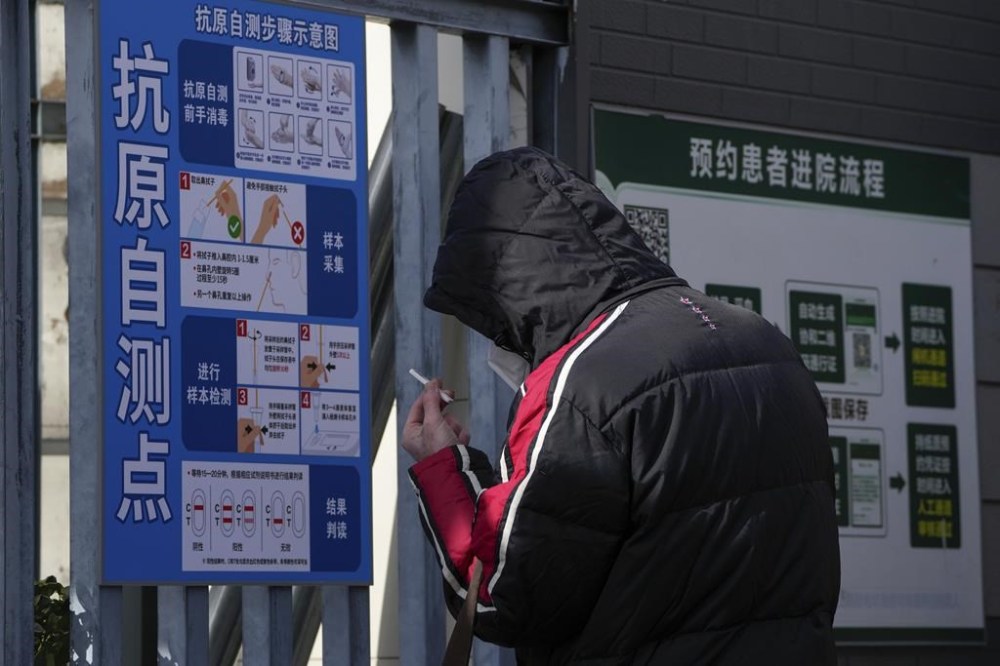
A man looks at his COVID-19 antigen test outside a hospital in Beijing, Thursday, Dec. 15, 2022. China said Wednesday that it would stop reporting asymptomatic COVID-19 cases since they've become impossible to track with mass testing no longer required, another step in the country's departure from some of the world's strictest antivirus policies. (AP Photo/Andy Wong)

After years of trying to track the virus down to every last infection, the government now says that’s essentially impossible — but it’s not clear what that means for reporting the most serious cases.

While major cities such as Beijing, Shanghai and Shenzhen have invested heavily in health care, second- and third-tier cities and communities in the vast rural hinterland have far fewer resources to deal with a major outbreak.

For a variety of economic and cultural reasons, Chinese tend to be more reliant than citizens of other countries on hospitals, even for illnesses that are not severe. The government has asked to those with mild symptoms to recuperate at home, but if they don’t, that could lead to strains, Yale professor of public health Xi Chen said.

“If people do not have such culture to stay at home, to keep those resources for sicker people, then that could easily crash the system,” Chen said.

So far, Beijing has more than tripled the number of fever clinics to over 300, and those visited by Associated Press journalists were generally calm and orderly, with few indications of overcrowding. A children’s hospital had 50 or 60 people waiting in line Wednesday afternoon, but three others had shorter queues. At one clinic in southern Beijing, a few elderly patients were put on IV drips, and one was inhaling pressurized oxygen.

Though the health care system in big cities appears to be holding up so far, Chen cautions that it’s too soon to tell when cases will peak. The January Lunar New Year — when millions of people travel to visit family — is expected to present another challenge, Chen said.

“I’m concerned it could be a super-spreader event,” he said.

Winter is also a tough time to loosen restrictions, Chen said, as the virus circulates more easily.

Other concerns include boosting China’s elderly vaccination rate and bolstering the country’s intensive care capacity. Though most of China’s population is vaccinated, millions of older adults haven’t had a booster shot of the country’s domestically made vaccines. Studies show Chinese vaccines are effective in preventing hospitalization and death, but require at least three doses in order to be fully effective.

China says around 30% of people 60 or older have yet to get three shots. Part of the hesitancy derives from original government directives that discouraged those above 59 from getting vaccinated, but there are also longstanding concerns about the safety of Chinese vaccines.

On Wednesday, the government said it would offer a fourth shot to those in vulnerable groups.
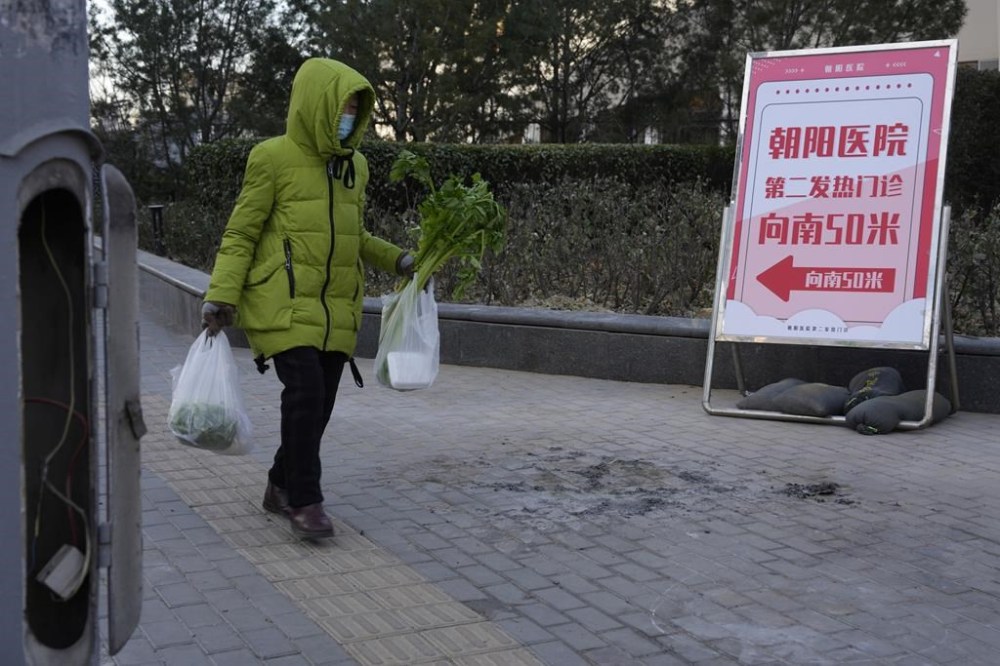
A resident walks with groceries past a sign advertising the newly opened second fever clinic of the Chaoyang Hospital using a gymnasium in Beijing, Thursday, Dec. 15, 2022. A week after China eased some of the world's strictest COVID-19 containment measures, uncertainty remains over the direction of the pandemic in the world's most populous nation. (AP Photo/Ng Han Guan)

Downtown Beijing was largely empty Thursday and those businesses and restaurants that remained open or had not cut back radically on operating hours saw few customers. The empty streets reflected both the fact that many who are sick are staying home but also that others don’t want venture out to avoid getting infected.

Experts have increasingly said China’s “zero-COVID” policy of lockdowns, quarantines and mandatory testing was unsustainable, especially in the face of the more infectious omicron variant that resulted in increasingly harsh restrictions.

Those measures were blamed for hindering the economy and created massive societal stress. The easing began after Beijing and several other cities saw protests over the restrictions that grew into calls for President Xi Jinping and the Communist Party to step down — a level of public dissent not seen in decades.

Though the Dec. 7 relaxation of measures has allowed more avenues for the coronavirus’s spread across the country, the full effects are not yet clear.

In the economy, the news has been mixed. The National Bureau of Statistics on Thursday said China’s value-added industrial output rose a modest 2.2% year-on-year, while the urban unemployment rate rose slightly to 5.7% in November, from 5.5% the month before. China does not survey unemployment outside of major cities.

Meanwhile, the company that assembles Apple’s iPhones announced Wednesday that it would ease restrictions at its largest factory in China that led thousands of workers to quit and drastically slowed production. Foxconn Technology Group said it would end the “closed-loop” system there that required workers to say in their workplaces and dormitories.

Xi’s government is still officially committed to stopping virus transmission. But the latest moves suggest the Communist Party will tolerate more cases without quarantines or shutting down travel or businesses.

Mi Feng, spokesperson for National Health Commission, reiterated that shift in tone on Thursday.

“At present, the focus of epidemic prevention and control has shifted from prevention and control of infection to medical treatment,” Mi said at a briefing.

The task of gauging China’s preparedness is made all the harder by the lack of reliable statistics and projections.
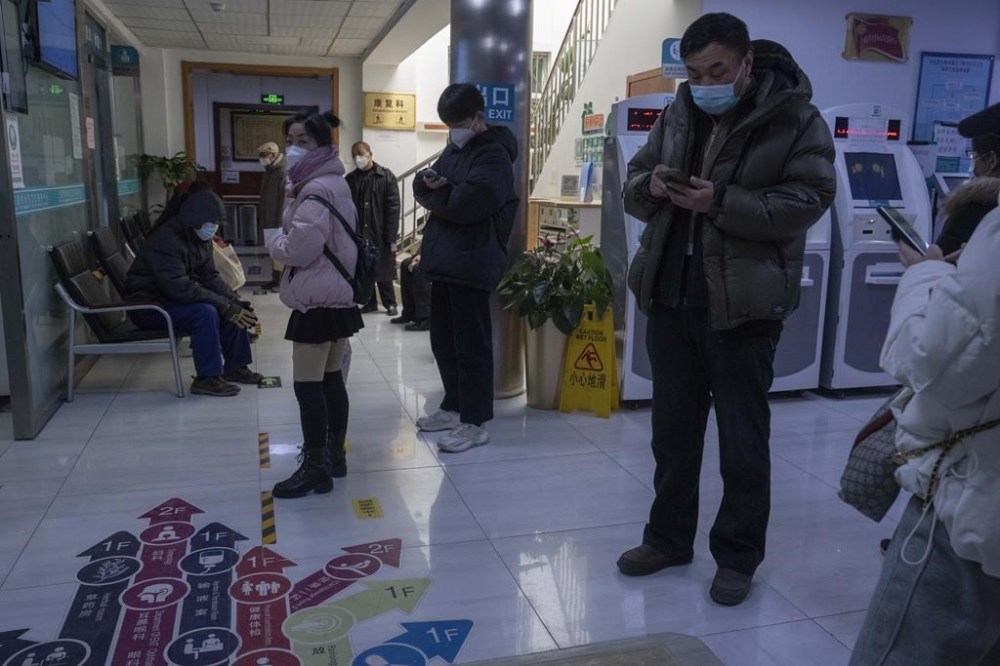
Visitors stand in the waiting area of a community health clinic in Beijing, Thursday, Dec. 15, 2022. A week after China eased some of the world's strictest COVID-19 containment measures, uncertainty remains over the direction of the pandemic in the world's most populous nation. (AP Photo/Ng Han Guan)

The only numbers the National Health Commission is currently reporting are confirmed cases detected in public testing facilities where symptoms are displayed.

The government stopped announcing asymptomatic case totals earlier this week, saying an accurate count was impossible. The results of home tests also won’t be captured.

China’s official death toll remains low, with just 5,235 deaths — compared with 1.1 million in the United States. However, public health experts caution that such statistics can’t be directly compared.

Chinese health authorities count only those who died directly from COVID-19, excluding those whose underlying conditions were worsened by the virus. In many other countries, guidelines stipulate that any death where COVID-19 is a factor or contributor is counted as a COVID-related death.

Experts say this has been the longstanding practice in China, but questions have been raised at times about whether officials have sought to minimize the figures.

___

Associated Press news assistant Caroline Chen and researcher Yu Bing in Beijing, and writer Huizhong Wu in Taipei, Taiwan, contributed to this report.

Report Error Submit a Tip

More Stories

Safety upgrades completed at Whiteshell park falls where brothers drowned

Free Press staff 2 minute read Preview

Safety upgrades completed at Whiteshell park falls where brothers drowned

Free Press staff 2 minute read Updated: 2:54 PM CDT

Safety improvements have been completed at Sturgeon Falls in Whiteshell Provincial Park, where two brothers from Winnipeg drowned in July, the province announced Friday.

The Sturgeon Falls trail was closed for upgrades after Maximo Au Ramirez, 10, and Aaron Au Ramirez, 13, disappeared in the fast-moving rapids. Their bodies were recovered days later.

The trail and viewing areas have reopened. Viewing areas are now fenced to prevent people from walking onto hazardous slippery rocks. Signs were installed to warn visitors of drowning hazards.

A new portage gives canoeists and kayakers access to and from safe shoreline areas adjacent to the falls, the province said.

Read
Updated: 2:54 PM CDT

Winnipeg, source d’inspiration pour la philanthropie canadienne

Camille Harper 7 minute read Preview

Winnipeg, source d’inspiration pour la philanthropie canadienne

Camille Harper 7 minute read Saturday, Sep. 19, 2026

Dirigé par le Franco-Manitobain d’origine Jean-Marc Mangin, l’organisme Fondations philanthropiques du Canada (FPC) sera à Winnipeg du 23 au 25 septembre prochains pour sa conférence nationale, organisée tous les deux ans. Une première pour FPC, et un retour au bercail attendu pour son président-directeur général.

Pour la première fois depuis 26 ans que l’organisme existe, FPC a choisi le Manitoba pour sa grande conférence nationale de 2026. “On a été dans plusieurs gros centres urbains du Canada, notamment Ottawa, Montréal, Toronto, Vancouver ou encore Calgary, mais ce sera notre première fois à Winnipeg,” se réjouit le PDG de FPC, Jean-Marc Mangin, lui-même originaire de Saint-Boniface.

Ce n’est toutefois pas la nostalgie de l’enfance qui a fait pencher la balance en faveur du Manitoba, mais plutôt un vent de changement observé par bon nombre dans la capitale manitobaine.

“Nous ne sommes pas les seuls dans le secteur caritatif à choisir Winnipeg,” constate Jean-Marc Mangin. “Plusieurs organismes y tiennent leurs conférences nationales cette année ou la suivante. Et ça, ça dit quelque chose sur ce qui se passe au Manitoba : c’est très actif, il y a beaucoup d’innovation sociale qui prend place.”

Read
Saturday, Sep. 19, 2026

Calm, balanced approach to game, life is what matters to unassuming Stastny

Jeff Hamilton 14 minute read Preview

Calm, balanced approach to game, life is what matters to unassuming Stastny

Jeff Hamilton 14 minute read Friday, Feb. 19, 2021

When the day comes for Paul Stastny to hang up his skates for good, ending what’s already been a sparkling pro career, he hopes to leave a lasting mark on the game he loves.

He didn’t use the word legacy, nor would he. If you’ve had the chance to speak with Stastny before, you quickly realize his discomfort in talking about personal accolades, despite possessing many. He’s been selected as an NHL all-star, and represented the United States on multiple occasions, including at two Olympics.

In 961 NHL games, Stastny has 253 goals and 482 assists for 735 points. He’s played another 97 playoff games, having reached the Western Conference final on three separate occasions over his career, adding another 25 goals and 42 assists to his point totals. He’s still chasing his first Stanley Cup.

But at 35 years old, and in the middle of his 15th NHL season, which includes a second go-around with the Winnipeg Jets, it’s not what shows up on the scoresheet that matters most to the veteran centre. Stastny is acutely aware that professional sports can be unforgiving; a good season one year doesn’t necessarily guarantee one the next. But what doesn’t have to change, he says, is how he approaches the game, and the way he treats the people around him.

Read
Friday, Feb. 19, 2021

Toddlers drown in northern First Nation lake

Free Press staff 3 minute read Thursday, Aug. 13, 2026

Two drowned toddlers were pulled from a lake Wednesday at Garden Hill Anisininew Nation.

Island Lake RCMP received a report at 1:45 p.m. that two boys had been rushed to the First Nation’s nursing station after a possible drowning, Mounties said in a news release Thursday.

Officers were told the boys, ages one and two, had been found in the lake by a family member and taken to the nursing station by the First Nation’s safety officers.

Police said it’s believed the boys managed to leave their home, entered the nearby lake and drowned.

Mayoral candidate Vogiatzak criticized for living outside Winnipeg

Malak Abas 4 minute read Preview

Mayoral candidate Vogiatzak criticized for living outside Winnipeg

Malak Abas 4 minute read 5:08 PM CDT

A mayoral hopeful took heat from other candidates Friday for living outside Winnipeg while running in the civic election.

Mike Vogiatzakis’s primary residence is in the Rural Municipality of St. Andrews, about 25 kilometres north of Winnipeg — a community with its own mayor and councillors.

But the funeral director said he owns a home in Winnipeg where he divides his time, and he would move to the city full-time if elected mayor.

“It doesn’t matter where a person lives. Why are we dividing St. Andrews and Manitoba and Winnipeg? I’ve met the criteria to run for mayor,” Vogiatzakis said Friday morning.

Read
5:08 PM CDT

Suspension upheld for teen hockey player involved in hazing

Free Press staff 3 minute read Preview

Suspension upheld for teen hockey player involved in hazing

Free Press staff 3 minute read Sunday, Aug. 9, 2026

A high school hockey player who was found to have been involved in sexualized hazing of rookie teammates lost his suspension appeal.

The youth player was barred from Hockey Canada-sanctioned activities. He was handed the four-year and nine-month suspension from sanctioned hockey after an interim ban issued in March 2024.

He appealed his suspension late last year to the Sport Dispute Resolution Centre of Canada, an independent conflict tribunal, but the centre upheld the youth’s suspension, according to a written decision issued earlier this year.

An independent investigator who probed the hockey player’s actions described the youth as a veteran player who both participated in and co-ordinated the “assigning” of rookie team members to veteran players to perform tasks for them. He himself was “assigned” a rookie, the decision said.

Read
Sunday, Aug. 9, 2026