China won’t report asymptomatic COVID cases in further shift

Advertisement

Advertise with us

BEIJING (AP) — China said Wednesday that it would stop reporting asymptomatic COVID-19 cases since they've become impossible to track with mass testing no longer required, another step in the country's departure from some of the world's strictest antivirus policies.

Read this article for free:


By clicking the button above, an account will be created and you will begin to receive some of our recommended newsletters. You may opt out of any newsletter by visiting your Email and Communication Preferences page or by clicking "unsubscribe" at the bottom of any email.

or

Already have an account? Log in here »

To continue reading, please subscribe:

Digital Subscription

One year of digital access for only $1.44 a week*

  • Enjoy unlimited reading on winnipegfreepress.com
  • Read the E-Edition, our digital replica newspaper
  • Access News Break, our award-winning app
  • Play interactive puzzles

*Billed as $5.77 plus GST every four weeks. After 52 weeks, price increases to the regular rate of $19.95 plus GST every four weeks. Offer available to new and qualified returning subscribers only. Cancel any time.

To continue reading, please subscribe:

Add Free Press access to your Brandon Sun subscription for only an additional

$1 for the first 4 weeks*

  • Enjoy unlimited reading on winnipegfreepress.com
  • Read the E-Edition, our digital replica newspaper
  • Access News Break, our award-winning app
  • Play interactive puzzles
Start now

*Your next Brandon Sun subscription payment will increase by $1.00 and you will be charged $17.95 plus GST for four weeks. After four weeks, your payment will increase to $24.95 plus GST every four weeks.

Hey there, time traveller!
This article was published 13/12/2022 (1417 days ago), so information in it may no longer be current.

BEIJING (AP) — China said Wednesday that it would stop reporting asymptomatic COVID-19 cases since they’ve become impossible to track with mass testing no longer required, another step in the country’s departure from some of the world’s strictest antivirus policies.

The change in reporting practices comes the week after the country announced its most significant easing yet of antivirus measures. Meanwhile, China has begun to see what appears to be a rapid increase in new infections, raising concerns that its health system could be overwhelmed just as those in other countries were during early COVID waves.

So far, many of those newly sick are staying home, and there has been little evidence of a surge in patient numbers. But it’s difficult to get a clear picture of the spread, and the new reporting rules could make that even harder. Some hospitals have reportedly struggled to remain staffed because of rising infections among employees.
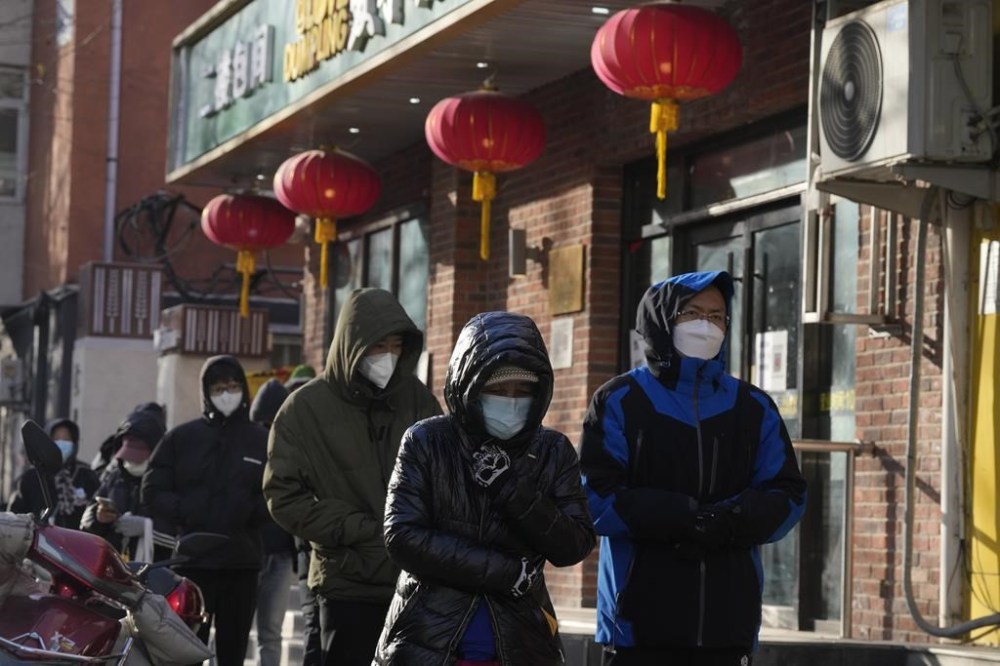
Residents wearing masks line up during a cold day outside a pharmacy to purchase medicine in preparation for a possible wave of COVID-19 outbreaks in Beijing, Tuesday, Dec. 13, 2022. Some Chinese universities say they will allow students to finish the semester from home in hopes of reducing the potential of a bigger COVID-19 outbreak during the January Lunar New Year travel rush. (AP Photo/Ng Han Guan)

A notice on the National Health Commission’s website on Wednesday said it stopped publishing daily figures on asymptomatic COVID-19 cases since it was “impossible to accurately grasp” the number of those infections, which have generally accounted for the vast majority of new cases.

The only numbers the commission is reporting are confirmed cases detected in public testing facilities where symptoms are displayed. Many people also test at home, and any positive results there would also not be captured.

China’s government-supplied figures have not been independently verified, and questions have been raised about whether the ruling Communist Party has sought to minimize numbers of cases and deaths.

While many governments have long focused on only the more serious cases, the latest move is part of a sea change for China, which has maintained a “zero COVID” policy that seeks to stamp out all virus transmission.

That included frequent mass testing campaigns and meant that anyone who tested positive was isolated in a government facility, even if they had no symptoms. Now people can recover at home if they don’t need medical care.

While many greeted the relaxing of the rules with relief, the rapid shift has also caused some concern after years in which the Chinese government talked about the virus as a major threat.

“Beijing is really confused right now,” said one resident, surnamed Zhu. “They made a complete 180-degree turn without even going through a transitionary period.”

Zhu, who refused to provide his full name to speak on what could be seen as a sensitive topic in China, said he wasn’t able to find a test after developing a sore throat and a fever. Authorities have said they will provide 25 million rapid test kits for Beijing pharmacies after a rush on such supplies.

Despite the easing, the streets of many major Chinese cities have grown eerily quiet as many people stay home, not because they have to, but because they’re worried about contracting the virus at a time when social media is lighting up with reports of infections.
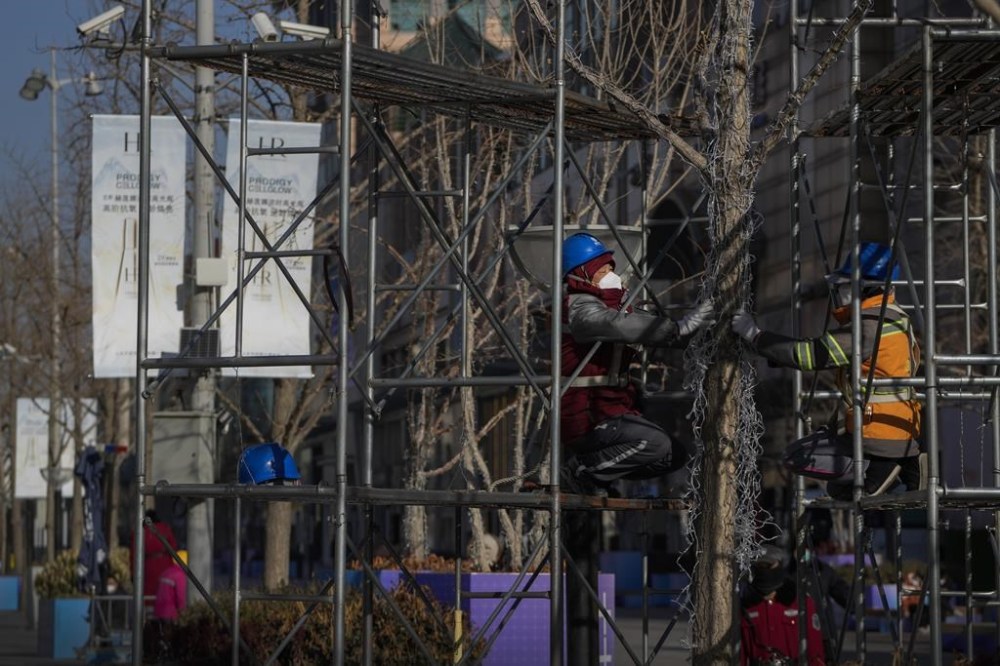
Masked workers install lights on a tree for the upcoming New Year festive season at the Wangfujing shopping district in Beijing, Wednesday, Dec. 14, 2022. China's National Health Commission scaled down its daily COVID-19 report starting Wednesday in response to a sharp decline in PCR testing since the government eased anti-virus measures and daily cases hit record highs. (AP Photo/Andy Wong)

With a clean bill of health still required to enter restaurants and some other public venues, many Chinese are also choosing to forgo such pleasures to avoid testing, leaving many establishments shuttered or empty.

In the usually bustling streets around the ancient imperial palace complex in the heart of Beijing, Huang Hanxin said he was making good use of the lack of crowds.

“If it was a few years ago, there would be a lot of cars and it would be packed with people here,” said the 19-year-old tourist from the southern city of Guangzhou, standing in front of a gate to the complex formerly known as the Forbidden City. “It’s comfortable to walk around and take photos.”

By contrast, lines have formed outside some fever clinics in Beijing — the number of which has increased from 94 to more than 300.

Pharmacies in Beijing are rationing out medicine and other supplies. Rapid antigen tests are sold out across the city and online.

At one establishment, pharmacist Zhu Qianqian tended to a relentless stream of customers, asking about their symptoms and suggesting medication.

“It’s sold out, so wait for two days,” she told a woman with a prescription for cough syrup, instead handing her a box of pills. “There’ll be more.”

Many times, she had to turn away customers asking for the painkiller ibuprofen or Lianhuaqingwen, a popular Chinese herbal remedy. Both were out of stock.
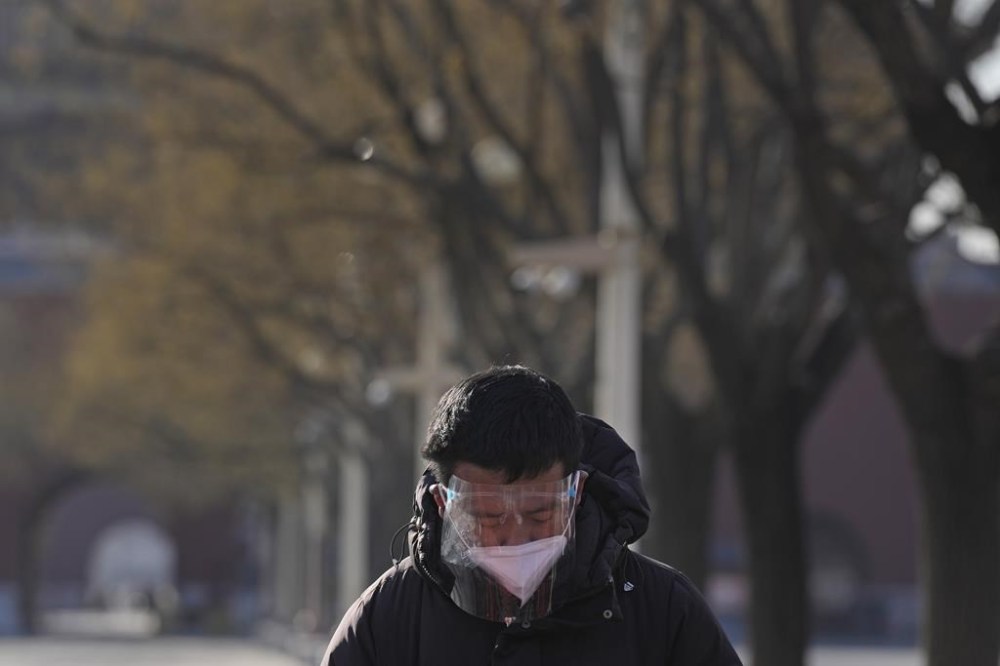
A worker wearing mask stands on duty outside the Forbidden City in Beijing, Wednesday, Dec. 14, 2022. China's National Health Commission scaled down its daily COVID-19 report starting Wednesday in response to a sharp decline in PCR testing since the government eased antivirus measures after daily cases hit record highs. (AP Photo/Ng Han Guan)

Some have taken to ordering from pharmacies in the semi-autonomous city of Hong Kong, which has been steadily relaxing its restrictions without the chaos and uncertainty seen on the mainland. Like much of the world, Hong Kong uses mRNA vaccines that are widely considered more effective than those mandated by China.

Residents of other major cities such as Guangzhou and Shanghai reached by telephone or messaging app also reported quiet streets.

Not everyone was worried.

“Many people around me have gotten (COVID),” said Ge Ge, who was bringing her child for a regular checkup at a Beijing hospital. “It’s just like having a cold for a few days and won’t last long.”

The elderly are more at risk of becoming seriously ill, and China has tried to boost vaccinations among older people. But two centers set up in Beijing to administer shots were empty Tuesday except for medical personnel.

Still, there was little evidence of a surge in people being hospitalized.

At Chaoyang Hospital in Beijing, about a dozen people waited in a line of blue tents in subzero temperatures. A similar number waited for test results a few kilometers (miles) away at the China-Japan Friendship Hospital’s fever clinic.

Nurses in full-body white protective gear checked in patients one by one at the clinic, one of the isolated wards where people can receive treatment at a reduced risk of infecting others.
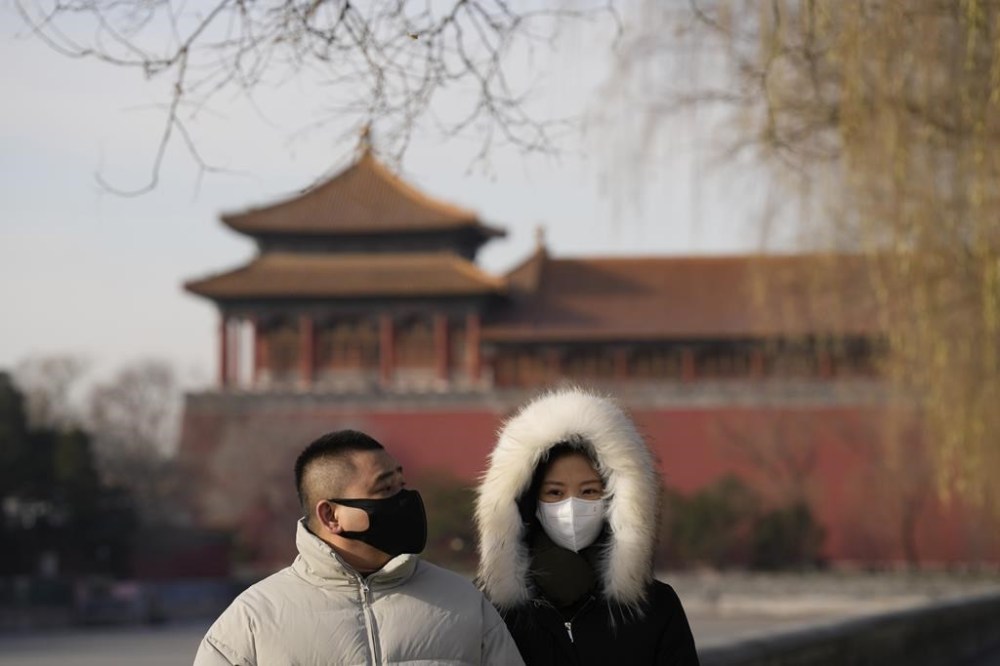
Residents wearing masks walk near the forbidden city in Beijing, Wednesday, Dec. 14, 2022. China's National Health Commission scaled down its daily COVID-19 report starting Wednesday in response to a sharp decline in PCR testing since the government eased antivirus measures after daily cases hit record highs. (AP Photo/Ng Han Guan)

Inquiries to health hotlines have increased sixfold, according to state media.

Without asymptomatic cases being counted, China reported just 2,249 “confirmed” infections Wednesday, bringing the nation’s total to 369,918 — more than double the level on Oct. 1. It has recorded 5,235 deaths — compared with 1.1 million in the United States.

President Xi Jinping’s government is still officially committed to stopping virus transmission. But the latest moves suggest the party will tolerate more cases without quarantines or shutting down travel or businesses.

Starting Tuesday, China also stopped tracking some travel, though China’s international borders remain largely shut.

The move follows the government’s dramatic announcement last week that it was ending many of the strictest measures. That came after Beijing and several other cities saw protests over the measures that grew into calls for Xi and the Communist Party to step down — a level of public dissent not seen in decades.


Report Error Submit a Tip

More Stories

Pair preps for weekend test in Kelowna

Laurie Nealin 6 minute read Preview

Pair preps for weekend test in Kelowna

Laurie Nealin 6 minute read 6:40 PM CDT

KELOWNA, B.C. — Their first spin around the ice at Skate Canada International on Thursday was a mix of business and pleasure for Winnipeg pair skaters Ava Kemp and Yohnatan Elizarov.

Job one for the practice session was to get accustomed to the size and feel of the ice surface at Propsera Place while test-driving the lifts, throws and jumps they’ll perform Friday in their senior ISU Grand Prix competition debut.

“The big thing is the patterns (skating into elements) because these boards are very narrow but very long — it’s NHL size — so when you’re setting up elements you need to make sure you’re using the full length or else you’re going to run into the boards,” Elizarov explained in a post-skate chat with media.

“The second thing is the ice which is sometimes really soft or really hard. This ice is really soft.”

Read
6:40 PM CDT

Railways report more accidents with dangerous goods

Dylan Robertson 6 minute read Preview

Railways report more accidents with dangerous goods

Dylan Robertson 6 minute read Monday, Jan. 20, 2020

OTTAWA — The number of rail accidents involving dangerous goods more than doubled in Canada in 2018.

There were 25 accidents involving dangerous goods in 2018, involving one death, according to Transport Canada data published Monday.

There were 11 accidents recorded a year prior, and five in 2016.

These accidents involve dangerous goods — flammable or corrosive substances — that either exploded or leaked.

Read
Monday, Jan. 20, 2020

Three’s company for new netminder Daws

Mike McIntyre 7 minute read Preview

Three’s company for new netminder Daws

Mike McIntyre 7 minute read 5:09 PM CDT

TAMPA — Nico Daws is still trying to catch his breath.

An unexpected piece of the Connor Hellebuyck blockbuster. A chaotic crash course in his latest hockey home. Joining a fragile club mired in a prolonged losing streak. And now, hitting the road for four tough tests, including one where he will find himself as the last line of defence.

It’s been quite the ride for the newest Winnipeg Jets netminder, who took some time Thursday morning to reflect on the experience.

“A whirlwind of a week. I haven’t even really had time to sit down and digest it,” said Daws.

Read
5:09 PM CDT

Voter turnout in mayoral race about 38 per cent

Free Press staff 2 minute read Preview

Voter turnout in mayoral race about 38 per cent

Free Press staff 2 minute read Updated: 1:16 PM CDT

Voter turnout in Wednesday’s mayoral contest in Winnipeg was 38 per cent, based on a Free Press analysis of unofficial results.

The city has not yet provided a figure for overall turnout for the municipal and school board election.

Incumbent Scott Gillingham won a second term with 39.82 per cent of the vote. He was followed by Kevin Klein (20.71 per cent), Noah Redden (19.84 per cent) and Mike Vogiatzakis (9.66 per cent) in a field of 12 candidates.

Unofficial voter turnout within the city’s 15 wards ranged from 26 per cent (Point Douglas) to 46 per cent (River Heights-Fort Garry).

Read
Updated: 1:16 PM CDT

‘All females are at risk’: serial sex offender released from prison

Erik Pindera 4 minute read Preview

‘All females are at risk’: serial sex offender released from prison

Erik Pindera 4 minute read 1:43 PM CDT

Law enforcement are warning the public that a dangerous sex offender with a lengthy history of abusing women is expected to live in Winnipeg after his release from prison.

Douglas Wayne Bowman, 62, left prison on Thursday after serving a lengthy sentence for two sexual assaults he committed at knifepoint, said the Manitoba Integrated High Risk Sex Offender Unit, a joint force of the Winnipeg Police Service and RCMP that keeps an eye on certain sex criminals.

Bowman was handed the 14-year sentence in 2018, less six years time served, and designated a dangerous offender. Criminals deemed dangerous offenders are given indefinite federal sentences until parole officials decide it is safe enough to release them.

Now that he’s leaving prison, Bowman will be subject to a 10-year long-term supervision order, which allows corrections and parole officials to continue to monitor him in the community even though his sentence is complete.

Read
1:43 PM CDT

Carrying a torch for tiki

Eva Wasney 5 minute read Preview

Carrying a torch for tiki

Eva Wasney 5 minute read Monday, Nov. 15, 2021

A paper tiki mask is the only indication that the door it’s affixed to leads somewhere other than a dive bar. Ring the doorbell and walk through the kitchen, however, and you’ll be transported to an island-themed lounge that’s equal parts kitschy and comfortable.

“This is just from people’s houses, like my mom’s,” says Allan Pineda, pointing to the wood carvings, water-buffalo horns and rattan furniture decorating the room. “A lot of the stuff you see in here, you’d see in a Filipino’s house back in the day — like second-wave immigrants in the ‘60s and ‘70s, they’d bring this stuff home (from the Philippines).”

Pineda is a local chef and part of the team behind the Bahay Kubo Tiki Bar, a pop-up Filipino drinking and dining experience hosted weekly at an undisclosed Winnipeg establishment.

The details are hush-hush because the temporary eatery is meant to operate like a speakeasy. The dinners are an offshoot of Baon Manila Nights, which Pineda started as a way to highlight Winnipeg’s Filipino culinary scene.

Read
Monday, Nov. 15, 2021