WEATHER ALERT

Judge rejects vaccine choice law in health care settings

Advertisement

Advertise with us

HELENA, Mont. (AP) — A person's choice to decline vaccinations does not outweigh public health and safety requirements in medical settings, a federal judge ruled in a Montana case.

Read this article for free:


By clicking the button above, an account will be created and you will begin to receive some of our recommended newsletters. You may opt out of any newsletter by visiting your Email and Communication Preferences page or by clicking "unsubscribe" at the bottom of any email.

or

Already have an account? Log in here »

To continue reading, please subscribe:

Digital Subscription

One year of digital access for only $1.44 a week*

  • Enjoy unlimited reading on winnipegfreepress.com
  • Read the E-Edition, our digital replica newspaper
  • Access News Break, our award-winning app
  • Play interactive puzzles

*Billed as $5.77 plus GST every four weeks. After 52 weeks, price increases to the regular rate of $19.95 plus GST every four weeks. Offer available to new and qualified returning subscribers only. Cancel any time.

To continue reading, please subscribe:

Add Free Press access to your Brandon Sun subscription for only an additional

$1 for the first 4 weeks*

  • Enjoy unlimited reading on winnipegfreepress.com
  • Read the E-Edition, our digital replica newspaper
  • Access News Break, our award-winning app
  • Play interactive puzzles
Start now

*Your next Brandon Sun subscription payment will increase by $1.00 and you will be charged $17.95 plus GST for four weeks. After four weeks, your payment will increase to $24.95 plus GST every four weeks.

Hey there, time traveller!
This article was published 12/12/2022 (1421 days ago), so information in it may no longer be current.

HELENA, Mont. (AP) — A person’s choice to decline vaccinations does not outweigh public health and safety requirements in medical settings, a federal judge ruled in a Montana case.

U.S. District Judge Donald Molloy last week permanently blocked a section of law the state said was meant to prevent employers — including many health care facilities — from discriminating against workers by requiring them to be vaccinated against communicable diseases, including COVID-19.

“The public interest in protecting the general populace against vaccine-preventable diseases in health care settings using safe, effective vaccines is not outweighed by the hardships experienced to accomplish that interest,” Molloy concluded in his Dec. 9 ruling.
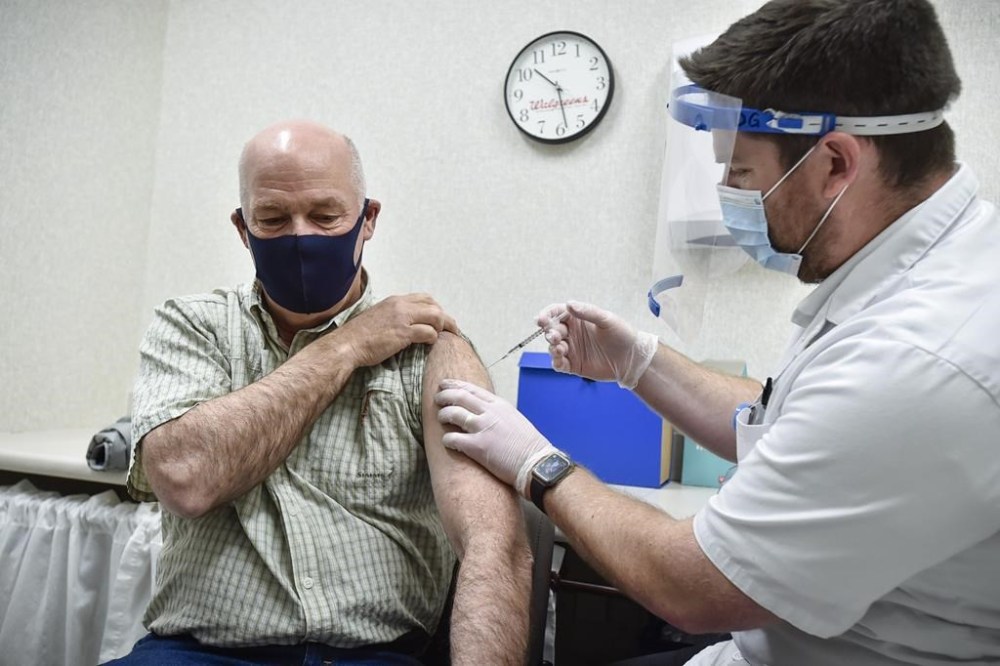
FILE - In this April 1, 2021, file photo Gov. Greg Gianforte receives a shot of the Pfizer COVID-19 vaccine from pharmacist Drew Garton at a Walgreen's pharmacy, in Helena, Mont. Medical providers and Montana residents with compromised immune systems are challenging the only law in the U.S. that prevents state employers from mandating workers get vaccinated amid a surge of COVID-19 infections. They argue the new law violates federal requirements for safe workplaces and reasonable accommodations for people with disabilities and want a federal judge to rule that it doesn't apply to hospitals and other medical providers. (Thom Bridge/Independent Record via AP, File)

The Montana Legislature passed the first-in-the-nation law in 2021, about a year into the pandemic as some people, businesses and Republican lawmakers were pushing back on health care measures enacted to prevent the spread of the virus that has now killed more than 1 million people in the United States. Just over 3,600 Montana residents have died from COVID-19, state officials say.

The Montana law made it illegal for a person to be denied services, goods or employment based on their vaccine status. The law did not change vaccine requirements at schools or daycare facilities or eliminate a person’s right to seek a religious or medical exemption.

Republican lawmakers who supported the bill said it was needed in response to employers threatening to fire workers who would not get vaccinated.

Before signing the bill, Republican Gov. Greg Gianforte asked lawmakers to amend it to allow long-term care facilities to require workers to receive COVID-19 vaccines if failing to do so meant the facility could lose funding under a federal directive.

The federal directive was recently challenged by attorneys general in 22 states including Montana.

The Montana Medical Association, clinics and immunocompromised patients filed a lawsuit against the state in September 2021 and were later joined by the Montana Nurses Association. They argued, and Molloy agreed, that treating clinics and hospitals differently from long-term care facilities made no sense for a law that the state said was meant to prevent discrimination and protect private health care information.

The plaintiffs argued that in some cases, the same people can work in all three types of facilities on the same day.

The plaintiffs successfully argued that the law violates the Americans With Disabilities Act, which requires public facilities to make reasonable accommodations for people with disabilities. An immunosuppressed patient would be vulnerable if they were treated at a health care facility where the employees were not vaccinated, Molloy found.

The law also violated the federal Occupational Health and Safety Act by failing to keep the workplace free from recognized hazards, he said. The plaintiffs proved that vaccine-preventable diseases constitute recognized hazards in health care settings, Molloy wrote.

“The Court’s order is a win for all Montanans — young or old, healthy or sick — who no longer need to worry about government interference with the safety of their healthcare in Montana,” Vicky Byrd, CEO of the Montana Nurses Association, said in a statement.

Montana Attorney General Austin Knudsen is studying the opinion to determine his next steps, spokeswoman Emilee Cantrell said in a statement.

In the meantime, Knudsen is leading a group of attorneys general challenging the federal Centers for Medicare & Medicaid Services mandate that health care workers in long-term care facilities be vaccinated against COVID-19. The challenge argues the vaccine does not prevent the spread of the virus, breakthrough infections are common and that the vaccines themselves are not entirely risk-free.


Report Error Submit a Tip

More Stories

Today’s horoscope

Georgia Nicols 4 minute read Preview

Today’s horoscope

Georgia Nicols 4 minute read Yesterday at 2:00 AM EST

MOON ALERT: There are no restrictions to shopping or important decisions today. The moon is in Leo.

ARIES (March 21-April 19)

Avoid disputes about shared property, inheritances, taxes, debt and insurance issues. This might also include shared expenses. Just coast. Parents should be vigilant about their kids. Social plans might suddenly change. It’s a good day to make art.

TAURUS (April 20-May 20)

Read
Yesterday at 2:00 AM EST

Expect a reasonable approach to keep Manitoba’s minimum wage out of cellar

Tom Brodbeck 5 minute read Preview

Expect a reasonable approach to keep Manitoba’s minimum wage out of cellar

Tom Brodbeck 5 minute read Tuesday, May. 31, 2022

The devil will be in the details when it comes to how much the Stefanson government will increase the minimum wage in 2022 under proposed legislation that’s expected to become law this week.

My prediction: government will boost the base wage by at least $1.10 an hour this year.

As expected, the Stefanson government plans to alter its inflation-based formula for setting the minimum wage, which now stands at $11.95 an hour. Normally, the base wage is indexed to the previous year’s rate of inflation. That’s sound policy during normal times. However, with inflation growing at rates not seen in more than 30 years, an immediate adjustment is required to ensure minimum-wage earners don’t lose purchasing power.

Conservative governments in Saskatchewan, Ontario and New Brunswick have all announced significant increases to their base wages in 2022, putting pressure on the Stefanson government to follow suit. Failure to do so would see Manitoba’s minimum wage (previously scheduled to rise 40 cents an hour to $12.35 on Oct. 1) rank lowest in the country.

Read
Tuesday, May. 31, 2022

Province tables legislation to cover health-care system changes

Larry Kusch 4 minute read Preview

Province tables legislation to cover health-care system changes

Larry Kusch 4 minute read Wednesday, Mar. 6, 2019

The Pallister government has introduced broad legislation to support several of its key planned health-care reforms.

Health Minister Cameron Friesen said Wednesday that Bill 10 (The Regional Health Authorities Amendment Act) will provide the framework to simplify the administration of the health-care system and improve accountability.

All health services in Manitoba will be delivered through the five current regional health authorities, CancerCare Manitoba and a new provincial authority called Shared Health. The administrative changes are set to begin next month and will continue to be rolled out over the next two to three years.

The Health Department will cease to administer health services directly and focus its activities on planning, policy development, funding and oversight. It will set system-wide performance goals and track results.

Read
Wednesday, Mar. 6, 2019

WRHA moves to cut growing echocardiogram wait list

Larry Kusch 6 minute read Preview

WRHA moves to cut growing echocardiogram wait list

Larry Kusch 6 minute read Tuesday, Aug. 21, 2018

Manitobans are waiting a year or more to receive a key test that detects and tracks heart disease.

As of June 15, there were about 6,500 Manitobans on the wait list for an echocardiogram, and the list is growing at a rate of about 265 per month.

Patients facing heart emergencies are receiving tests immediately, while most of those whose conditions are considered urgent or semi-urgent are getting them within established Canadian benchmark times -- about a week, officials say.

However, thousands of patients who are considered candidates for "elective" tests are waiting anywhere from 10 to 15 months, with a median wait of 12 months, according to the Winnipeg Regional Health Authority.

Read
Tuesday, Aug. 21, 2018

The ‘Gang of Nine’ and business as usual at city hall

Editorial 4 minute read Preview

The ‘Gang of Nine’ and business as usual at city hall

Editorial 4 minute read 2:00 AM EST

In the early 1990s, after the province reduced the number of municipal wards in Winnipeg to 15, critics spoke at length of how a theoretical “Gang of Eight” could control all decision making at city hall. In subsequent years, there were various incarnations of a Gang of Eight, although it was never conclusively shown that eight members of city council could consistently stay on the same page long enough to dominate civic affairs.

That is an apt tale to consider now, as Winnipeg city hall welcomes nine rookie councillors, the largest number of non-incumbents elected in more than 30 years.

Theoretically, this new group of councillors could band together and push through various reforms. It’s a highly intriguing scenario for anyone who has watched the city, on occasion, shun riskier strategies in favor of status quo politics.

However, as was the case in the early 1990s, the chances of that happening begin to fall apart once you consider the work of building and sustaining a coalition of rookie councillors who come from a broad array of backgrounds.

Read
2:00 AM EST

Third fire hits troubled Manitoba Housing apartment block

Malak Abas 4 minute read Preview

Third fire hits troubled Manitoba Housing apartment block

Malak Abas 4 minute read Yesterday at 3:19 PM EST

Residents of a North End Manitoba Housing apartment block with a long history of trouble say they’re shaken after the building was hit with its third fire in eight months Friday night.

An apartment complex at 145 Powers St. was evacuated by firefighters after a fire broke out at around 7:45 p.m.

When longtime resident Sharon Markwell heard the fire alarm go off, she chalked it up to a false alarm — kids will get into the building and pull the fire alarm around once or twice a month, she said — until smoke began billowing into the hallway of her fifth-floor apartment.

“Once I realized that I could smell smoke very, very strongly, and the smoke was seeping into my room, into my apartment, I said to myself, ‘This is no false alarm. This is the real thing,’” Markwell, 64, told the Free Press Sunday.

Read
Yesterday at 3:19 PM EST