COVID-19 benefits helped economy rebound, but post-payment verification lacking: AG

Advertisement

Advertise with us

OTTAWA - Canada's auditor general says COVID-19 benefits were delivered quickly and helped mitigate economic suffering, but the federal government hasn’t done enough to recover billions of dollars in overpayments.

Read this article for free:


By clicking the button above, an account will be created and you will begin to receive some of our recommended newsletters. You may opt out of any newsletter by visiting your Email and Communication Preferences page or by clicking "unsubscribe" at the bottom of any email.

or

Already have an account? Log in here »

To continue reading, please subscribe:

Digital Subscription

One year of digital access for only $1.44 a week*

  • Enjoy unlimited reading on winnipegfreepress.com
  • Read the E-Edition, our digital replica newspaper
  • Access News Break, our award-winning app
  • Play interactive puzzles

*Billed as $5.77 plus GST every four weeks. After 52 weeks, price increases to the regular rate of $19.95 plus GST every four weeks. Offer available to new and qualified returning subscribers only. Cancel any time.

To continue reading, please subscribe:

Add Free Press access to your Brandon Sun subscription for only an additional

$1 for the first 4 weeks*

  • Enjoy unlimited reading on winnipegfreepress.com
  • Read the E-Edition, our digital replica newspaper
  • Access News Break, our award-winning app
  • Play interactive puzzles
Start now

*Your next Brandon Sun subscription payment will increase by $1.00 and you will be charged $17.95 plus GST for four weeks. After four weeks, your payment will increase to $24.95 plus GST every four weeks.

Hey there, time traveller!
This article was published 06/12/2022 (1424 days ago), so information in it may no longer be current.

OTTAWA – Canada’s auditor general says COVID-19 benefits were delivered quickly and helped mitigate economic suffering, but the federal government hasn’t done enough to recover billions of dollars in overpayments.

In a new report Tuesday, Karen Hogan said federal benefit programs provided relief to workers and employers affected by the pandemic and helped the national economy rebound.

“Overall, we found that the Canada Revenue Agency and Employment and Social Development Canada effectively delivered COVID-19 programs,” Hogan said in a news conference.

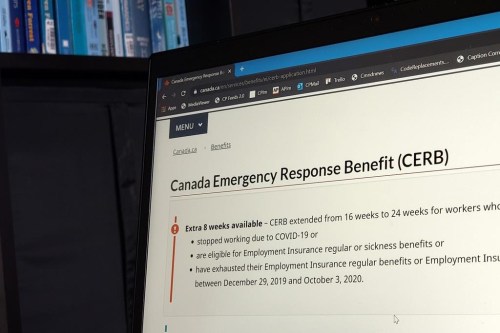
The landing page for the Canada Emergency Response Benefit is seen in Toronto, Monday, Aug. 10, 2020. THE CANADIAN PRESS/Giordano Ciampini

At the same time, she said the revenue agency and the department have not followed up by verifying those payments.

Hogan estimates $4.6 billion was paid to people who were not eligible, while another $27.4 billion in payments to individuals and businesses should be further investigated.

“Billions of dollars have gone, or may have gone, to ineligible recipients,” Hogan said.

The audit found that efforts to recover that money has been limited, with the Canada Revenue Agency collecting $2.3 billion through voluntary repayments.

Pre-payment controls were also lacking, though the report said the government made some changes to those controls for individual benefits.

However, the CRA made few changes to improve controls for businesses to mitigate risks of overpayment.

Hogan also flagged that there was a lack of sufficient data to assess the effectiveness of the Canada Emergency Wage Subsidy program.

Although the subsidy did go to businesses in industries hardest hit by the pandemic, the report said the effect of the subsidy on resilience is unclear because the agency collected limited data from businesses.

“The individual supports and programs in question achieved their goals of getting money into the hands of Canadians quickly,” said Employment Minister Carla Qualtrough.

When asked whether she regrets not adjusting the wage subsidy program to ensure only eligible businesses received payments, Qualtrough said, “I have no regrets.”

Miles Corak, an economics professor at City University of New York, said the auditor’s report shows a discrepancy between how benefits were administered for workers and their employers.

“The government was essentially working in the dark in administrating the Canada Emergency Wage (Subsidy),” Corak said.

The report said it’s unclear whether the subsidy helped businesses stay afloat because the businesses that existed before the pandemic were different than the ones that existed as of October 2021.

There was also missing data with regard to the workers who were supposed to benefit from the wage subsidy.

The audit could not determine the number of employees who benefited, whether employees stayed with their employers or the exact number of people who were rehired as a result of the subsidy program.

The auditor general has made a set of recommendations to improve the collection of overpayments and to fix data gaps relating to businesses.

Government organizations reviewed in the audit say they have accepted the recommendations, but only partially accepted a recommendation related to recuperating overpayments.

The federal government said it would prioritize which to pursue by weighing the resources necessary with the amount owed.

“It would not be cost effective nor in keeping with international and industry best practices to pursue 100 per cent of all potentially ineligible claims,” the response said.

Conservative finance critic Jasraj Singh Hallan called for the federal government to present a plan to recover the overpaid amount.

In a statement, NDP finance critic Daniel Blaikie said people who applied for benefits in good faith and don’t have the money to repay the federal government shouldn’t be persecuted.

This report by The Canadian Press was first published Dec. 6, 2022.

Report Error Submit a Tip

More Stories

A timeline of the WE Charity controversy

The Canadian Press 9 minute read Wednesday, Aug. 19, 2020

OTTAWA - A timeline of events regarding the Canada Student Service Grant program, based on public documents, events and statements from cabinet ministers, government officials, and WE Charity:

March 6, 2020: WE Charity staff prepare a concept paper on service learning for public servants at Employment and Social Development Canada.

April 5: Finance Minister Bill Morneau and Prime Minister Justin Trudeau talk over the phone about how to help students whose summer job and volunteer opportunities were vanishing due to the COVID-19 pandemic. Finance Department officials are tasked with considering options the next morning.

April 7: Small Business Minister Mary Ng and WE co-founder Craig Kielburger have an introductory phone call in which Ng asks WE to send what it calls a ``pre-established proposal'' to help young people launch businesses.

Fact Check

1 minute read Thursday, Nov. 30, 2023

Fact Check

Having problems with the form?Contact Us Directly |

One-on-one Journalism Training

0 minute read Wednesday, Jun. 18, 2025

Is Canada headed for time chaos this weekend?

Michelle Bastian 5 minute read 2:00 AM CDT

When Manitoba Premier Wab Kinew declared Sept. 17 that the province would remain on permanent daylight time, he suggested it was a historical moment people would share with their “great-great-grandkids.” But, while Sunday, Nov. 1 has been heralded as the date many Canadians will stop changing their clocks, there are rumblings behind the scenes suggesting this will actually cause more trouble than ever before.

There are, of course, the warnings from chrono-biologists and sleep scientists about the damage permanent daylight time will do. The lighter evenings will mean many more dark mornings. But there is another set of problems in the offing in the critical infrastructure that underpins our digital lives.

While it used to be common to spend the Sunday morning after a time change going around our homes updating the clocks, we now wake up to devices that have already adjusted to the new time. These automatic updates occur regularly for daylight time, as well as when we travel to new time zones.

Our clocks are able to change by themselves owing to the hard work of a group of volunteers who were recently named in a list of the people who hold up the internet. This group, led by Paul Eggert, a computer scientist at UCLA, maintains a little-known tool called the Time Zone Database. Since the 1980s, it has kept track of regional, national and international debates about clock time and provided an up-to-date table of what time it should be on our walls.

Shocking development

Kelly Taylor 6 minute read Preview

Shocking development

Kelly Taylor 6 minute read 2:00 AM CDT

HOCKLEY VALLEY, Ont. — It’s not too often you get into a new vehicle, look at the interior, and say to yourself, “Wow, this is different… in a good way.”

Automakers tend to stick pretty close to defined norms, and when they differ, it’s not always successful. I’m looking at you, Toyota Yaris and Nissan X-Trail.

So, stepping into the 2027 BMW iX3 was refreshing. A bright parallelogram of a main touchscreen is closer to the driver than most, aided in no small part by pushing the instrument cluster to a narrow band just under the windscreen.

The effect is to clean up the look of the dash but without moving to a centre-mount instrument panel like the Yaris and X-Trail. The most valuable information (speed, battery charge, range) is right in front of the driver, visible above the top rim of the steering wheel.

Read
2:00 AM CDT

COVID-19 benefits helped economy rebound, but post-payment verification lacking: AG

Nojoud Al Mallees, The Canadian Press 4 minute read Preview

COVID-19 benefits helped economy rebound, but post-payment verification lacking: AG

Nojoud Al Mallees, The Canadian Press 4 minute read Tuesday, Dec. 6, 2022

OTTAWA - Canada's auditor general says COVID-19 benefits were delivered quickly and helped mitigate economic suffering, but the federal government hasn’t done enough to recover billions of dollars in overpayments.

In a new report Tuesday, Karen Hogan said federal benefit programs provided relief to workers and employers affected by the pandemic and helped the national economy rebound.

"Overall, we found that the Canada Revenue Agency and Employment and Social Development Canada effectively delivered COVID-19 programs," Hogan said in a news conference.

At the same time, she said the revenue agency and the department have not followed up by verifying those payments.

Read
Tuesday, Dec. 6, 2022