COVID vaccine policy for Arctic Winter Games not due to Alberta influence: official

Advertisement

Advertise with us

YELLOWKNIFE - An official with the Arctic Winter Games says its decision to revoke a mandatory COVID-19 vaccine policy for the upcoming event had nothing to do with pressure from the Alberta government, despite claims by the premier.

Read this article for free:


By clicking the button above, an account will be created and you will begin to receive some of our recommended newsletters. You may opt out of any newsletter by visiting your Email and Communication Preferences page or by clicking "unsubscribe" at the bottom of any email.

or

Already have an account? Log in here »

To continue reading, please subscribe:

Digital Subscription

One year of digital access for only $1.44 a week*

  • Enjoy unlimited reading on winnipegfreepress.com
  • Read the E-Edition, our digital replica newspaper
  • Access News Break, our award-winning app
  • Play interactive puzzles

*Billed as $5.77 plus GST every four weeks. After 52 weeks, price increases to the regular rate of $19.95 plus GST every four weeks. Offer available to new and qualified returning subscribers only. Cancel any time.

To continue reading, please subscribe:

Add Free Press access to your Brandon Sun subscription for only an additional

$1 for the first 4 weeks*

  • Enjoy unlimited reading on winnipegfreepress.com
  • Read the E-Edition, our digital replica newspaper
  • Access News Break, our award-winning app
  • Play interactive puzzles
Start now

*Your next Brandon Sun subscription payment will increase by $1.00 and you will be charged $17.95 plus GST for four weeks. After four weeks, your payment will increase to $24.95 plus GST every four weeks.

Hey there, time traveller!
This article was published 30/11/2022 (1431 days ago), so information in it may no longer be current.

YELLOWKNIFE – An official with the Arctic Winter Games says its decision to revoke a mandatory COVID-19 vaccine policy for the upcoming event had nothing to do with pressure from the Alberta government, despite claims by the premier.

The Arctic Winter Games International Committee announced Nov. 18 it was dropping the vaccine requirement for attendees at the 2023 Games in the Regional Municipality of Wood Buffalo in northeastern Alberta to “align with current public health advice.”

Premier Danielle Smith recently told reporters during an unrelated press conference that the government had challenged the policy when the Games requested $1.2 million in support as an example of how she was “calling people” to stand up for the unvaccinated in the province.
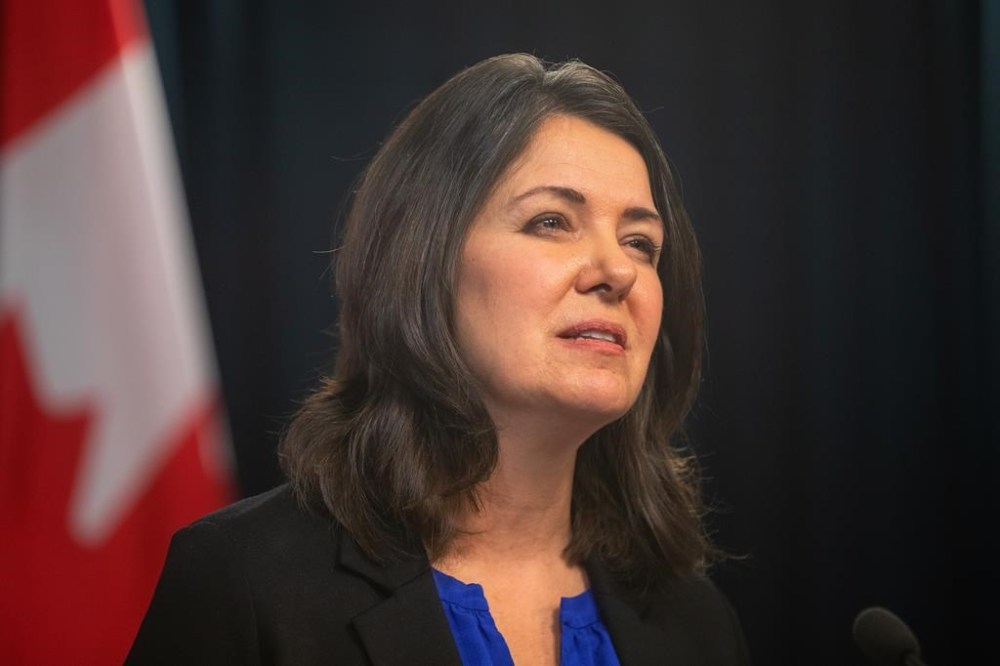
Alberta Premier Danielle Smith speaks at a press conference after the Speech from the Throne in Edmonton, Tuesday, Nov. 29, 2022. An official with the Arctic Winter Games says the decision to revoke a mandatory COVID-19 vaccine policy for the upcoming games had nothing to do with pressure from the Alberta government, despite claims by the premier. THE CANADIAN PRESS/Jason Franson

“They were discriminating against the athletes, telling them they had to be vaccinated,” she said. “So we asked them if they would reconsider their vaccination policy in the light of new evidence and they did. And I was pleased to see that.”

But committee president John Rodda said he’s not aware of the phone call Smith mentioned. He said three years ago, Alberta Sport Connection, which has since dissolved, granted $1.8 million to the Wood Buffalo host society.

“There was nothing contingent on any policy mandates,” he said.

Rodda said the decision on the vaccine policy was based on advice from health officials and discussions with other sporting organizations.

“There was no other external influence that forced us to make a decision,” he said. “We realize that things have changed and they’ve been relaxed and that’s how we came to our conclusion.”

The Games committee has said it supports any jurisdiction that wishes to enforce its own vaccine requirements and encourages protective measures like mask-wearing and sanitizing.

Smith’s office did not immediately respond to a request for comment.

During her first day as premier last month, Smith made headlines when she said unvaccinated Canadians were the most discriminated against group she’d witnessed in her lifetime. She subsequently issued a statement saying she “did not intend to trivialize” the discrimination faced by minority communities and persecuted groups.

“We just want to remind people that in this province we do not discriminate against people for any reason and that now that we know a lot more about this virus that we would like them to address their policies and bring them up to speed with what the environment is here that we are trying to create, which is a welcoming environment,” Smith said following her comments about the Arctic Winter Games.

The Games are a premier circumpolar sport and cultural event for youth that began in 1970 and are usually held every two years. Athletes from the Northwest Territories, Yukon, Nunavut, Alaska, Greenland, Nunavik in northern Quebec, and northern Alberta, as well as Indigenous Sami people of Norway, Sweden and Finland are to compete at the Games in Wood Buffalo from Jan. 29 to Feb. 4.

Athletes primarily range in ages from 10 to 19, depending on the category and sport, with young adults also competing in Arctic sports and Dene games.

The Games were cancelled in March 2020, just days before they were set to begin in Whitehorse, due to concerns with COVID-19. The Wood Buffalo event was originally scheduled to take place in March 2022 but it was postponed due to the pandemic. The Games in Mat-Su Valley, Alaska, have been set for March 2024.

“We’re going back-to-back so there’s quite a buzz,” Rodda said. “There’s more enthusiasm and excitement and energy where we’re back doing what we all love to do and that is provide opportunities for northern youth.”

This report by The Canadian Press was first published Nov. 30, 2022.

___

This story was produced with the financial assistance of the Meta and Canadian Press News Fellowship.

Report Error Submit a Tip

More Stories

A timeline of the WE Charity controversy

The Canadian Press 9 minute read Wednesday, Aug. 19, 2020

OTTAWA - A timeline of events regarding the Canada Student Service Grant program, based on public documents, events and statements from cabinet ministers, government officials, and WE Charity:

March 6, 2020: WE Charity staff prepare a concept paper on service learning for public servants at Employment and Social Development Canada.

April 5: Finance Minister Bill Morneau and Prime Minister Justin Trudeau talk over the phone about how to help students whose summer job and volunteer opportunities were vanishing due to the COVID-19 pandemic. Finance Department officials are tasked with considering options the next morning.

April 7: Small Business Minister Mary Ng and WE co-founder Craig Kielburger have an introductory phone call in which Ng asks WE to send what it calls a ``pre-established proposal'' to help young people launch businesses.

Transit driver killed in knife attack on U of M campus

8 minute read Preview

Transit driver killed in knife attack on U of M campus

8 minute read Tuesday, Feb. 14, 2017

A Winnipeg Transit driver was killed early this morning after he was stabbed by the only passenger on his bus at the University of Manitoba campus.

Irvine Jubal Fraser, 58, was rushed to hospital in critical condition but later died, police said.

The attack occurred at about 2 a.m. in the area of Dafoe Road West and Gillson Street.

Witnesses pointed officers led by the canine unit in the direction of the Red River, where a 22-year-old suspect trying to cross to the St. Vital side was arrested and taken into custody.

Read
Tuesday, Feb. 14, 2017

Newspaper websites display fewer stories, more curation

5 minute read Tuesday, Feb. 10, 2026

A city subcommittee was provided with a routine update on the status of an ongoing administrative process Thursday, in accordance with standard reporting procedures.

Actor-director Cooper takes new approach to familiar tale

Randall King 4 minute read Preview

Actor-director Cooper takes new approach to familiar tale

Randall King 4 minute read Thursday, Oct. 4, 2018

TORONTO — In his self-directed version of A Star Is Born, Bradley Cooper plays a rock star named Jackson Maine.

Note the name: it marks the character as a member of a cinematic lineage that descends all the way to 1937.

That year, the first A Star Is Born was made, with Frederick March in the role of alcoholic actor Norman Maine. The name stayed in 1954, when James Mason took over the role of an actor who first nurtures the career of Judy Garland’s up-and-coming star Vicki Lester before his drunken shenanigans threaten to derail it. By 1976, Kris Kristofferson played the role of musician John Norman Howard, a rock singer with a musical stake in the ascent of Barbra Streisand’s Esther Hoffman.

Cooper, 43, remembered the Maine name, but also brought his own vision as a first-time feature filmmaker to the new version, which opens Thursday, Oct. 4, opposite Lady Gaga after the originally designated director, Clint Eastwood, dropped out. While actors might not want to see different interpretations of a role, Cooper embraced the opportunity to see all the past iterations.

Read
Thursday, Oct. 4, 2018

Ottawa announces $500 million for North End sewage plant upgrade

Joyanne Pursaga 4 minute read Preview

Ottawa announces $500 million for North End sewage plant upgrade

Joyanne Pursaga 4 minute read 5:03 PM CDT

The federal government will provide $500 million to help complete the major upgrade to Winnipeg’s North End sewage treatment plant.

Winnipeg South MP Terry Duguid confirmed the total funding at a news conference at the plant Friday, calling the work critical to Winnipeg’s future.

“The stakes could not be higher. Without expanded wastewater treatment, Winnipeg would run out of capacity to build new homes and accommodate new industries within six years,” said Duguid.

The commitment offers the final funding needed to cover the $1.57-billion third and final phase of the upgrade. The city and province will also pay $500 million each for the work.

Read
5:03 PM CDT

City rec facilities crumbling

Ryan Thorpe 6 minute read Preview

City rec facilities crumbling

Ryan Thorpe 6 minute read Monday, Oct. 22, 2018

Throughout Winnipeg, decades-old community assets — pools, arenas and recreation and leisure centres — are deteriorating so quickly that service disruptions are inevitable.

Meanwhile, the city’s community services department, which is responsible for managing those assets, operates with an annual deficit of roughly $80 million, meaning there are scant resources to do little more than bail water on a sinking ship.

Soon, Winnipeggers will have a choice: fewer community services or higher costs.

“It poses a huge challenge because we have very limited dollars that we have to invest in our existing facilities. We also have growing demands for new amenities in new areas. We have to be very strategic,” said Ken McKim, manager of asset management for the department.

Read
Monday, Oct. 22, 2018