China’s ‘zero-COVID’ limits saved lives but no clear exit
Advertisement
Read this article for free:
or
Already have an account? Log in here »
To continue reading, please subscribe:

Digital Subscription
One year of digital access for only $205*
- Enjoy unlimited reading on winnipegfreepress.com
- Read the E-Edition, our digital replica newspaper
- Access News Break, our award-winning app
- Play interactive puzzles
*First annual payment billed as $205.00 + GST for one year. This annual subscription will automatically renew at $233.00 + GST every 52 weeks (10% off the regular annual price of $259.35). Offer available to new and qualified returning subscribers only. Cancel any time.
To continue reading, please subscribe:
Add Free Press access to your Brandon Sun subscription for only an additional
$1 for the first 4 weeks*
- Enjoy unlimited reading on winnipegfreepress.com
- Read the E-Edition, our digital replica newspaper
- Access News Break, our award-winning app
- Play interactive puzzles
*Your next Brandon Sun subscription payment will increase by $1.00 and you will be charged $17.95 plus GST for four weeks. After four weeks, your payment will increase to $24.95 plus GST every four weeks.
Read unlimited articles for free today:
or
Already have an account? Log in here »
Hey there, time traveller!
This article was published 28/11/2022 (1400 days ago), so information in it may no longer be current.
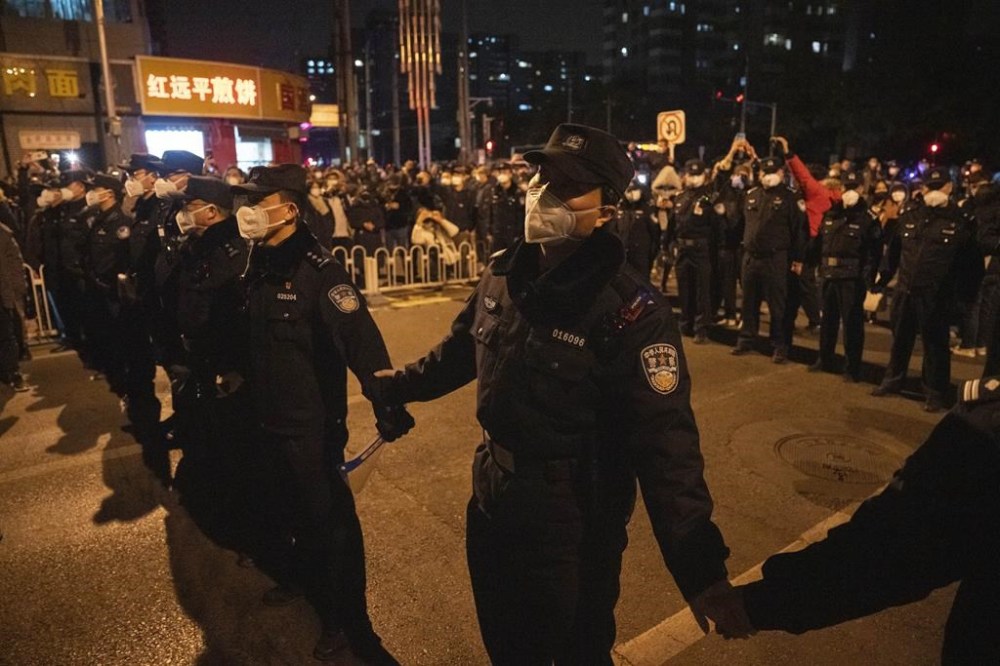
China’s strategy of controlling the coronavirus with lockdowns, mass testing and quarantines has provoked the greatest show of public dissent against the ruling Communist Party in decades.
Most protesters on the mainland and in Hong Kong have focused their anger on restrictions that confine families to their homes for months. Global health experts have criticized China’s methods as unsustainable.
A look at China’s “zero-COVID” approach:
CHINA’S POLICY
President Xi Jinping’s government has pursued a policy of lockdowns, repeated testing of millions of people and lengthy quarantines for overseas arrivals in an attempt to tamp down spread.
At the beginning of the pandemic, other countries also had lockdowns and other restrictions that were eventually eased. Initially, the strategy in China succeeded at holding down the death toll. But it now means China’s population has very little exposure to the virus. And China is using only domestically developed vaccines that are less effective than those widely used elsewhere, and not enough elderly people are fully protected.
China’s continued reliance on lockdowns has been “rather draconian,” Dr. Anthony Fauci, the top U.S. infectious disease expert, said on NBC’s “Meet the Press.” It “really doesn’t make public health sense.”
NO ‘PLAN B’
China has had far fewer deaths compared to other large nations and one of the lowest deaths per capita in the world. The official death toll stands at 5,233, the majority during the initial outbreak in early 2020.
The strict policies saved lives, but cannot be sustained, said Ali Mokdad, a professor of health metrics sciences at the University of Washington in Seattle.
“They do not have a plan B,” said Mokdad, adding that China’s approach ultimately will lead to surges in deaths and strain on hospitals. “They cannot lock the country forever.”
Julian Tang, a virologist at Britain’s University of Leicester, agreed that China’s attempt to stop every single case of COVID-19 is “simply impossible” and that it will do what most of the rest of the world has done and learn to live with the virus.
“There is no endgame for ‘zero-COVID,’” Tang said.
While China’s tough rules helped to avoid the thousands of infections, hospitalizations and deaths seen in the West during the first year of the pandemic, that disappeared with the emergence of the super-infectious omicron variant, Tang said.
“The only thing to do is to accept that there is going to be a certain level of disease,” Tang said.
GRIM PREDICTIONS
Dr. Paul Hunter, a professor of medicine at Britain’s University of East Anglia, said China had now backed itself into a corner and warned that exiting would be painful. He said the value of measures like lockdowns and mask-wearing was mostly to delay as many infections as possible until vaccines were available.
“Unfortunately, the vaccines in China were not very good,” Hunter said, adding that vaccination levels of its most vulnerable people are low and much of the protection the shots provided has now faded for those immunized long ago.
Hunter said restrictions should be lifted incrementally to avoid hospitals being overwhelmed and said other restrictions, like mask-wearing, could be held in place to reduce spread as much as possible. He said China will eventually have to open its borders, a step that will inevitably bring a surge of disease.
“The surge will peak very quickly and also fade rather quickly. But while they are going through it, it will be dreadful,” he said.
The health analytics firm Airfinity released projections on Monday estimating that up to about 2 million people in China could be at risk of death if the country were to lift its “zero-COVID” policy, given its low vaccination rates and the lack of natural immunity among its population.
Local Chinese authorities eased some regulations after recent rallies, but the government showed no sign of backing down on its larger coronavirus strategy.
VACCINES AS ‘WAY OUT’
Dr. Bharat Pankhania, an infectious diseases expert at the University of Exeter, said China should import mRNA vaccines made by Pfizer-BioNTech and Moderna.

“The scientific answer is very clear,” Pankhania said.
He acknowledged that it might be politically challenging for China to acknowledge the shortcomings of its homegrown shots, but said the country needed to find a way to change course.
“This should not be about saving face,” he said. “The Chinese population is clearly fed up with lockdown after lockdown and the quickest way out is to immunize as fast as possible.”
___
The Associated Press Health and Science Department receives support from the Howard Hughes Medical Institute’s Department of Science Education. The AP is solely responsible for all content.

Advertisement Advertise With Us
Advertisement Advertise With Us