EXPLAINER: Pregnancy complications under abortion spotlight

Advertisement

Advertise with us

Serious pregnancy complications are rare in the United States but they still affect thousands of women each year.

Read this article for free:


or

Already have an account? Log in here »

To continue reading, please subscribe:

Subscribe and receive a limited-edition Free Press branded hat or tote.

Digital Subscription

One year of digital access for only $205*

  • Enjoy unlimited reading on winnipegfreepress.com
  • Read the E-Edition, our digital replica newspaper
  • Access News Break, our award-winning app
  • Play interactive puzzles

*First annual payment billed as $205.00 + GST for one year. This annual subscription will automatically renew at $233.00 + GST every 52 weeks (10% off the regular annual price of $259.35). Offer available to new and qualified returning subscribers only. Cancel any time.

To continue reading, please subscribe:

Add Free Press access to your Brandon Sun subscription for only an additional

$1 for the first 4 weeks*

  • Enjoy unlimited reading on winnipegfreepress.com
  • Read the E-Edition, our digital replica newspaper
  • Access News Break, our award-winning app
  • Play interactive puzzles
Start now

*Your next Brandon Sun subscription payment will increase by $1.00 and you will be charged $17.95 plus GST for four weeks. After four weeks, your payment will increase to $24.95 plus GST every four weeks.

Hey there, time traveller!
This article was published 22/08/2022 (1457 days ago), so information in it may no longer be current.

Serious pregnancy complications are rare in the United States but they still affect thousands of women each year.

They may endanger the health of the mother, fetus or both. Many are more common in Black patients and contribute to their disproportionately high maternal mortality rate.

Severe cases may force patients and their physicians to consider abortions, but laws enacted or proposed since the Supreme Court overturned Roe v. Wade in June have limited that option.
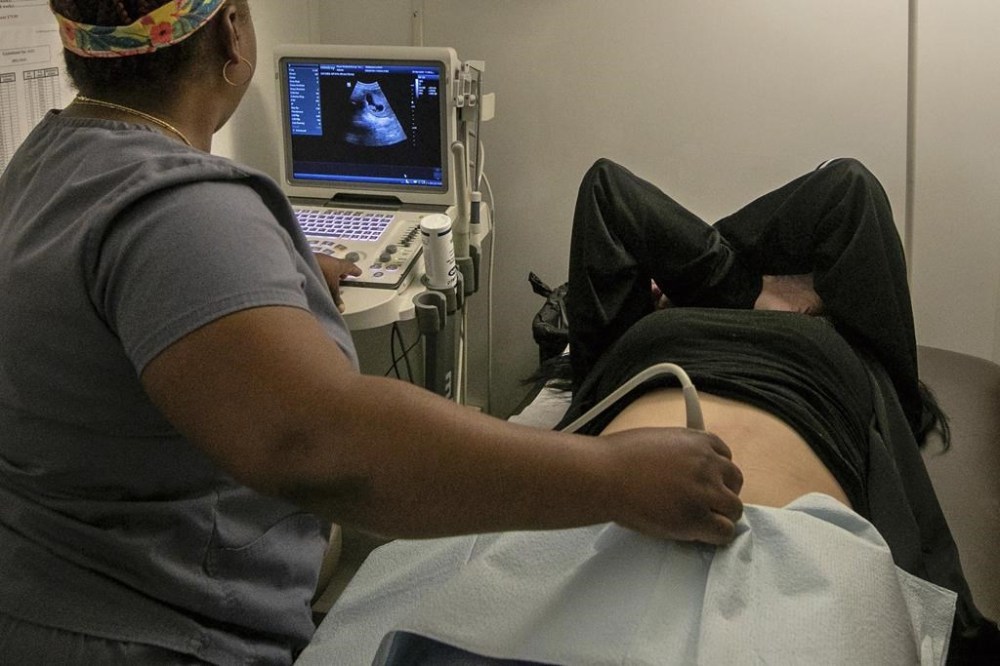
FILE - An operating room technician performs an ultrasound on a patient at an abortion clinic in Shreveport, La., Wednesday, July 6, 2022. Serious pregnancy complications are rare in the United States but they still affect thousands of women each year. (AP Photo/Ted Jackson, File)

At least 19 states with abortion restrictions allow exemptions if the mother develops a condition with severe or life-threatening health consequences, but determining whether either situation exists can be a challenging judgment call. Physicians have said they feel new abortion limits are forcing them to let patients with complications deteriorate.

Here’s a look at some of the most common pregnancy complications that could lead a doctor to recommend an abortion:

PREECLAMPSIA

A serious high blood pressure condition that can develop suddenly in pregnancy, typically during the second half, is called preeclampsia.

It develops in about 1 in 25 pregnancies. Symptoms include swollen limbs, headaches and blurred vision.

In addition to elevated blood pressure, patients may develop kidney problems. In severe cases, fluid in the lungs, seizures or strokes may occur.

Treatment may include hospitalization, along with medicines to lower blood pressure and promote fetal lung development. Ending the pregnancy by inducing delivery or with an abortion may be recommended when the mother’s life is in danger.

PREMATURE RUPTURE OF MEMBRANES

Membranes in the fluid-filled amniotic sac that surrounds the fetus often rupture or break at the start of childbirth — commonly called water breaking. In at least 3% of pregnancies, the sac ruptures too early, often leading to preterm birth.

The condition increases chances for a uterine infection. Doctors may recommend ending the pregnancy, especially if water breaks before 24 weeks, when infant survival chances are slim.

Instead of abortion, doctors could monitor the patients and closely watch for signs of infection. But risks of severe maternal complications are greatly increased and chances of a successful birth are small, recent studies have shown.

ECTOPIC PREGNANCIES

Ectopic pregnancies are when a fertilized egg grows outside the womb, often in a fallopian tube. It happens in about 2% of U.S. pregnancies.

There is no chance for the embryo to survive, but it can cause the tube to burst, leading to dangerous internal bleeding.

Treatment for less severe cases may include medication that stops the embryo from growing, ending the pregnancy. Otherwise surgery is done, sometimes requiring removing the affected tube.

Doctors emphasize that treatment for ectopic pregnancies is not the same as an abortion.

Some politicians who oppose abortions have suggested that ectopic pregnancies could be reimplanted in the uterus, sometimes citing two unsubstantiated case reports published decades apart in medical journals. Experts say any such attempts would damage the embryo and could not result in a successful pregnancy.

PLACENTA ABRUPTION

The placenta is a crucial structure that develops in pregnancy and attaches to the uterine wall, connecting with the umbilical cord to help nourish the fetus.

In about 1 in 100 pregnancies, the placenta separates prematurely from the womb, after about 20 weeks of pregnancy. That can pose a life-threatening risk to the fetus and can cause dangerous maternal bleeding.

Inducing childbirth or ending the pregnancy may be recommended.

___

Follow AP Medical Writer Lindsey Tanner at @LindseyTanner.

___

The Associated Press Health and Science Department receives support from the Howard Hughes Medical Institute’s Department of Science Education. The AP is solely responsible for all content.

Report Error Submit a Tip

More Stories

Free Press Sales Center

1 minute read Updated: 10:07 AM CDT

| Advertise With Usto have your brand reach an engaged audience on the most trusted news source in Manitoba. Create Your Campaign Today

44%

of Winnipeg adults read Free Press print and digital products weekly. This is the best per capita readership of any English daily newspaper in a major Canadian city.

Winnipeg School Division to review all its schools named after people

Maggie Macintosh 6 minute read Preview

Winnipeg School Division to review all its schools named after people

Maggie Macintosh 6 minute read Thursday, Sep. 23, 2021

Manitoba’s largest school board is reviewing all of its K-12 building titles to determine whether the namesakes and their respective legacies are in line with modern-day morals.

Last week, Jamie Dumont, vice-chairwoman of the board of trustees in the Winnipeg School Division, introduced a motion to undertake an evaluation of all schools named after people and research each historical figure’s resumé.

“We operate, as a school division, under a number of values and, in many cases, we are very much a leader in diversity, equity, inclusion and Indigenous education — so I think it’s important that, as a board, we ensure that our schools and our buildings don’t contradict these values,” Dumont said during a virtual board meeting Sept. 13.

The review will identify whether any buildings are named after individuals with a history of actions that are discriminatory or not in accordance with WSD values, namely: inclusiveness, diversity, reconciliation, and respect for the rights and human dignity of others, or both.

Read
Thursday, Sep. 23, 2021

MamiMarkets connecting ethnic food vendors, customers

Aaron Epp 4 minute read Preview

MamiMarkets connecting ethnic food vendors, customers

Aaron Epp 4 minute read Yesterday at 8:04 PM CDT

A West African soup recipe and a fruitless search for ingredients led to a business opportunity for two Manitoba entrepreneurs.

La Salle-based husband and wife Tayo Olayinka and Adeola Adegoke are two of the co-founders behind MamiMarkets.com, an online marketplace that connects ethnic stores to their customers. Launched in Winnipeg around 2 1/2 years ago, the service is now available in seven Canadian cities.

Ethnic grocery vendors add their products and storefront to MamiMarkets, with no point-of-sale integration required.

Customers then search for the specific brands and ingredients they need, and identify which nearby vendor has them. They can then place an order and have the products delivered to their home that day.

Read
Yesterday at 8:04 PM CDT

Change is keyword in move to define infill boundaries

Tessa Vanderhart 5 minute read Preview

Change is keyword in move to define infill boundaries

Tessa Vanderhart 5 minute read Wednesday, Sep. 18, 2019

After 40 years of sprawl, Winnipeg is trying to grow up — but first, it will have to update its rules on infill development in mature neighbourhoods.

Winnipeg’s footprint grew three times faster than its population from 1971 to 2011, city documents show. For the last five years, 15 per cent of growth has been infill development in older neighbourhoods — a whiplash change that’s sparked concerns about different rules for different neighbourhoods and too much change, too fast.

While many infill developments are approved by city hall despite community opposition, Charleswood residents were able to block a 100-foot lot from being split early this summer.

“The lack of consistency and the imprecise guidelines is the most important thing,” River Heights resident Ann Hodges said. “There are criteria that are meant to be used.

Read
Wednesday, Sep. 18, 2019

Winnipeggers deserve an explanation for waste of taxpayer dollars: expert

Ryan Thorpe 12 minute read Preview

Winnipeggers deserve an explanation for waste of taxpayer dollars: expert

Ryan Thorpe 12 minute read Tuesday, Feb. 22, 2022

The anti-corruption expert grew increasingly concerned with each passing example of costly and confusing construction projects ordered by Winnipeg’s public works department — year after year, intersection after intersection.

Kevin Gillese stopped the presentation halfway through — he’d seen enough.

“The materials you’ve shown me are extremely disturbing. They suggest a pattern of incompetence or corruption, or perhaps both… The patterns shown are over a long period of time and there’s no obvious rhyme or reason to what’s being done,” Gillese said.

“The extent and the magnitude is so great that it staggers the imagination. It suggests something very, very wrong in the way intersection engineering is being done in the City of Winnipeg.”

Read
Tuesday, Feb. 22, 2022

Despite outbreaks, Winnipeg care-home residents allowed to leave, visit families

Danielle Da Silva 8 minute read Preview

Despite outbreaks, Winnipeg care-home residents allowed to leave, visit families

Danielle Da Silva 8 minute read Friday, Dec. 18, 2020

When an email from the personal care home where Marie Tremblay’s mother lives landed in her inbox with the subject line “holiday season visitation,” her mind started racing.

Tremblay’s mom is a resident at Park Manor Personal Care Home in Transcona, where an outbreak of COVID-19 has infected 73 residents and 37 staff. Twenty-two residents have died due to the disease.

“They’ve asked families not to go in there during COVID; it’s bad enough with staff getting it. So, I haven’t gone in to visit her since the lockdown,” Tremblay said Friday.

In a follow-up email to Tremblay, the chief executive officer explained he was obligated to inform families that the regional health authority has set guidelines for out-of-home visits, or a “social pass,” despite the home strongly discouraging such visits.

Read
Friday, Dec. 18, 2020