Ontario health minister won’t rule out privatization as option to help ER crisis

Advertisement

Advertise with us

TORONTO - Ontario's health minister is not ruling out privatization as the government looks at ways to deal with a major staff shortage straining hospitals across the province.

Read this article for free:


By clicking the button above, an account will be created and you will begin to receive some of our recommended newsletters. You may opt out of any newsletter by visiting your Email and Communication Preferences page or by clicking "unsubscribe" at the bottom of any email.

or

Already have an account? Log in here »

To continue reading, please subscribe:

Digital Subscription

One year of digital access for only $1.44 a week*

  • Enjoy unlimited reading on winnipegfreepress.com
  • Read the E-Edition, our digital replica newspaper
  • Access News Break, our award-winning app
  • Play interactive puzzles

*Billed as $5.77 plus GST every four weeks. After 52 weeks, price increases to the regular rate of $19.95 plus GST every four weeks. Offer available to new and qualified returning subscribers only. Cancel any time.

To continue reading, please subscribe:

Add Free Press access to your Brandon Sun subscription for only an additional

$1 for the first 4 weeks*

  • Enjoy unlimited reading on winnipegfreepress.com
  • Read the E-Edition, our digital replica newspaper
  • Access News Break, our award-winning app
  • Play interactive puzzles
Start now

*Your next Brandon Sun subscription payment will increase by $1.00 and you will be charged $17.95 plus GST for four weeks. After four weeks, your payment will increase to $24.95 plus GST every four weeks.

Hey there, time traveller!
This article was published 10/08/2022 (1542 days ago), so information in it may no longer be current.

TORONTO – Ontario’s health minister is not ruling out privatization as the government looks at ways to deal with a major staff shortage straining hospitals across the province.

Sylvia Jones said the government is considering many ideas in an effort to keep emergency departments from closing.

When asked if further privatization of the health system could occur, Jones said “all options are on the table.”

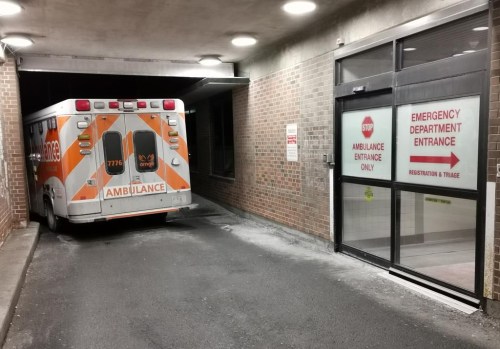
An ambulance is parked at the emergency department at the Lakeridge Health hospital in Bowmanville, Ont. on Wednesday January 12, 2022. Ontario’s health minister would not rule out further privatization in health care among a number of possibilities being considered as the province deals with major staff shortages in hospitals.THE CANADIAN PRESS/Doug Ives

“I’m saying that there is innovation and opportunities here in Ontario, and we will explore those,” she said at the legislature on Wednesday.

Emergency departments across Ontario have had to close for hours or days at a time this summer, which health-care officials say is due to a nurse staffing crisis. Some small rural hospitals have been hit harder than larger urban hospitals.

Jones said she’s been in talks with hospital corporations in an effort to fix the problem. The government is considering changes to the health system, she said, although she did not specify what those would be.

“We’ve always had a public health-care system in the province of Ontario and we will continue to,” she said.

“Are we looking at options? Absolutely. There are jurisdictions in other parts of Canada, in the world, that have other opportunities that we’re going to look at and all of those suggestions are being considered.”

Interim NDP Leader Peter Tabuns said any health-care privatization “would be a disaster for Ontario.”

Advocates have urged Premier Doug Ford to repeal public sector wage restraint legislation that he introduced in 2019, saying it is harming efforts to recruit and retain nurses.

Jones and Ford were peppered Tuesday about the ongoing pressures in hospitals as they attended the first Question Period since the Progressive Conservatives’ re-election in June.

Both did not call it a crisis, saying the government was investing in the health-care system.

“If there was 5,000 nurses that could fly from the sky, we’d be hiring them tomorrow,” Ford said.

Jones said she is looking at “tweaks” to the health-care system to help the problems in emergency departments.

She said she has met with hospital administrators and nurses unions to get more ideas on what to do. But she said she is being cautious to understand how any suggested changes could affect other parts of the health-care system.

“You can’t just fix what is happening in health care shortages in an emergency department and not appreciate and understand that there are impacts that may happen in the community through community care services, through (personal support workers), through long term care,” she said.

Last week, Jones sent directives to the College of Nurses of Ontario and the College of Physicians and Surgeons of Ontario, urging them to make every effort to register internationally educated nurses and doctors in the province as fast as possible.

The issue of privatization in health care has been in the spotlight elsewhere in the country recently.

The British Columbia Court of Appeal upheld a lower court’s dismissal of a Vancouver surgeon’s challenge of that province’s Medicare Protection Act, saying bans on extra-billing and private insurance do not violate the Charter.

The decision upholds the law aimed at ensuring access to medical care in the public system is based on need, not a patient’s ability to pay.

This report by The Canadian Press was first published Aug. 10, 2022.

Report Error Submit a Tip

More Stories

Ontario health minister won’t rule out privatization as option to help ER crisis

Liam Casey, The Canadian Press 4 minute read Preview

Ontario health minister won’t rule out privatization as option to help ER crisis

Liam Casey, The Canadian Press 4 minute read Wednesday, Aug. 10, 2022

TORONTO - Ontario's health minister is not ruling out privatization as the government looks at ways to deal with a major staff shortage straining hospitals across the province.

Sylvia Jones said the government is considering many ideas in an effort to keep emergency departments from closing.

When asked if further privatization of the health system could occur, Jones said "all options are on the table."

"I'm saying that there is innovation and opportunities here in Ontario, and we will explore those," she said at the legislature on Wednesday.

Read
Wednesday, Aug. 10, 2022

Building healthier Canadians

Jason M. Sutherland 4 minute read 2:00 AM CDT

Ottawa is betting that billions of taxpayer dollars spent on steel, asphalt and concrete will secure Canada’s economic future and prosperity. Through the $51 billion Build Communities Strong fund, the federal government is paying for roads, bridges, water systems and transit to boost productivity and attract capital from Europe and Asia.

As the shovels hit the ground from Halifax to Vancouver, Canadians should be asking themselves: What good does it do to build a stronger country if we are not building healthier Canadians?

The fund’s $5 billion allocation for health infrastructure is welcome news, as many of our hospitals and long-term care homes across the country are showing severe signs of aging, and modern care centres are much needed. But pouring concrete for new facilities is not the same as building a healthy population.

A ribbon-cutting at a modern hospital does not guarantee you see a family doctor when you need one, keep a rural emergency department open overnight, or shorten the wait for a knee replacement keeping someone off the job or robbing a retiree of independence.

The volatile U.S. midterms

Allan Levine 5 minute read Preview

The volatile U.S. midterms

Allan Levine 5 minute read 2:00 AM CDT

The last time the Democratic Party had 218 or more seats — the number required to control the U.S. House of Representatives — was from 2021 to 2023, following the election of Democrat Joe Biden as president. During that same period, the Democrats also had the edge in the Senate. Despite a 50-50 split with the Republicans, Democrats were able to control the Senate with the help of Vice-President Kamala Harris, who cast the key vote in a tie. From 2023 to 2025, the Democrats had a slim 51 to 49 Senate majority.

If history repeats itself and the latest polls are fairly accurate, on Tuesday, Nov. 3, the Democratic Party will take back the House and (probably) the Senate from the Republicans, who have controlled both legislative bodies since the 2024 election. In the House, the Democrats have to gain at least three more seats. In the Senate, they have to win four more, which is entirely doable, though they almost certainly have to win a seat in Texas, Ohio, Kansas or Alaska, each of which currently has two Republican senators.

The prospect of a Democratic victory has President Donald Trump in a tizzy. For the past two years, he has abused his executive power to impose illegal tariffs on Canada and other countries; started a war with Iran; cozied up to Russian president Vladimir Putin and turned his back on Ukrainian president Volodymyr Zelenskyy; and increased the national debt through questionable tax cuts — to list only a few of his more egregious actions. He has been able to get away with this mainly because Republicans in the Senate and the House refuse to even question his decisions.

With the Democrats in charge, Trump’s brazen actions won’t be completely halted, but he will face significant legislative challenges and obstacles not easily dismissed. His controversial appointees, such as Attorney General Todd Blanche, who perceives himself as Trump’s private lawyer rather than the legal representative of the people, won’t get a free pass in committee hearings.

Read
2:00 AM CDT

Must-see Folk Fest workshops

16 minute read Preview

Must-see Folk Fest workshops

16 minute read Thursday, Jul. 5, 2018

Workshops have always been an integral part of the Winnipeg Folk Festival.

They are magic-moment makers; a curated group of musicians — sometimes friends, sometimes strangers — on one stage playing together, supporting each other, creating something that will only exist for an hour or two. No one knows what will come out of the collaboration, but usually it’s something special.

When the Free Press spoke to Winnipeg Folk Festival artistic director Chris Frayer ahead of the lineup release in early March, he noted he would be paying some extra attention to workshops this year, as some of the special projects occurring during the past couple of festivals had pulled some of his attention away.

And with 37 workshops on the books, it would seem he followed through on his promise.

Read
Thursday, Jul. 5, 2018

Shocking development

Kelly Taylor 6 minute read Preview

Shocking development

Kelly Taylor 6 minute read 2:00 AM CDT

HOCKLEY VALLEY, Ont. — It’s not too often you get into a new vehicle, look at the interior, and say to yourself, “Wow, this is different… in a good way.”

Automakers tend to stick pretty close to defined norms, and when they differ, it’s not always successful. I’m looking at you, Toyota Yaris and Nissan X-Trail.

So, stepping into the 2027 BMW iX3 was refreshing. A bright parallelogram of a main touchscreen is closer to the driver than most, aided in no small part by pushing the instrument cluster to a narrow band just under the windscreen.

The effect is to clean up the look of the dash but without moving to a centre-mount instrument panel like the Yaris and X-Trail. The most valuable information (speed, battery charge, range) is right in front of the driver, visible above the top rim of the steering wheel.

Read
2:00 AM CDT

Trump touts USMCA win in state of the union

James McCarten, The Canadian Press 6 minute read Preview

Trump touts USMCA win in state of the union

James McCarten, The Canadian Press 6 minute read Tuesday, Feb. 4, 2020

WASHINGTON - President Donald Trump declared his scorched-earth political style an unmitigated success Tuesday in a fiercely partisan, made-for-TV state of the union speech that made it clear he expects to be back in the White House next year on the strength of the U.S. economy and his trade deals with Canada, Mexico and China.

Trump, addressing a joint session of Congress in the very chamber where House Democrats voted to impeach him less than two months ago, became only the second president in American history — Bill Clinton was the first — to deliver a state of the union while standing trial in the Senate.

Unrepentant, he pointedly refused to shake the offered hand of House Speaker Nancy Pelosi on the dais before singing the praises of what he billed as "the great American comeback," pointing to strong job growth, a soaring stock market and low unemployment as evidence of his leadership. And when he was done, Pelosi ripped up the speech in full view of the television cameras.

"America's enemies are on the run, America's fortunes are on the rise, and America's future is blazing bright. The years of economic decay are over," Trump declared, taking full credit for the country's "roaring economy," including what he billed as seven million new jobs and the lowest jobless rate in half a century — a "blue-collar boom" that he's counting on to help his re-election chances in November.

Read
Tuesday, Feb. 4, 2020