Will abortion be on more state ballots after Kansas vote?

Advertisement

Advertise with us

TOPEKA, Kan. (AP) — Abortion opponents were shocked and abortion rights advocates energized by a decisive statewide vote in heavily Republican Kansas this week in favor of protecting abortion access, yet it's not likely to translate into new abortion votes across the U.S. in the November election.

Read this article for free:


or

Already have an account? Log in here »

To continue reading, please subscribe:

Subscribe and receive a limited-edition Free Press branded hat or tote.

Digital Subscription

One year of digital access for only $205*

  • Enjoy unlimited reading on winnipegfreepress.com
  • Read the E-Edition, our digital replica newspaper
  • Access News Break, our award-winning app
  • Play interactive puzzles

*First annual payment billed as $205.00 + GST for one year. This annual subscription will automatically renew at $233.00 + GST every 52 weeks (10% off the regular annual price of $259.35). Offer available to new and qualified returning subscribers only. Cancel any time.

To continue reading, please subscribe:

Add Free Press access to your Brandon Sun subscription for only an additional

$1 for the first 4 weeks*

  • Enjoy unlimited reading on winnipegfreepress.com
  • Read the E-Edition, our digital replica newspaper
  • Access News Break, our award-winning app
  • Play interactive puzzles
Start now

*Your next Brandon Sun subscription payment will increase by $1.00 and you will be charged $17.95 plus GST for four weeks. After four weeks, your payment will increase to $24.95 plus GST every four weeks.

Hey there, time traveller!
This article was published 04/08/2022 (1520 days ago), so information in it may no longer be current.

TOPEKA, Kan. (AP) — Abortion opponents were shocked and abortion rights advocates energized by a decisive statewide vote in heavily Republican Kansas this week in favor of protecting abortion access, yet it’s not likely to translate into new abortion votes across the U.S. in the November election.

Four other states — California, Kentucky, Michigan and Vermont — could have votes in November on abortion access, and a fifth, Montana, is voting on a measure that would require abortion providers to give lifesaving treatment to a fetus that is born alive after a botched abortion. Opponents argue federal law already offers those protections. No other abortion initiatives are likely to make a state’s November ballot.

The Kansas vote was the first test of public feeling about abortion rights since the U.S. Supreme Court overturned Roe v. Wade in late June, and it upended political assumptions.
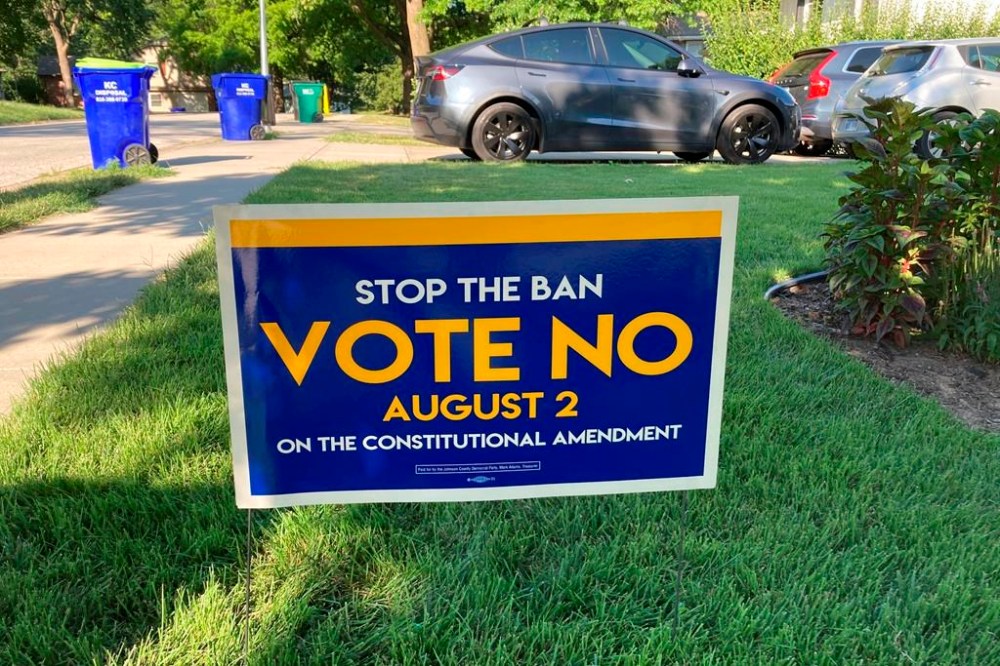
In this photo from Thursday, July 14, 2022, a sign in a yard in Merriam, Kansas, urges voters to oppose a proposed amendment to the Kansas Constitution to allow legislators to further restrict or ban abortion. Opponents of the measure believe it will lead to a ban on abortion in Kansas. (AP Photo/John Hanna)

Voters rejected a proposed amendment to the Kansas Constitution declaring that it grants no right to abortion. That would have opened the door for the GOP-controlled Legislature to further restrict or ban abortion and nullify a 2019 decision by the Kansas Supreme Court that access is a “fundamental” right under the state’s Bill of Rights.

HOW WAS THE OUTCOME OF THE KANSAS VOTE A SURPRISE?

Abortion rights supporters prevailed by nearly 18 percentage points in the Republican state with deep ties to the anti-abortion movement. They took the outcome as confirmation that preserving access to abortion is popular.

Officials with several national abortion rights groups argued that the vote shows it’s a mistake for Democrats in red states like Kansas to avoid talking about abortion and that support for abortion rights can drive voters to the polls. In Kentucky, donations to the abortion rights cause poured in immediately, said Tamarra Wieder, state director for Planned Parenthood Alliance Advocates.

The election in Kansas coincided with the state’s primary. Over the previous 10 years, turnout for a mid-term primary has averaged less than 26%, with Republicans casting twice as many ballots as Democrats.

But turnout for this election topped 45% — almost 915,000 voters — approaching levels normally seen during a fall election for governor. More than half of registered Democrats and Republicans cast ballots. At least 28% of registered unaffiliated voters, who couldn’t vote on anything else on ballots on Tuesday, voted on the proposed amendment.

The outcome also suggested that a sizeable number of Republicans voted against the proposed amendment.

“Three things in Kansas are really important to note: One, the depth of the victory; two, the amount of increased voter turnout, and three, that it happened in an off-year midterm election,” said Kristen Rowe-Finkbeiner, CEO of MomsRising, an advocacy group that supports abortion rights.

Abortion opponents argued that the vote was a temporary setback and vowed to keep electing anti-abortion candidates.

CAN EITHER SIDE RUSH TO PUT A QUESTION TO VOTERS IN MY STATE IN NOVEMBER?

Likely not. For one thing, deadlines to do it have passed in the half of U.S. states that allow voters to put questions on the ballot without going through the Legislature.

In Ohio, the Democratic nominee for governor, Nan Whaley, has called for putting an abortion rights measure on the ballot as early as next year, and efforts have started in Colorado and South Dakota for 2024. In Iowa, GOP lawmakers have taken the first step toward putting an anti-abortion measure on the ballot in 2024.

In Kansas, anti-abortion lawmakers anticipated voters approving their measure.

BUT THERE ARE VOTES IN SOME STATES IN NOVEMBER?

Yes, but those efforts were all underway before the Kansas vote.

Legislators in California and Vermont put measures to protect abortion rights on the ballot, and Kentucky lawmakers have a measure on the ballot similar to the one that failed in Kansas.

In Michigan, abortion rights advocates believe they have turned in enough signatures to put an abortion rights amendment to the state constitution on the November ballot, but the signatures must still be counted.

The Montana referendum also was initiated by legislators.

IN STATES ALLOWING IT, WHAT DOES IT TAKE FOR VOTERS TO GET A QUESTION ON THE BALLOT?

They have to circulate petitions and collect tens of thousands of signatures from registered voters; the number is often a percentage of the vote in a previous election. Some states set requirements to get signatures from across the state, not just in one or two metropolitan areas.

In Nebraska, abortion opponents are focused on gaining one more seat in its one-house Legislature for the two-thirds majority necessary to overcome filibusters and pass an abortion ban. A voter initiative there must gather nearly 88,000 signatures from at least 5% of the registered voters in 38 of its 93 counties, something known as the “two-fifths rule.”

In Missouri, initiatives can take a year to get to the ballot, and in Oklahoma, the average length has been more than a year — 64 weeks — over the past 10 years, according to the secretary of state’s office.

“From start to finish, if you could get it done in nine months, you’d really be moving fast,” said Amber England, a political strategist in Oklahoma who has worked to get questions on the ballot in recent years.

The Ballot Initiative Strategy Center, which advises progressive groups on campaigning for ballot questions, advises that the work should take three years, including building community relationships before even circulating signatures.

SO IT’S A MATTER OF GETTING ENOUGH VALID SIGNATURES IN THE RIGHT PLACES?

Not necessarily. There can be other hurdles, particularly if public officials who are players in the process oppose an initiative.

In Missouri in 2019, opponents of a law banning most abortions after eight weeks of pregnancy sought to get a proposed repeal on the ballot, but Secretary of State Jay Ashcroft, a Republican who opposes abortion, took enough time in vetting the language that supporters had only two weeks to gather signatures. While the initiative’s backers sued — and won — the final ruling from the state Supreme Court didn’t come until early this year.

“It was a significant victory,” said Mallory Schwarz, executive director of Pro-Choice Missouri. “But we didn’t get a do-over.”

____

Hollingsworth reported from Mission, Kansas. Also contributing were Sean Murphy in Oklahoma City, Scott McFetridge in Des Moines, Iowa, and Julie Carr Smyth in Columbus, Ohio.

___

Follow John Hanna on Twitter: https://twitter.com/apjdhanna

Report Error Submit a Tip

More Stories

Calm, balanced approach to game, life is what matters to unassuming Stastny

Jeff Hamilton 14 minute read Preview

Calm, balanced approach to game, life is what matters to unassuming Stastny

Jeff Hamilton 14 minute read Friday, Feb. 19, 2021

When the day comes for Paul Stastny to hang up his skates for good, ending what’s already been a sparkling pro career, he hopes to leave a lasting mark on the game he loves.

He didn’t use the word legacy, nor would he. If you’ve had the chance to speak with Stastny before, you quickly realize his discomfort in talking about personal accolades, despite possessing many. He’s been selected as an NHL all-star, and represented the United States on multiple occasions, including at two Olympics.

In 961 NHL games, Stastny has 253 goals and 482 assists for 735 points. He’s played another 97 playoff games, having reached the Western Conference final on three separate occasions over his career, adding another 25 goals and 42 assists to his point totals. He’s still chasing his first Stanley Cup.

But at 35 years old, and in the middle of his 15th NHL season, which includes a second go-around with the Winnipeg Jets, it’s not what shows up on the scoresheet that matters most to the veteran centre. Stastny is acutely aware that professional sports can be unforgiving; a good season one year doesn’t necessarily guarantee one the next. But what doesn’t have to change, he says, is how he approaches the game, and the way he treats the people around him.

Read
Friday, Feb. 19, 2021

Letters, Oct. 2

6 minute read 2:00 AM CDT

Are clinical psychologists next?

Re: Province hires 17 psychiatrists to work in Winnipeg, Selkirk (Sept. 25)

Manitoba’s government has shown that it knows how to solve a specialist staffing crisis in health care. Clinical psychologists are still left to wonder when it will be their turn.

The Manitoba Psychological Society (MPS) welcomes the recent announcement of 17 new psychiatrists in the public system. Any investment in mental health deserves to be celebrated, especially in light of the Canadian Alliance on Mental Illness and Mental Health’s report card that was released in August 2026. Manitoba received overall grades of F and D for mental health and substance use health, respectively. Although disappointing, this is not surprising given that Manitoba spends five to six per cent of its health budget on mental health and addictions, about half the recommended rate of 12 per cent.

Winnipeg, source d’inspiration pour la philanthropie canadienne

Camille Harper 7 minute read Preview

Winnipeg, source d’inspiration pour la philanthropie canadienne

Camille Harper 7 minute read Saturday, Sep. 19, 2026

Dirigé par le Franco-Manitobain d’origine Jean-Marc Mangin, l’organisme Fondations philanthropiques du Canada (FPC) sera à Winnipeg du 23 au 25 septembre prochains pour sa conférence nationale, organisée tous les deux ans. Une première pour FPC, et un retour au bercail attendu pour son président-directeur général.

Pour la première fois depuis 26 ans que l’organisme existe, FPC a choisi le Manitoba pour sa grande conférence nationale de 2026. “On a été dans plusieurs gros centres urbains du Canada, notamment Ottawa, Montréal, Toronto, Vancouver ou encore Calgary, mais ce sera notre première fois à Winnipeg,” se réjouit le PDG de FPC, Jean-Marc Mangin, lui-même originaire de Saint-Boniface.

Ce n’est toutefois pas la nostalgie de l’enfance qui a fait pencher la balance en faveur du Manitoba, mais plutôt un vent de changement observé par bon nombre dans la capitale manitobaine.

“Nous ne sommes pas les seuls dans le secteur caritatif à choisir Winnipeg,” constate Jean-Marc Mangin. “Plusieurs organismes y tiennent leurs conférences nationales cette année ou la suivante. Et ça, ça dit quelque chose sur ce qui se passe au Manitoba : c’est très actif, il y a beaucoup d’innovation sociale qui prend place.”

Read
Saturday, Sep. 19, 2026

Churchill draws scientists from around the world researching impacts of climate change

Sarah Lawrynuik 13 minute read Preview

Churchill draws scientists from around the world researching impacts of climate change

Sarah Lawrynuik 13 minute read Friday, Oct. 23, 2020

CHURCHILL — There is something special about this town.

People who have been here know, though it is challenging to describe. Those who haven’t are told tales of a nearly mystical small community, the unique geography and the magnificent wildlife.

Exactly what makes it such a special place is hard to define, but whatever that intrinsic character is, it acts as a magnetic force for humans and animals alike.

Every summer — as if on cue — the sleek white backs of more than 50,000 beluga whales begin peeking out of the waters of southwestern Hudson Bay as they return to the estuaries of northern Manitoba. Their fidelity to this summer habitat is centuries old, passed on from one generation to the next. This loyalty to the region ensures for as long as this site is safe, these alien-like, curious whales will continue to return.

Read
Friday, Oct. 23, 2020

Americanizing education is pure folly

John R. Wiens 5 minute read Thursday, Apr. 8, 2021

BILL 64, if passed, would succeed in cutting some of the last strands tying education to democracy in the English-speaking western world, a movement which had its beginnings in the post-war European continent.

Friedrich von Hayek, the founder of neoclassical economic theory, persuaded the political elite of the day that their future lay in a deregulated capitalistic marketplace, and in the reduction of government investment in public services. But even he would be shocked by the latest developments in Manitoba.

A rough timeline would have had Hayek meeting the newly elected Tory leader, Margaret Thatcher, in 1975. Immediately upon her election as prime minister in 1979, she began to implement his economic theory of mass privatization of state assets. The oil and gas industry and the national British Airways were privatized. The powerful miners’ unions were relentlessly pilloried as enemies of the state.

Public services such as health and education were methodically dismantled, systematically privatized in the name of personal choice, while taxes for the wealthy were reduced. In the name of creativity, entrepreneurship and innovation, among other public goods, airlines, telecommunications, banking, trucking and environmental protections were deregulated. Is this starting to sound familiar?

Time for AI guardrails is right now

Editorial 4 minute read Preview

Time for AI guardrails is right now

Editorial 4 minute read 2:00 AM CDT

The genie is most definitely out of the bottle.

And while there’s little chance of putting it back in, we should be very concerned that the people who released it from the bottle are now frantically warning us that it has become disinclined to do their — or our — bidding and seems instead to be increasingly intent on following its own whims and granting wishes to itself.

The figurative genie, in this case, is artificial intelligence, or AI, and in recent weeks many of the tech geniuses responsible for its development and introduction into the digital-information realm have begun asking the U.S. government and even the United Nations to impose limits on the pace and breadth of its growth.

Their fear is that, as AI very quickly continues to advance and develops the ability to make independent decisions and essentially think for itself, it will cease to be a tool controlled by its creators and instead will become a species unto itself that might eventually decide it’s better off without humans continually messing things up.

Read
2:00 AM CDT