Indiana Republicans propose banning abortion with exceptions
Advertisement
Read this article for free:
or
Already have an account? Log in here »
To continue reading, please subscribe:
Digital Subscription
One year of digital access for only $1.44 a week*
- Enjoy unlimited reading on winnipegfreepress.com
- Read the E-Edition, our digital replica newspaper
- Access News Break, our award-winning app
- Play interactive puzzles
*Billed as $5.77 plus GST every four weeks. After 52 weeks, price increases to the regular rate of $19.95 plus GST every four weeks. Offer available to new and qualified returning subscribers only. Cancel any time.
To continue reading, please subscribe:
Add Free Press access to your Brandon Sun subscription for only an additional
$1 for the first 4 weeks*
- Enjoy unlimited reading on winnipegfreepress.com
- Read the E-Edition, our digital replica newspaper
- Access News Break, our award-winning app
- Play interactive puzzles
*Your next Brandon Sun subscription payment will increase by $1.00 and you will be charged $17.95 plus GST for four weeks. After four weeks, your payment will increase to $24.95 plus GST every four weeks.
Read unlimited articles for free today:
or
Already have an account? Log in here »
Hey there, time traveller!
This article was published 20/07/2022 (1561 days ago), so information in it may no longer be current.
INDIANAPOLIS (AP) — Leaders of Indiana’s Republican-dominated Senate on Wednesday proposed banning abortion with limited exceptions — a move that comes amid a political firestorm over a 10-year-old rape victim who came to the state from neighboring Ohio to end her pregnancy.
The proposal will be taken up during a special legislative session that is scheduled to begin Monday, making Indiana one of the first Republican-run states to debate tighter abortion laws following the U.S. Supreme Court decision last month overturning Roe v. Wade. The Supreme Court ruling is expected to lead to abortion bans in roughly half the states.
The Indiana proposal would allow exceptions to the ban, such as in cases of rape, incest or to protect a woman’s life.
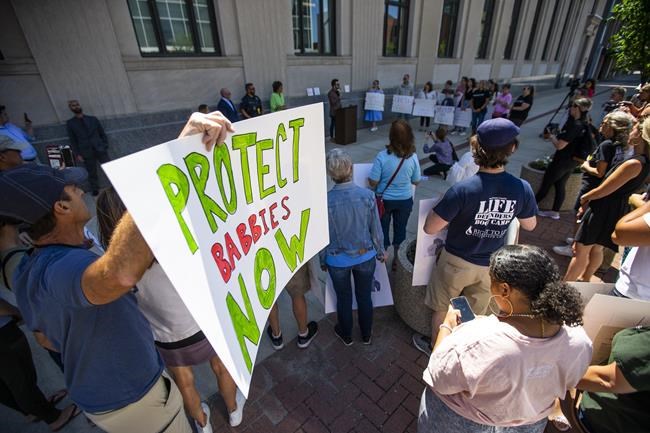
Republican state Sen. Sue Glick, who is sponsoring the bill, said the proposal would not limit access to emergency contraception known as the morning-after pill or limit doctors from treating miscarriages or ectopic pregnancies.
The bill would prohibit abortions from the time an egg is implanted in a woman’s uterus.
“Being pro-life is not about criminalizing women,” Glick said. “It’s about preserving the dignity of life and helping mothers bring new happy, healthy babies in the world.”
Planned Parenthood’s Indiana affiliate criticized the bill, saying in a news release that “a complete ban on abortion is on its way to Indiana.”
“Even the bill’s limited exemptions would leave providers risking investigations, and even criminalization, making them exceptions in name only,” said the organization, which operates four abortion clinics in the state.
Ohio’s so-called fetal heartbeat law, which bans abortions after cardiac activity can be detected — typically in around the sixth week of pregnancy — led the 10-year-old rape victim to go to Indiana to get a medication-induced abortion on June 30, according to the girl’s doctor.
Indiana Republicans have pushed through numerous anti-abortion laws over the past decade and the vast majority signed a letter in March supporting a special session to further tighten those laws. But legislative leaders and Republican Gov. Eric Holcomb had been tightlipped since the Supreme Court decision over whether they would push for a full abortion ban or allow exceptions.
The proposal unveiled Wednesday faces at least a couple of weeks of debate. Republican House Speaker Todd Huston didn’t endorse the bill, saying in a statement that, “Our caucus will take time to review and consider the details of the Senate bill, and continue to listen to thoughts and input from constituents across the state.”
Current Indiana law generally prohibits abortions after the 20th week of pregnancy and tightly restricts it after the 13th week. Nearly 99% of abortions in the state last year took place at 13 weeks or earlier, according to a state Health Department report.
Elsewhere Wednesday, the 11th U.S. Circuit Court of Appeals reversed a lower court and said Georgia’s restrictive 2019 abortion law should be allowed to take effect. The law bans most abortions once a “detectable human heartbeat” is present, though it does include some limited exceptions.
The appeals court also rejected arguments that a “personhood” provision in the law is unconstitutionally vague. The provision grants a fetus the same legal rights that people have after they’re born.
In Michigan, meanwhile, Democratic Gov. Gretchen Whitmer on Wednesday vetoed portions of a state budget proposal that would have sent nearly $20 million in state funding to anti-abortion causes, including groups that run “pregnancy resource centers” focused on persuading pregnant women to give birth.
Before Indiana lawmakers announced their proposal, the leader of the state’s most prominent anti-abortion group told reporters that the group would pressure legislators to advance a bill “that affirms the value of all life including unborn children” while not taking questions on whether any exceptions would be acceptable.
Indiana Right to Life President Mike Fichter said the vast majority of Indiana lawmakers have “campaigned as pro-life, they’ve run multiple election cycles as being pro-life.”
“This is not the time when legislators should be drafting legislation that would appear that Roe versus Wade is still in place,” Fichter said. “Roe is no longer in place. The Roe shield is no longer there.”
The state’s debate comes as an Indiana doctor has been at the center of a political fracas after speaking out about the 10-year-old Ohio rape victim.

A 27-year-old man was charged in Columbus, Ohio, last week with raping the girl, confirming the existence of a case that was initially met with skepticism by some media outlets and Republican politicians. The pushback grew after Democratic President Joe Biden expressed sympathy for the girl during the signing of an executive order aimed at protecting some abortion access.
Indiana Republicans have passed several laws on social issues in recent years that made headlines. In May, they overrode a veto by Holcomb of a bill that banned transgender women and girls from participating in school sports that match their gender identity.
That came seven years after Indiana faced a national uproar over a religious objections law signed by then-Gov. Mike Pence that opponents maintained could be used to discriminate against gays and lesbians. The Republican-dominated Legislature quickly made revisions blocking its use as a legal defense for refusing to provide services and preventing the law from overriding local ordinances with LGBTQ protections.
___
Associated Press writer Kate Brumback in Atlanta and AP/Report for America writer Joey Cappelletti in Lansing, Michigan, contributed to this report.