WEATHER ALERT

Food prices soar to record levels on Ukraine war disruptions

Advertisement

Advertise with us

ROME (AP) — Prices for food commodities like grains and vegetable oils reached their highest levels ever last month largely because of Russia's war in Ukraine and the “massive supply disruptions” it is causing, threatening millions of people in Africa, the Middle East and elsewhere with hunger and malnourishment, the United Nations said Friday.

Read this article for free:


By clicking the button above, an account will be created and you will begin to receive some of our recommended newsletters. You may opt out of any newsletter by visiting your Email and Communication Preferences page or by clicking "unsubscribe" at the bottom of any email.

or

Already have an account? Log in here »

To continue reading, please subscribe:

Digital Subscription

One year of digital access for only $1.44 a week*

  • Enjoy unlimited reading on winnipegfreepress.com
  • Read the E-Edition, our digital replica newspaper
  • Access News Break, our award-winning app
  • Play interactive puzzles

*Billed as $5.77 plus GST every four weeks. After 52 weeks, price increases to the regular rate of $19.95 plus GST every four weeks. Offer available to new and qualified returning subscribers only. Cancel any time.

To continue reading, please subscribe:

Add Free Press access to your Brandon Sun subscription for only an additional

$1 for the first 4 weeks*

  • Enjoy unlimited reading on winnipegfreepress.com
  • Read the E-Edition, our digital replica newspaper
  • Access News Break, our award-winning app
  • Play interactive puzzles
Start now

*Your next Brandon Sun subscription payment will increase by $1.00 and you will be charged $17.95 plus GST for four weeks. After four weeks, your payment will increase to $24.95 plus GST every four weeks.

Hey there, time traveller!
This article was published 08/04/2022 (1669 days ago), so information in it may no longer be current.

ROME (AP) — Prices for food commodities like grains and vegetable oils reached their highest levels ever last month largely because of Russia’s war in Ukraine and the “massive supply disruptions” it is causing, threatening millions of people in Africa, the Middle East and elsewhere with hunger and malnourishment, the United Nations said Friday.

The U.N. Food and Agriculture Organization said its Food Price Index, which tracks monthly changes in international prices for a basket of commodities, averaged 159.3 points last month, up 12.6% from February. As it is, the February index was the highest level since its inception in 1990.

FAO said the war in Ukraine was largely responsible for the 17.1% rise in the price of grains, including wheat and others like oats, barley and corn. Together, Russia and Ukraine account for around 30% and 20% of global wheat and corn exports, respectively.
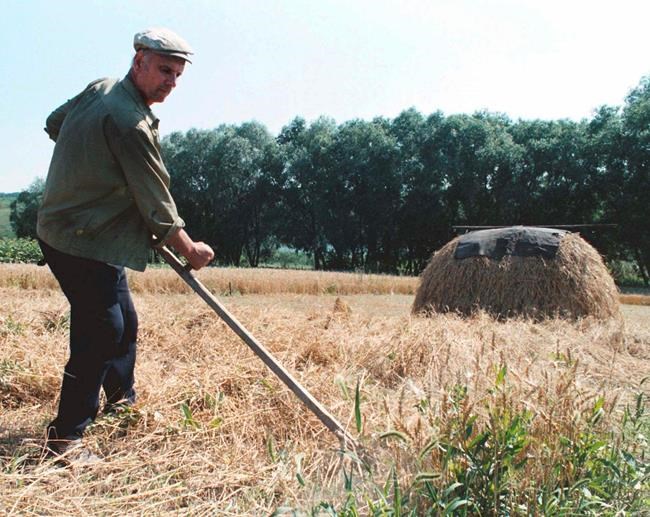
FILE--A private Ukrainian farmer Dmytro Hnatkevitch harvests wheat crop on his farm in the village of Grygorovka, 110 km south of Kiev, in August, 1996. Prices for food commodities like grains and vegetable oils reached their highest levels ever last month because of Russia's war in Ukraine and the “massive supply disruptions” it is causing, the United Nations said Friday, April 8, 2022. (AP Photo/Efrem Lukatsky)

While predictable given February’s steep rise, “this is really remarkable,” said Josef Schmidhuber, deputy director of FAO’s markets and trade division. “Clearly, these very high prices for food require urgent action.”

The biggest price increases were for vegetable oils: that price index rose 23.2%, driven by higher quotations for sunflower seed oil that is used for cooking. Ukraine is the world’s leading exporter of sunflower oil, and Russia is No. 2.

“There is, of course, a massive supply disruption, and that massive supply disruption from the Black Sea region has fueled prices for vegetable oil,” Schmidhuber told reporters in Geneva.

He said he couldn’t calculate how much the war was to blame for the record food prices, noting that poor weather conditions in the United States and China also were blamed for crop concerns. But he said “logistical factors” were playing a big role.

“Essentially, there are no exports through the Black Sea, and exports through the Baltics is practically also coming to an end,” he said.

Soaring food prices and disruption to supplies coming from Russia and Ukraine have threatened food shortages in countries in the Middle East, Africa and parts of Asia where many people already were not getting enough to eat.

Those nations rely on affordable supplies of wheat and other grains from the Black Sea region to feed millions of people who subsist on subsidized bread and bargain noodles, and they now face the possibility of further political instability.

Other large grain producers like the United States, Canada, France, Australia and Argentina are being closely watched to see if they can quickly ramp up production to fill in the gaps, but farmers face issues like climbing fuel and fertilizer costs exacerbated by the war, drought and supply chain disruptions.

In the Sahel region of Central and West Africa, the disruptions from the war have added to an already precarious food situation caused by COVID-19, conflicts, poor weather and other structural problems, said Sib Ollo, senior researcher for the World Food Program for West and Central Africa in Dakar, Senegal.

“There is a sharp deterioration of the food and nutrition security in the region,” he told reporters, saying 6 million children are malnourished and nearly 16 million people in urban areas are at risk of food insecurity.

Farmers, he said, were particularly worried that they would not be able to access fertilizers produced in the Black Sea region. Russia is a leading global exporter.

“The cost of fertilizers has increased by almost 30% in many places of this region due to the supply disruption that we see provoked by a crisis in Ukraine,” he said.

The World Food Program has appealed for $777 million to meet the needs of 22 million people in the Sahel region and Nigeria over six months, he said.

To address the needs of food-importing countries, the FAO was developing a proposal for a mechanism to alleviate the import costs for the poorest countries, Schmidhuber said. The proposal calls for eligible countries to commit to added investments in their own agricultural productivity to obtain import credits to help soften the blow.

Report Error Submit a Tip

More Stories

Killer pleads guilty in three-year-old daughter’s fatal stabbing

Dean Pritchard 4 minute read Preview

Killer pleads guilty in three-year-old daughter’s fatal stabbing

Dean Pritchard 4 minute read Thursday, May. 26, 2022

A Winnipeg man has pleaded guilty to second-degree murder in the shocking stabbing death of his three-year-old daughter.

Frank Nausigimana, 29, entered his plea before Queen’s Bench Justice Joan McKelvey during a brief hearing Thursday morning.

Asked if he understood he was waiving his right to a trial, Nausigimana, through an American Sign Language interpreter, told McKelvey: “ Yes, I accept the punishment and I am following the law of God.”

“I’ve decided that I am going to pray,” Nausigimana said. “I admit I am guilty.”

Read
Thursday, May. 26, 2022

Expect a reasonable approach to keep Manitoba’s minimum wage out of cellar

Tom Brodbeck 5 minute read Preview

Expect a reasonable approach to keep Manitoba’s minimum wage out of cellar

Tom Brodbeck 5 minute read Tuesday, May. 31, 2022

The devil will be in the details when it comes to how much the Stefanson government will increase the minimum wage in 2022 under proposed legislation that’s expected to become law this week.

My prediction: government will boost the base wage by at least $1.10 an hour this year.

As expected, the Stefanson government plans to alter its inflation-based formula for setting the minimum wage, which now stands at $11.95 an hour. Normally, the base wage is indexed to the previous year’s rate of inflation. That’s sound policy during normal times. However, with inflation growing at rates not seen in more than 30 years, an immediate adjustment is required to ensure minimum-wage earners don’t lose purchasing power.

Conservative governments in Saskatchewan, Ontario and New Brunswick have all announced significant increases to their base wages in 2022, putting pressure on the Stefanson government to follow suit. Failure to do so would see Manitoba’s minimum wage (previously scheduled to rise 40 cents an hour to $12.35 on Oct. 1) rank lowest in the country.

Read
Tuesday, May. 31, 2022

The Leaf at Assiniboine Park welcomes first visitors

Ryan Thorpe 5 minute read Preview

The Leaf at Assiniboine Park welcomes first visitors

Ryan Thorpe 5 minute read Saturday, Dec. 3, 2022

The parking lot was full and Winnipeggers came out in droves Saturday morning for the public opening of The Leaf, the new indoor horticultural attraction at Assiniboine Park.

Read
Saturday, Dec. 3, 2022

Manitoba’s First Nations and the Indian Act

Hersh Seth 6 minute read 2:00 AM EST

On Monday in Ottawa, Manitoba Premier Wab Kinew called for the Indian Act to be abolished. Prime Minister Mark Carney said he was open to working with First Nations to reform or repeal this law, calling it racist.

The act was created in 1876 and still controls Indian status, reserve lands and band governance. It’s understandable why many people want a better relationship.

But repealing a law and building a new relationship are not the same. What would replace the act’s protections? Who decides? How do governments ensure removing federal authority gives First Nations power while the Crown keeps its promises?

Manitoba has faced these questions before. In 1971, First Nations created a document called Wahbung: Our Tomorrows, in response to then-prime minister Pierre Trudeau’s white paper on assimilation. More than 45 years later, elders and knowledge keepers met at Turtle Lodge, north of Winnipeg, to continue the conversation. Manitobans Dave Courchene Sr. and his son, Dave Courchene Jr., are generational links to the broader movement, and their story should be part of this discussion.

Comfort, kindness, acceptance and grandpa’s store

Deborah Schnitzer 5 minute read 2:00 AM EST

My grandfather, Ben W. Kert, had a women’s dress shop along Queen Street in Sault Ste. Marie where a number of Jewish men, many of them “Greenies” from the old country, owned and operated women’s haberdasheries with variable success.

Ben had come from Quebec via Northern Manitoba and Fort Frances, a singular man whose French was as good as his English and whose great heart filled my childhood with glory.

Unlike the other Jewish store owners, Ben W. was born in Trois-Rivières, the only male child who survived with five or six sisters born ahead of him.

Legend has it that my grandfather’s arrival and survival were celebrated with the nickname Sonny. When he left home at 15 (rumour claims his stepmother threw him out) and arrived in Montreal, his first employer would not accept the nickname, so my grandfather invented Ben W. on the spot. The W. never stood for anything. When he died, my mother discovered that his first name was actually Harry.

Bob Saget, beloved TV dad of 'Full House,' dead at 65

Lynn Elber, The Associated Press 6 minute read Preview

Bob Saget, beloved TV dad of 'Full House,' dead at 65

Lynn Elber, The Associated Press 6 minute read Monday, Jan. 10, 2022

LOS ANGELES (AP) — Bob Saget, the actor-comedian known for his role as beloved single dad Danny Tanner on the sitcom “Full House” and as the wisecracking host of “America’s Funniest Home Videos,” died while on a stand-up tour. He was 65.

Deputies in Orange County, Florida, were called Sunday about an “unresponsive man” in a hotel room at the Ritz-Carlton in Orlando and found Saget dead, according to a sheriff’s statement on Twitter. Detectives found “no signs of foul play or drug use in this case.”

Saget was in Florida as part of his “I Don't Do Negative Comedy Tour.” After warm audience receptions to his gigs Friday in Orlando and Saturday in the Ponte Vedra Beach resort area, he celebrated online.

“I’m back in comedy like I was when I was 26. I guess I’m finding my new voice and loving every moment of it,” he posted Saturday on Instagram.

Read
Monday, Jan. 10, 2022