WEATHER ALERT

Canada’s premiers disappointed in lack of federal funds for struggling health systems

Advertisement

Advertise with us

OTTAWA - Canada's premiers say they're disappointed the federal government didn't put forward a sustainable plan to financially shore up the country's ailing health systems in its newly tabled budget.

Read this article for free:


By clicking the button above, an account will be created and you will begin to receive some of our recommended newsletters. You may opt out of any newsletter by visiting your Email and Communication Preferences page or by clicking "unsubscribe" at the bottom of any email.

or

Already have an account? Log in here »

To continue reading, please subscribe:

Digital Subscription

One year of digital access for only $1.44 a week*

  • Enjoy unlimited reading on winnipegfreepress.com
  • Read the E-Edition, our digital replica newspaper
  • Access News Break, our award-winning app
  • Play interactive puzzles

*Billed as $5.77 plus GST every four weeks. After 52 weeks, price increases to the regular rate of $19.95 plus GST every four weeks. Offer available to new and qualified returning subscribers only. Cancel any time.

To continue reading, please subscribe:

Add Free Press access to your Brandon Sun subscription for only an additional

$1 for the first 4 weeks*

  • Enjoy unlimited reading on winnipegfreepress.com
  • Read the E-Edition, our digital replica newspaper
  • Access News Break, our award-winning app
  • Play interactive puzzles
Start now

*Your next Brandon Sun subscription payment will increase by $1.00 and you will be charged $17.95 plus GST for four weeks. After four weeks, your payment will increase to $24.95 plus GST every four weeks.

Hey there, time traveller!
This article was published 08/04/2022 (1669 days ago), so information in it may no longer be current.

OTTAWA – Canada’s premiers say they’re disappointed the federal government didn’t put forward a sustainable plan to financially shore up the country’s ailing health systems in its newly tabled budget.

Premiers have been calling for the health minister to negotiate a new deal for how much the federal government will pay into health care in Canada, but there was no money put forward in the budget.

“The federal budget missed an opportunity to address the major health care challenges facing Canadians,” said British Columbia Premier John Horgan, chair of the Council of the Federation, in a statement Friday.
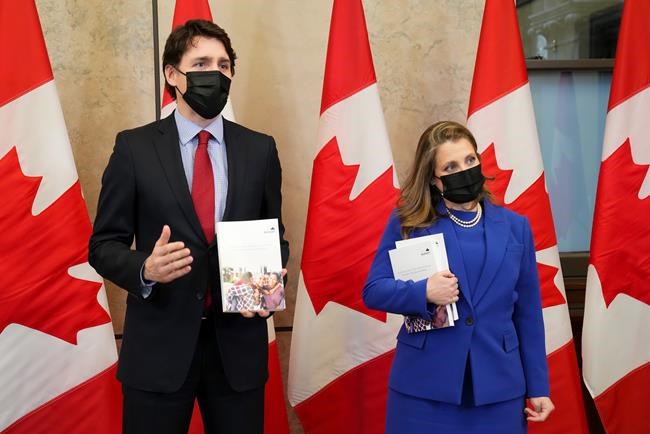
Finance Minister and Deputy Prime Minister Chrystia Freeland and Prime Minister Justin Trudeau speak with members of the media before the release of the federal budget, on Parliament Hill, in Ottawa, Thursday, April 7, 2022. Canada's premiers say they're disappointed the federal government didn't put forward a sustainable plan to financially shore up the country's ailing health systems in its newly tabled budget. THE CANADIAN PRESS/Sean Kilpatrick

“Increased, predictable and sustainable federal health funding would make a real difference in people’s lives. Unfortunately, the federal budget failed to deliver on this priority.”

Provinces have clamoured for the federal government to increase its share of health spending, with an immediate increase of about $28 billion.

They also want minimum funding increases of five per cent annually, arguing the current three per cent means transfers don’t keep pace with yearly cost increases.

Currently, federal contributions to provincial health systems grow in line with a three-year moving average of nominal gross domestic product. Thanks to a sunnier economic outlook than expected, the transfers will rise by about 4.8 per cent.

The government also recently pledged $2 billion in one-time funding to help health systems work through the massive surgical backlogs that accumulated during the pandemic.

Those short-term gains aren’t enough to make sustainable changes though, the premiers argue.

“One-time or short-term targeted spending cannot address the long-term challenges facing Canadians’ health care systems,” the premiers’ statement read.

Prime Minister Justin Trudeau says he knows the federal government needs to invest structurally in health care, but he wants to make sure it gets the best results.

“We need to be there as partners, so we’re having preliminary discussions with the provinces about how we can move forward,” Trudeau said in French in his first press conference since the budget was tabled.

Trudeau has said in the past he wants to get through the COVID-19 pandemic before renegotiating the federal government’s share of health spending.

Organizations who represent health workers say they were also left wanting after the federal budget. They say the budget had no funds or plan to address serious worker burnout or the precarious state of the provincial systems as the pandemic wears on.

They’re now pinning their hopes to the premiers’ negotiations with the federal government.

HealthCareCan, an association of health-care organizations and Canadian hospitals, urged the government to meet with provincial and territorial leaders.

“We have heard repeatedly that movement towards the future of Canada’s health care system would occur once the pandemic passed,” said president Paul-Émile Cloutier in a statement.

“Canadians can no longer wait for the political leadership to build a modern health-care system that provides timely access to high-quality care, regardless of where you are in the country. They want and deserve action now.”

The Canadian Federation of Nurses Unions says it will stand with provinces in demanding an increased investment from the Liberals.

“The federal government has a legal obligation under the Canada Health Act to make sure the provinces and territories have enough resources to provide every Canadian health-care service regardless of where we live,” said president Linda Silas.

The budget states that the Liberals want to make sure that any extra federal funds will improve the system.

Canada spends more of its gross domestic product on health than the Organization for Economic Co-operation and Development average, but is ranked behind peer countries in terms of outcomes.

Future negotiations will focus on improving outcomes, the budget stated, suggesting that more money would come with conditions like improved access to primary and mental health care.

This report by The Canadian Press was first published April 8, 2022.

Report Error Submit a Tip

More Stories

Third fire hits troubled Manitoba Housing apartment block

Malak Abas 4 minute read Preview

Third fire hits troubled Manitoba Housing apartment block

Malak Abas 4 minute read Yesterday at 3:19 PM EST

Residents of a North End Manitoba Housing apartment block with a long history of trouble say they’re shaken after the building was hit with its third fire in eight months Friday night.

An apartment complex at 145 Powers St. was evacuated by firefighters after a fire broke out at around 7:45 p.m.

When longtime resident Sharon Markwell heard the fire alarm go off, she chalked it up to a false alarm — kids will get into the building and pull the fire alarm around once or twice a month, she said — until smoke began billowing into the hallway of her fifth-floor apartment.

“Once I realized that I could smell smoke very, very strongly, and the smoke was seeping into my room, into my apartment, I said to myself, ‘This is no false alarm. This is the real thing,’” Markwell, 64, told the Free Press Sunday.

Read
Yesterday at 3:19 PM EST

Deluxe apartment tower taking shape in Tuxedo

Ben Waldman 4 minute read Preview

Deluxe apartment tower taking shape in Tuxedo

Ben Waldman 4 minute read Monday, Aug. 22, 2022

The owners of a shopping strip in the city’s wealthiest neighbourhood have identified the site of a longtime gas station on Corydon Avenue as an untapped residential resource.

Read
Monday, Aug. 22, 2022

China’s electric car sales grow in 2024, as sales of gasoline cars plunge

Ken Moritsugu And Zen Soo, The Associated Press 2 minute read Monday, Jan. 13, 2025

BEIJING (AP) — Sales of all types of electric vehicles rose more than 40% in China last year, while those of gasoline-powered automobiles plunged, industry data showed Monday.

A total of 31.4 million vehicles were sold last year in the world's biggest market by sales, up 4.5% compared from a year earlier, the China Association of Automobile Manufacturers reported. Growth in sales outpaced production, which rose 3.7%.

China's exports of passenger cars jumped almost 20% in 2024, to almost 5 million vehicles. Out of that, exports of what China calls “new energy vehicles,” including battery EVs, fuel-cell cars and plug-in hybrids -- electric vehicles with a small gasoline-powered engine to back up the batteries -- reached 1.28 million. That was a 6.7% increase from 2023.

Domestically, sales of passenger cars rose 13.6% in December, driven in part by rebates for trade-ins, raising sales of all passenger cars in China by 3.1% for the year, to 22.6 million.

Comfort, kindness, acceptance and grandpa’s store

Deborah Schnitzer 5 minute read 2:00 AM EST

My grandfather, Ben W. Kert, had a women’s dress shop along Queen Street in Sault Ste. Marie where a number of Jewish men, many of them “Greenies” from the old country, owned and operated women’s haberdasheries with variable success.

Ben had come from Quebec via Northern Manitoba and Fort Frances, a singular man whose French was as good as his English and whose great heart filled my childhood with glory.

Unlike the other Jewish store owners, Ben W. was born in Trois-Rivières, the only male child who survived with five or six sisters born ahead of him.

Legend has it that my grandfather’s arrival and survival were celebrated with the nickname Sonny. When he left home at 15 (rumour claims his stepmother threw him out) and arrived in Montreal, his first employer would not accept the nickname, so my grandfather invented Ben W. on the spot. The W. never stood for anything. When he died, my mother discovered that his first name was actually Harry.

Cottage communities constrained by COVID

Cassandra Szklarski, The Canadian Press 6 minute read Preview

Cottage communities constrained by COVID

Cassandra Szklarski, The Canadian Press 6 minute read Friday, May. 1, 2020

TORONTO - A springtime trickle of Manitobans entering Ontario to visit their lakeside cottages alarmed Kenora Mayor Daniel Reynard a month ago.

Now that Manitoba is poised to restart some non-essential services Monday, Reynard fears an even bigger influx — this time sun-seekers expecting amenities that are simply unavailable.

The message in Ontario is still one of restraint: Avoid non-essential travel, and do not visit your cottage. Provincial travel is not prohibited, but vacationers and day-trippers will find little to do.

Restaurants are closed, as are all beaches, golf courses, parks, trails and marinas.

Read
Friday, May. 1, 2020

Russian Olympic biathlon champion loses Sochi doping case

Graham Dunbar, The Associated Press 5 minute read Preview

Russian Olympic biathlon champion loses Sochi doping case

Graham Dunbar, The Associated Press 5 minute read Thursday, Sep. 24, 2020

GENEVA - Two-time Olympic biathlon champion Olga Zaitseva lost her appeal Thursday against disqualification from the 2014 Sochi Olympics for her part in Russia’s state-backed doping program.

The Court of Arbitration for Sport said its judges upheld the International Olympic Committee’s disciplinary ruling of 2017, which used evidence against Zaitseva from Russian whistleblower Grigory Rodchenkov.

Zaitseva’s disqualification from all her Sochi events strips Russia of its silver medal in the women’s biathlon 4x6-kilometre relay. She won — and will retain — her gold medals from the same relay event at the two previous Winter Games in 2006 and 2010.

Her lawyer in Switzerland, Yvan Henzer, said Zaitseva would appeal the CAS ruling at Switzerland’s supreme court. The federal court typically only intervenes if legal process was abused.

Read
Thursday, Sep. 24, 2020