Ukraine refugees encouraged to find jobs as war exodus slows

Advertisement

Advertise with us

WARSAW, Poland (AP) — As the number of people fleeing Ukraine slows, authorities in Poland and other neighboring nations are encouraging refugees from the war to find jobs, especially in health care and education.

Read this article for free:


By clicking the button above, an account will be created and you will begin to receive some of our recommended newsletters. You may opt out of any newsletter by visiting your Email and Communication Preferences page or by clicking "unsubscribe" at the bottom of any email.

or

Already have an account? Log in here »

To continue reading, please subscribe:

Digital Subscription

One year of digital access for only $1.44 a week*

  • Enjoy unlimited reading on winnipegfreepress.com
  • Read the E-Edition, our digital replica newspaper
  • Access News Break, our award-winning app
  • Play interactive puzzles

*Billed as $5.77 plus GST every four weeks. After 52 weeks, price increases to the regular rate of $19.95 plus GST every four weeks. Offer available to new and qualified returning subscribers only. Cancel any time.

To continue reading, please subscribe:

Add Free Press access to your Brandon Sun subscription for only an additional

$1 for the first 4 weeks*

  • Enjoy unlimited reading on winnipegfreepress.com
  • Read the E-Edition, our digital replica newspaper
  • Access News Break, our award-winning app
  • Play interactive puzzles
Start now

*Your next Brandon Sun subscription payment will increase by $1.00 and you will be charged $17.95 plus GST for four weeks. After four weeks, your payment will increase to $24.95 plus GST every four weeks.

Hey there, time traveller!
This article was published 31/03/2022 (1674 days ago), so information in it may no longer be current.

WARSAW, Poland (AP) — As the number of people fleeing Ukraine slows, authorities in Poland and other neighboring nations are encouraging refugees from the war to find jobs, especially in health care and education.

The U.N. refugee agency UNHCR reported Thursday that the daily number of arrivals recorded by the countries that border Ukraine dropped below 40,000 on Wednesday, the fewest s ince Russian troops invaded five weeks ago.

Poland’s Border Guard registered more than half of the new arrivals, maintaining a pattern seen since the start of the war. Of the conflict’s more than 4 million refugees, almost 2.4 million went to Poland, according to the country’s border agency. It’s Europe’s worst refugee crisis since World War II.
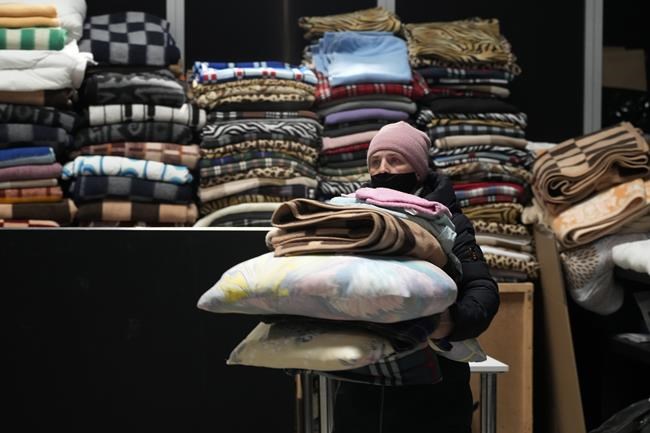
A Ukrainian refugee carries pillows and blankets at a refugee center in Nadarzyn, near Warsaw, Poland, Thursday, March 31, 2022. The talks between Ukraine and Russia will resume on Friday as NATO Secretary-General says Russia does not appear to be scaling back its military operations in Ukraine but is instead redeploying forces to the eastern Donbas region. (AP Photo/Czarek Sokolowski)

Humanitarian organizations and other observers have attributed the slowing of the Ukrainian exodus in recent days to several possible factors, including residents of surrounded and besieged cities having no way to safely evacuate. Others may be reluctant to leave their homes and hoping to wait out the hostilities, observers say.

A spokesperson for Poland’s Border Guard, Anna Michalska, said the numbers could pick up again if Russian attacks continue.

Recent legislation passed in Poland allows refugees from Ukraine to obtain ID numbers that entitle them to free medical care, education, social benefits and the right to work for 18 months.

Many Poles are putting up refugees in their homes or volunteering in civic groups that bring all sorts of assistance.

Refugees in Warsaw have submitted about 700 applications and some 100 have been hired for jobs in the Polish capital’s medical centers and schools, according to city officials.

To boost the employment drive, Mayor Rafal Trzaskowski and Deputy Mayor Renata Kaznowska met Thursday with the director of the Bielanski Hospital and some Ukrainian and Polish staff members.

“Our guests are full of fortitude, they want to start to help us right away, they want to find jobs,” Trzaskowski told a news conference.

Kaznowska said employment and professional activity were the best way to integrate the adults who have fled Ukraine into Polish society.

Educators are also needed to help thousands of refugee children adjust to their new school environment, where lessons are taught in Polish and where the curriculum is largely different from the one in Ukraine. Adjusting the school system will cost over 440,000 zlotys ($105,000) in Warsaw alone, city authorities said.

Two nurses who are in the hiring process, speaking in Ukrainian mixed with Polish, said they appreciated the chance to continue their careers.

Olena Halych had to fight back tears as she spoke of fleeing home near shelled Bucha “to save my children.”

“I want to truly thank people in Poland for offering us shelter,” Halych said in Ukrainian. “I have found a job at the Bielanski Hospital, I want to really thank you for that.”

Hospital director Dorota Galczynska-Zych said the new recruits have provided valuable skills, and added that language has not been a barrier.

Some 570,000 refugees have reached Warsaw, a city of some 1.8 million, and some 300,000 remain in the capital for now, Trzaskowski said.

In Romania, which has received over 608,000 refugees, 35-year-old Uliana Polyakova from Odessa was busy Thursday registering at the Brasov city refugee center’s integration office that helps find accommodation, jobs and access to social assistance.

“Some people told me to arrive here at the center … in case we need medicine or something else,” she said, as her 7-year-old son enjoyed some screen-time nearby. “(A) Romanian family invited us to live with them. I did not expect that Romania is so kind to Ukrainians.”

“We’re not here because we want to leave Ukraine, me and my husband want to live with our relatives in Odessa,” she said. “I hope that the war is over in two weeks, one month, and we will go home.”

___

Stephen McGrath in Brasov, Romania, contributed to this report.

___

Follow all of AP’s coverage of the war in Ukraine at https://apnews.com/hub/russia-ukraine

Report Error Submit a Tip

More Stories

One-on-one Journalism Training

0 minute read Wednesday, Jun. 18, 2025

Transit driver killed in knife attack on U of M campus

8 minute read Preview

Transit driver killed in knife attack on U of M campus

8 minute read Tuesday, Feb. 14, 2017

A Winnipeg Transit driver was killed early this morning after he was stabbed by the only passenger on his bus at the University of Manitoba campus.

Irvine Jubal Fraser, 58, was rushed to hospital in critical condition but later died, police said.

The attack occurred at about 2 a.m. in the area of Dafoe Road West and Gillson Street.

Witnesses pointed officers led by the canine unit in the direction of the Red River, where a 22-year-old suspect trying to cross to the St. Vital side was arrested and taken into custody.

Read
Tuesday, Feb. 14, 2017

Just say no (to deficits during good economic times)

Tom Brodbeck 5 minute read Preview

Just say no (to deficits during good economic times)

Tom Brodbeck 5 minute read Wednesday, Oct. 2, 2019

When a political party pledges to run small, “manageable” deficits if elected, it almost always means it will go deeper into the red if it wins government.

It’s human nature.

After all, as a government, if you get the blessing of the public to spend beyond your means, what’s a few billion more a year in overspending?

The problem is, it doesn’t usually end there. When those same politicians seek re-election, they often want permission to post even larger deficits. In some cases, they’ve abandoned the idea of balancing the books altogether, arguing perpetual deficit financing is acceptable, as long as the debt doesn’t exceed a certain percentage of the economy.

Read
Wednesday, Oct. 2, 2019

Health officials ponder next steps as COVID cases surge in Southern Health region

Katie May 5 minute read Preview

Health officials ponder next steps as COVID cases surge in Southern Health region

Katie May 5 minute read Wednesday, Nov. 3, 2021

Public-health officials say they're trying to avoid ordering another lockdown in southern Manitoba, where COVID-19 infection rates are surging.

Deputy chief provincial public health officer Dr. Jazz Atwal told a news conference Wednesday he doesn't anticipate more lockdowns and suggested he will prioritize keeping schools open when considering future restrictions.

But he couldn't say what the next step will be in an area of the province where hospitalizations among unvaccinated residents are on the rise.

Average daily case counts in the southern part of the province are higher now than they were before lockdown measures went into effect last November, and officials are still figuring out what to do.

Read
Wednesday, Nov. 3, 2021

Brian Bowman wins mayoral battle

Aldo Santin and Mary Agnes Welch 6 minute read Preview

Brian Bowman wins mayoral battle

Aldo Santin and Mary Agnes Welch 6 minute read Thursday, Oct. 23, 2014

In the end, it wasn’t even close.

A mayoral race that was supposed to be a head-to-head battle between privacy lawyer Brian Bowman and former NDP MP and MLA Judy Wasylycia-Leis turned into a rout on election night. Wasylycia-Leis, the experienced politician, had held what looked like an unassailable lead for months, but Bowman, the outsider who promised Winnipeggers a better, prosperous future, chipped doggedly away at it.

“I’m excited to tell you that positive change is coming to city hall,” Bowman told roaring supporters at the Inn At The Forks after making his way into the small ballroom accompanied by his wife and two young sons.

He said he hadn’t expecting such a landslide victory, but had believed that the campaign was building momentum.

Read
Thursday, Oct. 23, 2014

Building healthier Canadians

Jason M. Sutherland 4 minute read 2:00 AM CDT

Ottawa is betting that billions of taxpayer dollars spent on steel, asphalt and concrete will secure Canada’s economic future and prosperity. Through the $51 billion Build Communities Strong fund, the federal government is paying for roads, bridges, water systems and transit to boost productivity and attract capital from Europe and Asia.

As the shovels hit the ground from Halifax to Vancouver, Canadians should be asking themselves: What good does it do to build a stronger country if we are not building healthier Canadians?

The fund’s $5 billion allocation for health infrastructure is welcome news, as many of our hospitals and long-term care homes across the country are showing severe signs of aging, and modern care centres are much needed. But pouring concrete for new facilities is not the same as building a healthy population.

A ribbon-cutting at a modern hospital does not guarantee you see a family doctor when you need one, keep a rural emergency department open overnight, or shorten the wait for a knee replacement keeping someone off the job or robbing a retiree of independence.