UN: War in Ukraine to hurt poor nations importing grain

Advertisement

Advertise with us

ROME (AP) — Poorer countries in northern Africa, Asia and the Middle East that depend heavily on wheat imports risk suffering significant food insecurity because of Russia's war in Ukraine, and the conflict is poised to drive up already soaring food prices in much of the world, the U.N. food agency warned Friday.

Read this article for free:


By clicking the button above, an account will be created and you will begin to receive some of our recommended newsletters. You may opt out of any newsletter by visiting your Email and Communication Preferences page or by clicking "unsubscribe" at the bottom of any email.

or

Already have an account? Log in here »

To continue reading, please subscribe:

Digital Subscription

One year of digital access for only $1.44 a week*

  • Enjoy unlimited reading on winnipegfreepress.com
  • Read the E-Edition, our digital replica newspaper
  • Access News Break, our award-winning app
  • Play interactive puzzles

*Billed as $5.77 plus GST every four weeks. After 52 weeks, price increases to the regular rate of $19.95 plus GST every four weeks. Offer available to new and qualified returning subscribers only. Cancel any time.

To continue reading, please subscribe:

Add Free Press access to your Brandon Sun subscription for only an additional

$1 for the first 4 weeks*

  • Enjoy unlimited reading on winnipegfreepress.com
  • Read the E-Edition, our digital replica newspaper
  • Access News Break, our award-winning app
  • Play interactive puzzles
Start now

*Your next Brandon Sun subscription payment will increase by $1.00 and you will be charged $17.95 plus GST for four weeks. After four weeks, your payment will increase to $24.95 plus GST every four weeks.

Hey there, time traveller!
This article was published 11/03/2022 (1695 days ago), so information in it may no longer be current.

ROME (AP) — Poorer countries in northern Africa, Asia and the Middle East that depend heavily on wheat imports risk suffering significant food insecurity because of Russia’s war in Ukraine, and the conflict is poised to drive up already soaring food prices in much of the world, the U.N. food agency warned Friday.

Ukraine and Russia, which is under heavy economic sanctions for invading its neighbor two weeks ago, account for one-third of global grain exports.

With the conflict’s intensity and duration uncertain, “the likely disruptions to agricultural activities of these two major exporters of staple commodities could seriously escalate food insecurity globally, when international food and input prices are already high and vulnerable,” said Qu Dongyu, director-general of the Rome-based Food and Agriculture Organization.
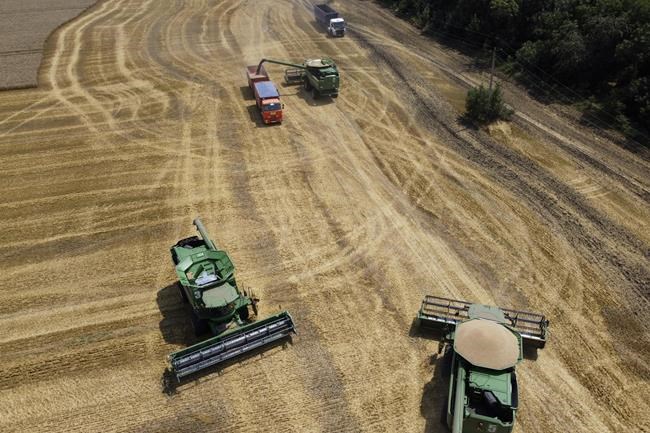
FILE - Farmers harvest with their combines in a wheat field near the village Tbilisskaya, Russia, July 21, 2021. The Russian tanks and missiles besieging Ukraine also are threatening the food supply and livelihoods of people in Europe, Africa and Asia who rely on the vast, fertile farmlands known as the “breadbasket of the world.” Russia and Ukraine combine for about a third of the world’s wheat and barley exports and provide large amounts of corn and cooking oils. (AP Photo/Vitaly Timkiv, File)

The U.N. agency, known as FAO, also noted that Russia is the lead producer of fertilizer, and a key fertilizer component — urea — has jumped more than threefold in price in the last 12 months.

There’s also the uncertainty over whether Ukraine’s wheat ready in June can be harvested as “massive population displacement has reduced the number of agricultural laborers and workers. Accessing agricultural fields would be difficult,” Qu noted.

Ukraine’s ports on the Black Sea are shuttered, and its government this week banned the export of wheat, oats, millet, buckwheat and some other food products to prevent a crisis in its own country.

The ban does not apply to its major global exports of corn and sunflower oil. It and Russia together supply 52% of the world’s sunflower oil exports. They also account for 19% of the world’s barley supply, 14% of wheat and 4% of corn.

“It is still unclear whether (other) exporters would be able to fill this gap,” Qu said, warning that wheat inventories are already running low in Canada.

The United States, Argentina and other wheat-producing nations are likely to limit exports as governments seek to ensure domestic supply, he said.

Adding to the pressure, countries that depend on Russian and Ukrainian wheat are likely to increase imports. Egypt, Turkey, Bangladesh and Iran buy 60% of their wheat from Russia and Ukraine. Also heavily reliant are Lebanon, Tunisia, Yemen, Libya and Pakistan.

In Libya, where civil war has ground on for years, the latest price increases for food staples have people worried.

Salah Alabar, a 37-year-old father of two, said bread and flour have increased by roughly 40% in his Benghazi neighborhood. Sunflower oil is 25% higher.

“This poses a challenge to families with minimum wages and even the middle-class families as expenses increase across the board,” he said.

The U.N. agency said its simulations suggest that “the global number of undernourished people could increase by 8 to 13 million” in 2022-2023, particularly in Asia, sub-Saharan Africa, the Middle East and North Africa.

Potential for unrest could rise with the prices.
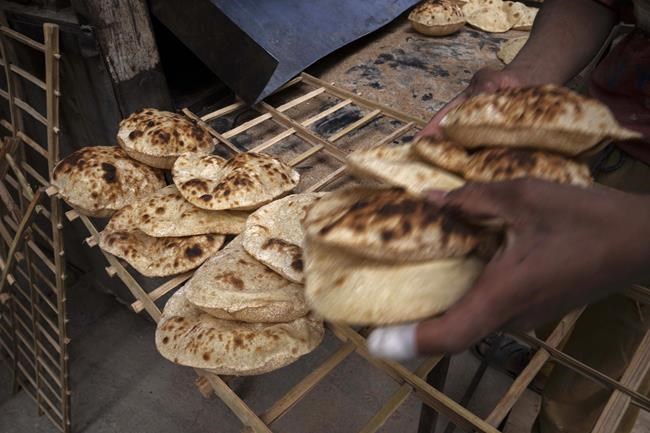
FILE - A worker collects Egyptian traditional 'baladi' flatbread, at a bakery, in el-Sharabia, Shubra district, Cairo, Egypt, Wednesday, March 2, 2022. Ukraine's government banned the export of wheat, oats and other food staples on Wednesday, March 9, 2022 as authorities try to make sure they can feed people while Russia's invasion intensifies.(AP Photo/Nariman El-Mofty, File)

Mohammed Jassim, who owns a small bakery in Baghdad, said there was real concern in Iraq, where dozens of people held demonstrations in the past week over skyrocketing food prices.

“I am a consumer who buys staples for my business, and I have seen an increase of about 20% in the price of sugar and wheat,” he said. “If this keeps up, then I will be forced to raise my prices, and ultimately, the average citizen will be the one to pay for it.”

With shortfalls in grain and sunflower seed exports by Ukraine and Russia, “worryingly, the resulting global supply gap could push up international food and feed prices by 8 to 22% above their already elevated levels,” the FAO’s report warned.

Its figures show food prices reached an all-time high in February.

The COVID-19 pandemic already had a major impact on global food security. Last year, global prices of wheat and barley rose 31%, and rapeseed and sunflower oil prices jumped by more than 60%. Wheat prices have surged more than 50% since a week before the invasion.

In Italy, supermarkets in Tuscany and Sardinia are limiting sales of sunflower seed oil to two containers per customer, Italian state TV said. Spanish supermarkets also are rationing it.

Italian importers of the seed for processing into oil say their supply has already dried up.

___

Associated Press reporters Qassim Abdul-Zahra contributed from Baghdad, Iraq, and Rami Musa contributed from Benghazi, Libya.

Report Error Submit a Tip

More Stories

Regulator urged to force MPI to lower rates, tackle claims costs

Nicole Buffie 4 minute read Preview

Regulator urged to force MPI to lower rates, tackle claims costs

Nicole Buffie 4 minute read Updated: 5:01 PM CDT

A citizen-led coalition has urged the Public Utilities Board to order Manitoba Public Insurance to lower its rates, which it says would force the Crown corporation to tackle rising claims costs.

The Consumers Coalition described MPI as “risk-averse,” at a hearing this week to discuss its application for a rate increase.

“The last three (general rate applications) have demonstrated that the corporation is running out of ideas and tools to mitigate rate increases and are executing a strategic plan grounded in their legacy business model,” said Katrine Dilay, a lawyer for the Public Interest Law Centre who spoke on behalf of the coalition.

Dilay said the coalition believes MPI is riding out the cost pressures and passing them on to ratepayers rather than preparing for the future.

Read
Updated: 5:01 PM CDT

Newspaper websites display fewer stories, more curation

5 minute read Tuesday, Feb. 10, 2026

A city subcommittee was provided with a routine update on the status of an ongoing administrative process Thursday, in accordance with standard reporting procedures.

Transit driver killed in knife attack on U of M campus

8 minute read Preview

Transit driver killed in knife attack on U of M campus

8 minute read Tuesday, Feb. 14, 2017

A Winnipeg Transit driver was killed early this morning after he was stabbed by the only passenger on his bus at the University of Manitoba campus.

Irvine Jubal Fraser, 58, was rushed to hospital in critical condition but later died, police said.

The attack occurred at about 2 a.m. in the area of Dafoe Road West and Gillson Street.

Witnesses pointed officers led by the canine unit in the direction of the Red River, where a 22-year-old suspect trying to cross to the St. Vital side was arrested and taken into custody.

Read
Tuesday, Feb. 14, 2017

Judge halts any construction on housing project across from curling club until he rules on city’s approval

Dean Pritchard 4 minute read Preview

Judge halts any construction on housing project across from curling club until he rules on city’s approval

Dean Pritchard 4 minute read 6:58 PM CDT

A judge has ordered that preliminary construction activities at a hotly contested housing development next door to the Granite Curling Club be “paused” until after he delivers a court ruling that could decide its future.

At a hearing last June, lawyers for the curling club urged King’s Bench Justice Ami Kotler to quash a city bylaw approving the project, set to be built on a parking lot owned by the city but used for decades by the curling club, arguing the decision was rushed and significantly flawed.

Kotler has not yet delivered his decision.

On Friday, curling club lawyer James Mercury told court project developer Granite Project Holding Inc. had secured permits to begin “early works” including excavating and shoring of the site and the installation of piles, starting as early as Monday.

Read
6:58 PM CDT

Ottawa announces $500 million for North End sewage plant upgrade

Joyanne Pursaga 5 minute read Preview

Ottawa announces $500 million for North End sewage plant upgrade

Joyanne Pursaga 5 minute read 5:03 PM CDT

The federal government will provide $500 million to help complete the major upgrade to Winnipeg’s North End sewage treatment plant.

Winnipeg South MP Terry Duguid confirmed the total funding at a news conference at the plant Friday, calling the work critical to Winnipeg’s future.

“The stakes could not be higher. Without expanded wastewater treatment, Winnipeg would run out of capacity to build new homes and accommodate new industries within six years,” said Duguid.

The commitment offers the final funding needed to cover the $1.57-billion third and final phase of the upgrade. The city and province will also pay $500 million each for the work.

Read
5:03 PM CDT

Westman to lose sole medical oncologist

Rylee Gerrard 5 minute read Preview

Westman to lose sole medical oncologist

Rylee Gerrard 5 minute read Updated: 9:26 AM CDT

BRANDON — Western Manitoba is about to lose its only medical oncologist, leaving just 22 in the province — all of whom are in Winnipeg.

Brandon West MLA Wayne Balcaen raised the issue during question period Thursday, saying the departure of Dr. Brady Anderson will be a “major loss” for the region.

After four years working out of the Western Manitoba Cancer Centre in Brandon, Anderson’s last day will be Nov. 13.

“He literally sees hundreds of patients within the Westman area, and now those individuals will have to travel to Winnipeg to get that personal service,” Balcaen said, calling Anderson’s impending departure “catastrophic.”

Read
Updated: 9:26 AM CDT