House of Commons passes Emergencies Act motion after fractious debate
Advertisement
Read this article for free:
or
Already have an account? Log in here »
To continue reading, please subscribe:
Digital Subscription
One year of digital access for only $1.44 a week*
- Enjoy unlimited reading on winnipegfreepress.com
- Read the E-Edition, our digital replica newspaper
- Access News Break, our award-winning app
- Play interactive puzzles
*Billed as $5.77 plus GST every four weeks. After 52 weeks, price increases to the regular rate of $19.95 plus GST every four weeks. Offer available to new and qualified returning subscribers only. Cancel any time.
To continue reading, please subscribe:
Add Free Press access to your Brandon Sun subscription for only an additional
$1 for the first 4 weeks*
- Enjoy unlimited reading on winnipegfreepress.com
- Read the E-Edition, our digital replica newspaper
- Access News Break, our award-winning app
- Play interactive puzzles
*Your next Brandon Sun subscription payment will increase by $1.00 and you will be charged $17.95 plus GST for four weeks. After four weeks, your payment will increase to $24.95 plus GST every four weeks.
Read unlimited articles for free today:
or
Already have an account? Log in here »
Hey there, time traveller!
This article was published 21/02/2022 (1715 days ago), so information in it may no longer be current.
OTTAWA – The House of Commons has passed a motion to approve extraordinary, time-limited measures in the Emergencies Act, which Prime Minister Justin Trudeau invoked last week in a bid to end blockades in Ottawa and at several border crossings.
The motion to confirm the declaration of emergency powers passed 185-151 on Monday evening with the New Democrats voting in favour alongside the minority Liberal government.
New Democrat Leader Jagmeet Singh said earlier Monday his party would support the motion, but would withdraw that support as soon as it decides the measures are no longer necessary, including if remaining convoy members stopped lingering in Ottawa and near border crossings.
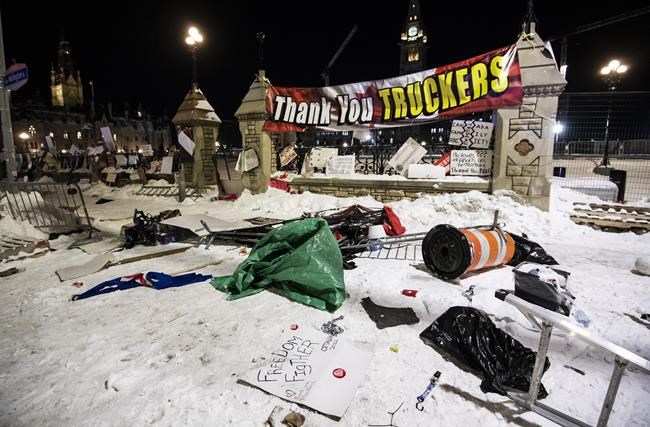
The Conservatives and the Bloc Québécois opposed it, while the two Green MPs in the House were split.
The vote to approve the measures will keep them in place until mid-March at the latest. The Senate must also vote on the government’s request. At any point, the Senate, House of Commons or government could pull support and the extraordinary powers stemming from the emergencies law would be revoked.
Leading up to the vote, there were signs the government had decided to make it a confidence vote, meaning that if it failed, the minority Liberal government could have fallen, which would have triggered an election.
Trudeau had not officially designated the vote as such, but he opened the door to that interpretation by likening the decision to a vote on a throne speech, which lays out the government’s agenda.
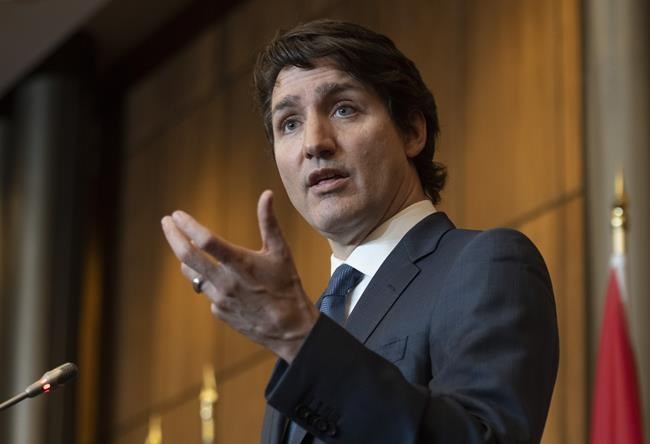
“I can’t imagine that anyone who votes ‘no’ tonight is doing anything other than indicating that they don’t trust the government to make incredibly momentous and important decisions at a very difficult time,” he said at a news conference earlier in the day.
Just before the voting began around 8 p.m. EST Monday, government House leader Mark Holland was asked by the Conservatives to clarify whether this was a confidence vote.
“It’s time to vote,” he replied.
Singh said his party had always seen the vote as a confidence matter.
Toronto Liberal MP Nathaniel Erskine-Smith, who voted in favour, said in the debate he might have voted against continuing to use the act now that the blockades had ended. He said he would vote yes because he had no interest in helping trigger an election.
Joël Lightbound, a Liberal MP who has criticized the government over its handling of the crisis, said invoking the act was “a slippery slope.” He said he would be inclined to vote against the measures if it were not a vote of confidence, and asked for clarification from ministers. He also voted in favour of the motion Monday night.
Without any clear indication from Trudeau’s office or caucus whips, the Official Opposition criticized the prime minister for what B.C. MP Todd Doherty styled a “veiled threat” of an election because his leadership was “threatened” and “fragile.”
Bloc Québécois Leader Yves-François Blanchet said Trudeau seemed to have made the matter a vote of confidence because he was afraid of his own caucus. Bloc MP Martin Champoux questioned the validity of the vote and accused Trudeau of “twisting the arm” of people who might otherwise disagree.
After a weekend of fractious debate while police cleared protesters by Parliament Hill, the final hours Monday were peppered with barbs at Trudeau and Singh for giving the prime minister the backing he needed.
“When did the NDP lose their way?” B.C. Conservative Dan Albas asked, arguing that the use of the Emergencies Act “would further divide Canadians.” Warren Steinley, a Saskatchewan Conservative, asked Trudeau how he convinced “the federal NDP to sell out the core beliefs of Jack Layton and Tommy Douglas,” referencing two key, former leaders of the New Democrats.
Immediately after the vote, interim Conservative leader Candice Bergen said the Tories would continue to fight the prime minister’s “power grab” and the party tabled a motion to revoke the powers.
Ontario Conservative MP Dave Epp accused the prime minister of using “the politics of division rather than co-operation and understanding,” using words Trudeau has said in the past.
“The capacity for kindness that Canadians are known for has been strained by our nation’s leader,” he said. “There is a sadness that comes when Canadians are pitted against Canadians.”
Emergency Preparedness Minister Bill Blair said the Conservatives, by opposing the measures, had “abandoned all pretext of supporting law and order,” and Public Safety Minister Marco Mendicino said the measures were “very proportional, measured and respectful of the charter” and not here to stay.
“We will absolutely retreat from the Emergencies Act as soon as we can,” Mendicino said.
Edmonton MP Ziad Aboultaif said using the act was overkill to stop what amounted to some illegally parked vehicles.
Liberal Peter Schiefke criticized “frequent, unabated displays of hatred” during the protests including swastikas. He said U.S. financial backing for the protests had some links to supporters of the Jan. 6, 2021 storming of the Capitol in Washington, D.C.
Trudeau said a week ago he was invoking the act for the first time since it passed in 1988 because police needed extra help to end blockades that had been ongoing in downtown Ottawa for weeks.
Regulations under the act grant powers to make tow trucks into essential services, require banks to freeze accounts of people participating directly or indirectly in the protest, and designate no-go zones for public gatherings, including Parliament Hill.
Singh said Monday the act was needed because all three levels of government had failed to take the threat posed by the convoy seriously until it was too late.
“Our support from the beginning has always been reluctant,” he said. “We were reluctant because it should have never got to this point.”

Singh’s decision to support the Emergencies Act has drawn criticism from former NDP MP Svend Robinson who said it set “a very dangerous precedent.”
“The NDP Caucus in 1970 under Tommy Douglas took a courageous and principled stand against the War Measures Act. Today’s NDP under Jagmeet Singh betrays the legacy and supports Liberals on the Emergencies Act,” the former Burnaby MP tweeted.
When asked if he was breaking from Douglas, Singh said the Emergencies Act is not the same as the War Measures Act, as the Emergencies Act has parliamentary oversight and limitations on its powers.
Former NDP Leader Ed Broadbent has also said the Emergencies Act is not the War Measures Act, which he voted against in 1970. He said the Emergencies Act has reduced powers, will expire after 30 days and the Charter of Rights and Freedoms is not suspended.
This report by The Canadian Press was first published Feb. 21, 2022.
Related Articles
Party lines hold in passing of Emergencies Act
Advertisement Advertise With Us
Advertisement Advertise With Us