Emergencies Act prohibits bringing children, food or fuel to ‘illegal’ blockades
Advertisement
Read this article for free:
or
Already have an account? Log in here »
To continue reading, please subscribe:
Digital Subscription
One year of digital access for only $1.44 a week*
- Enjoy unlimited reading on winnipegfreepress.com
- Read the E-Edition, our digital replica newspaper
- Access News Break, our award-winning app
- Play interactive puzzles
*Billed as $5.77 plus GST every four weeks. After 52 weeks, price increases to the regular rate of $19.95 plus GST every four weeks. Offer available to new and qualified returning subscribers only. Cancel any time.
To continue reading, please subscribe:
Add Free Press access to your Brandon Sun subscription for only an additional
$1 for the first 4 weeks*
- Enjoy unlimited reading on winnipegfreepress.com
- Read the E-Edition, our digital replica newspaper
- Access News Break, our award-winning app
- Play interactive puzzles
*Your next Brandon Sun subscription payment will increase by $1.00 and you will be charged $17.95 plus GST for four weeks. After four weeks, your payment will increase to $24.95 plus GST every four weeks.
Read unlimited articles for free today:
or
Already have an account? Log in here »
Hey there, time traveller!
This article was published 15/02/2022 (1703 days ago), so information in it may no longer be current.
OTTAWA – Bringing children to the antigovernment blockades that have immobilized downtown Ottawa and shuttered border crossings is among the activities that could net protesters a fine of up to $5,000 or five years in prison while Canada is under the national Emergencies Act.
The same punishment would apply to anyone violating any of the new rules, such as participating in the protests directly, or bringing aid such as food or fuel to those involved, according to regulations published Tuesday night that spell out the temporary but extraordinary powers that flow through the act.
Prime Minister Justin Trudeau invoked the act on Monday for the first time in Canadian history.
Attorney General David Lametti said Tuesday the decision to use the act was not taken lightly.
“Nobody wants to be the attorney general that has to invoke the Emergencies Act,” Lametti said in an interview Tuesday morning.
“But I have a responsibility to Canadians to do this. I have a responsibility to the rule of law and to good government. We can’t allow our democratic system to be hijacked by shows of force. That’s what happens in some other places in the world that we’re highly critical about.”
Public Safety Minister Marco Mendicino said at a news conference Tuesday in Ottawa that the blockades are “driven by an ideology to overthrow the government” and there are elements within them that pose a serious threat to safety.
He pointed to the seizure Monday of multiple weapons and the arrest of 13 individuals at the blockade near the border in Coutts, Alta. Mendicino said that should be a wake-up call to Canadians about “what it is that we are precisely dealing with here.”
Details of the regulations contained in two cabinet orders were published Tuesday night, hours after officials from the Justice and Finance Departments, as well as the RCMP, provided a technical briefing to the media on the condition they not be named.
Ottawa police have said repeatedly the presence of children was making it difficult for officers to enforce the law, fearing any clashes with protesters could put the kids at risk. Last week, police said they believed about 100 children were living in trucks and RVs around Parliament Hill. The new rules prohibit anyone from even causing a minor to travel within 500 metres of where an assembly deemed to be unlawful is taking place. There are exemptions for those who live or work in the area or are there for other reasons besides taking part in a protest.
The regulations also list the places blockades are not allowed, including Parliament Hill and the streets around it known as the parliamentary precinct where many federal buildings are found. Hundreds of vehicles have blocked roads there for more than two weeks.
Official residences, such as Rideau Hall, and government and defence buildings are on the list. So are war monuments, such as the National War Memorial in downtown Ottawa that was desecrated the first weekend convoy protesters started occupying the streets.
They also apply to airports, harbours, border crossings, piers, lighthouses, canals, interprovincial and international bridges, hospitals and COVID-19 vaccine clinics, trade corridors and infrastructure needed for the supply of utilities including power generation and transmission.
An order on emergency economic measures gives special powers to police, banks and insurance companies to freeze accounts and cancel vehicle insurance belonging to people participating in what the orders deem to be “illegal assemblies.”
Towing companies are being designated as essential and must either help police remove vehicles from the blockades when asked, or police could seize their tow trucks to remove the vehicles themselves. The order says anyone asked to provide essential goods and services through the Emergencies Act will be compensated at market prices.
Police in Ottawa and Windsor, Ont., say towing operators refused their requests, fearing reprisals from trucking companies that provide a lot of their business. Windsor police turned to American towing companies to remove vehicles from the Ambassador Bridge border crossing on the weekend.
The cabinet order invoking the Emergencies Act was published Tuesday morning. It says the government needs temporary but extraordinary powers to end blockades because they are threatening Canada’s supply chains, economic security and trading relationships in a bid to achieve political or ideological goals.
That order, and the ones that identify and describe the new but temporary powers, are now in effect but must all be confirmed by motions to be put to both the House of Commons and the Senate for a vote.
The government could take until next week to table the motion invoking the act itself, but has only until Thursday to do so for the motions on the specific powers being enacted.
They will remain in place for 30 days unless the government revokes them sooner.
Interim Conservative leader Candice Bergen warned the government Tuesday not to wait too long, because next week the House is on a break. That could mean Parliament would not debate the use of the Emergencies Act for more than two weeks after it was invoked.
“Twenty-four hours in and there are more questions than answers,” Bergen said in the House of Commons. “Questions about whether this is justified, questions around if the criteria is met, and questions around what this means to Canadians’ rights and freedoms.”
The NDP are indicating likely support for the motion, but Edmonton MP Blake Desjarlais said his party would hold the government to account over the use of unprecedented powers. He warned against “overreach that could harm Canadians,” saying “Canadians should rightfully be questioning the limits of authority.”
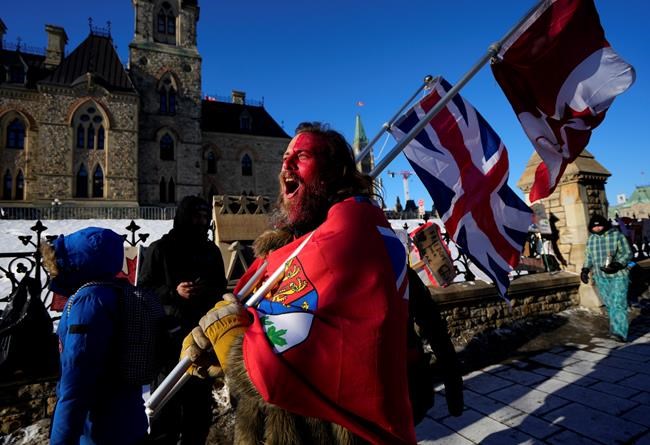
On Tuesday, it appeared only the blockade in Ottawa was digging in, nearly three weeks after the first big rigs rolled into town. Wellington Street in front of Parliament Hill was still crammed with commercial trucks, RVs and other vehicles. Many were flying Canada flags or banners with the word “freedom” in giant letters along their front grilles.
Jack Van Rootselaar, a trucker from Dunnville, Ont., sat in his white big rig in front of Parliament Hill Tuesday and dismissed the use of the Emergencies Act as a scare tactic. He said the truckers planned to stay until all vaccine mandates are lifted.
“We are not scared,” he said.
While access to funds raised online was already proving difficult, people were spotted handing out cash — including $50 bills — and hot food to truckers through their cab windows.
Joseph Michel, a former federal contractor from the National Capital Region who was collecting money to help pay for food and fuel for truckers, said it was concerning that the government would go to such lengths.
“People have families,” he said. “We are prisoners in our own country right now.”
Three of the four major blockades at border crossings are now over. Police cleared the standoff at the Ambassador Bridge on Sunday, arresting 42 people and seizing 32 vehicles. Most of those arrested were charged with mischief and some with disobeying a court order, related to the injunction granted Friday by an Ontario judge.
The remaining convoy participants at the border near Coutts, Alta., pulled out Tuesday morning, a day after the RCMP raid and weapons seizure. And RCMP in Surrey, B.C., reported that border crossing reopened after demonstrators were ordered to leave Monday. The police said arrests had been made but did not say how many.
A blockade continues at the border in Emerson, Man., but RCMP in Manitoba said Tuesday they expected it would be over Wednesday. Chief Supt. Rob Hill said in a statement that officers are confident that a resolution has been reached and demonstrators will soon be leaving the area.
While many people involved in the various blockades say they are there to demand an end to all COVID-19 restrictions, some, including many of the most vocal organizers, want the Liberal government overthrown.
Lametti said a protest is no longer a protest when it is an ideologically motivated occupation endangering the lives of Canadians and the economy.
“You do have a right to protest, and you have a right to throw the government out the next time there’s an election,” he said. “That’s the way our democratic system works. What a certain core group of people want on this is to get rid of a government through violence and harassment and by occupation. That’s not our democratic system.”
The Canadian Civil Liberties Association said Monday it did not believe the government had met the “high and clear” threshold needed to invoke the Emergencies Act.

Executive director Noa Mendelsohn Aviv warns that normalizing emergency legislation “threatens our democracy and our civil liberties.”
Perrin Beatty, the CEO of the Canadian Chamber of Commerce, was the minister of defence who introduced the Emergencies Act in 1988 to replace the War Measures Act. He said that the government’s use of the act is an indication of how serious a threat the blockades are to public safety and the economy.
“When I brought in the Emergencies Act 35 years ago, I wished that it would never need to be used, but I knew that there would inevitably be future crises and that it was essential to protect the basic rights of Canadians even in an emergency,” Beatty said in a tweet.
This report by The Canadian Press was first published Feb. 15, 2022.
— With files from Brittany Hobson in Winnipeg, Colette Derworiz in Edmonton and Beth Leighton in Vancouver.
Related Articles
RCMP clear protest blocking B.C. border crossing
Advertisement Advertise With Us
Advertisement Advertise With Us