Disinfecting Canada’s athletes villages an Olympic effort for Quebec company

Advertisement

Advertise with us

MONTREAL - In the days before Canada's athletes began arriving in Beijing with their dreams of Olympic glory, Brian Massie and Jean-François Picard were already hard at work doing the somewhat less glamorous work of scrubbing and disinfecting.

Read this article for free:


By clicking the button above, an account will be created and you will begin to receive some of our recommended newsletters. You may opt out of any newsletter by visiting your Email and Communication Preferences page or by clicking "unsubscribe" at the bottom of any email.

or

Already have an account? Log in here »

To continue reading, please subscribe:

Digital Subscription

One year of digital access for only $1.44 a week*

  • Enjoy unlimited reading on winnipegfreepress.com
  • Read the E-Edition, our digital replica newspaper
  • Access News Break, our award-winning app
  • Play interactive puzzles

*Billed as $5.77 plus GST every four weeks. After 52 weeks, price increases to the regular rate of $19.95 plus GST every four weeks. Offer available to new and qualified returning subscribers only. Cancel any time.

To continue reading, please subscribe:

Add Free Press access to your Brandon Sun subscription for only an additional

$1 for the first 4 weeks*

  • Enjoy unlimited reading on winnipegfreepress.com
  • Read the E-Edition, our digital replica newspaper
  • Access News Break, our award-winning app
  • Play interactive puzzles
Start now

*Your next Brandon Sun subscription payment will increase by $1.00 and you will be charged $17.95 plus GST for four weeks. After four weeks, your payment will increase to $24.95 plus GST every four weeks.

Hey there, time traveller!
This article was published 03/02/2022 (1734 days ago), so information in it may no longer be current.

MONTREAL – In the days before Canada’s athletes began arriving in Beijing with their dreams of Olympic glory, Brian Massie and Jean-François Picard were already hard at work doing the somewhat less glamorous work of scrubbing and disinfecting.

The business partners from Trois-Rivières, Que. were hired by the Canadian Olympic Committee to sanitize and disinfect the spaces used by the country’s athletes and staff, including three Olympic villages, gyms and common rooms.

COVID-19, and the rise of the Omicron variant in particular, has shifted organizers’ focus more than ever to sanitation, as athletes work to avoid the virus that could end their medal hopes.
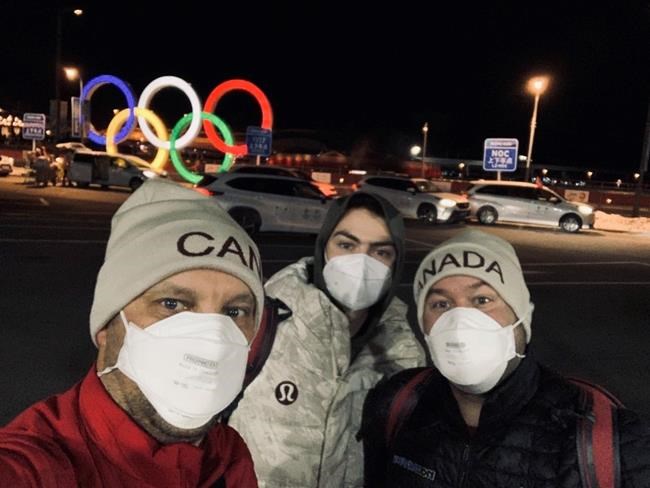
Staff of Quebec cleaning company Proaxion pose in Beijing for an undated selfie handout photo. Proaxion were hired by the Canadian Olympic Committee to clean and disinfect the Canadian athletes villages and other spaces. THE CANADIAN PRESS/HO-Proaxion, Jean-Francois Picard, *MANDATORY CREDIT*

For Massie and Picard, their role meant flying to Beijing two weeks before the games with a small team of employees to do a full disinfection that included treating surfaces to repel bacteria and installing air filters in common spaces. While the day-to-day cleaning during the games will be done by Chinese employees, two of the employees will remain in place to monitor the cleaning efforts, including swabbing high-traffic areas to ensure no dangerous diseases are lurking.

Arriving in China before the Olympics was “a little overwhelming,” said Massie, who co-founded Proaxion in 2016. The company offers “sanitation management” services including disinfection, monitoring and janitorial services.

The company members were greeted by Chinese employees in full masks, visors and plastic suits, looking like something “in a bad movie,” Massie said.

“It’s like you’re being scanned,” he said in a recent phone interview. “Every time you enter a building you need to pass daily throat PCR tests.”

But once in the village, he said the Olympic buzz began to build, and “you don’t really think of any of that.”

While COVID-19 has heightened concerns over sanitation, worries about diseases at the Olympics are nothing new. Massie said his company was first hired for the 2018 Pyeongchang Olympics, after the previous Games in Rio de Janeiro had raised concerns over mosquito-borne illnesses. The South Korean Olympics had an outbreak of norovirus, although Massie says Canadians were largely spared.

The team was once again on the grounds in Tokyo last summer — the first games since COVID-19 was declared a global pandemic.

The biggest difference in Beijing, he said, was being able to see some of the athletes arrive in the village, in contrast to Tokyo where competitors were asked to arrive as close as possible to the start of their events.

“Feeling this vibe of all the athletes coming into village is really something that we didn’t get the chance to live in, in Tokyo,” he said.

While he was initially a bit apprehensive about flying to China, Massie praised the Canadian Olympic Committee for helping walk him through all the paperwork and complex security protocols that included switching to burner phones and computers.

In the end, he said everything went smoothly, and, as an avid athlete, he describes his Olympic experience as “a dream come true.”

“We’re still pinching ourselves,” he said.

While he’s now back in Quebec, he said the company’s employees will remain on site during the Olympic and Paralympic Games to monitor the cleaning until the athletes leave the village.

This report by The Canadian Press was first published Feb. 3, 2022.

Report Error Submit a Tip

More Stories

Tools, technology required to retain doctors

4 minute read Preview

Tools, technology required to retain doctors

4 minute read 2:01 AM EST

Manitoba has made some encouraging progress in addressing its doctor shortage. But attracting more physicians to the province will accomplish only so much if the health-care system can’t give them the tools, technology and working conditions they need to do their jobs.

A new report from Doctors Manitoba suggests the province is making progress in growing its physician workforce. But serious gaps remain.

The organization’s annual Physicians in Manitoba report contains some welcome news. The province now has a record number of physicians practising here, with 235 doctors per 100,000 residents. That’s getting closer to the national average of 245.

The overall physician shortage has also been cut nearly in half from its peak three years ago, when Manitoba needed 445 additional doctors to reach the national average. It now needs 229.

Read
2:01 AM EST

Fact Check

1 minute read Thursday, Nov. 30, 2023

Fact Check

Having problems with the form?Contact Us Directly |

City plans renos, repairs on underused, money-losing office tower next to police HQ

Joyanne Pursaga 4 minute read Preview

City plans renos, repairs on underused, money-losing office tower next to police HQ

Joyanne Pursaga 4 minute read 2:01 AM EST

The city is preparing to repair two floors of the mostly vacant office tower linked to the Winnipeg Police Service headquarters that has cost taxpayers hundreds of thousands of dollars more each year than it earns.

The plan is to renovate the second and third floors of the 11-storey former Canada Post tower at 266 Graham Ave, including some repairs needed to meet current building codes, notes a tendering document seeking a contractor to do the work.

In 2009, the city spent $29 million to buy the Canada Post warehouse and the tower, as part of the scandal-plagued police HQ project. Police now work out of the former warehouse and utilize some space in the tower.

The repair work will include interior demolition, asbestos abatement, several fire safety and smoke detection upgrades and some replacement of partitions, doors, hardware and ceilings. The winning bidder will also complete electrical, mechanical and lighting upgrades.

Read
2:01 AM EST

Sarault wins silver medal in 1,000-metre

The Canadian Press 2 minute read Saturday, Feb. 8, 2020

DRESDEN, Germany - Canadian Courtney Sarault won a silver medal in the women's 1,000-metre event at the ISU short track World Cup on Saturday.

Sarault, from Moncton, N.B., took second place with a time of 1:55.143 — finishing behind South Korea's Kim Ji Yoo (1:54.955) and ahead of World Cup overall standings leader Suzanne Schulting of the Netherlands. (1:55.167).

"Going into the final, I didn't feel amazing, but I was trying to stay positive, and hoping to come out of it with a podium," said Sarault.

Meanwhile, Canada's Kim Boutin had her string of podium results come to an end at eight events.

Netherlands Canada's top source for illicit meth shipments in 2018

Dylan Robertson 6 minute read Preview

Netherlands Canada's top source for illicit meth shipments in 2018

Dylan Robertson 6 minute read Monday, Mar. 9, 2020

OTTAWA — While Winnipeg was in the midst of its ongoing meth crisis in 2018, quantities of the drug were coming from an unexpected country, and through Canadians' most common mode of delivery.

According to documents obtained by the Free Press, there was an increase in "inbound seizures destined to Winnipeg addresses," of postal mail containing meth in 2018 from a year prior. "However, such shipments are likely for personal consumption,” as they were under 35 grams.

And though Canadian officials have called out meth smugglers in China and Mexico, the mailed drugs came from Europe.

"The Netherlands is the top transit country by number of seizures (of meth), while Mexico is the main transit country by quantity,” reads an internal Canada Border Services Agency report from mid-2018.

Read
Monday, Mar. 9, 2020

Submit a news tip

1 minute read Monday, Mar. 16, 2026

Submit a news tip