WEATHER ALERT

EXPLAINER: How COVID tests, isolation will work at Olympics

Advertisement

Advertise with us

NEW YORK (AP) — Athletes and others headed to the Olympics face a multitude of COVID-19 testing hurdles as organizers seek to catch any infections early and keep the virus at bay.

Read this article for free:

or

Already have an account? Log in here »

To continue reading, please subscribe:

Subscribe and receive a limited-edition Free Press branded hat or tote.

Digital Subscription

One year of digital access for only $205*

  • Enjoy unlimited reading on winnipegfreepress.com
  • Read the E-Edition, our digital replica newspaper
  • Access News Break, our award-winning app
  • Play interactive puzzles

*First annual payment billed as $205.00 + GST for one year. This annual subscription will automatically renew at $233.00 + GST every 52 weeks (10% off the regular annual price of $259.35). Offer available to new and qualified returning subscribers only. Cancel any time.

To continue reading, please subscribe:

Add Free Press access to your Brandon Sun subscription for only an additional

$1 for the first 4 weeks*

  • Enjoy unlimited reading on winnipegfreepress.com
  • Read the E-Edition, our digital replica newspaper
  • Access News Break, our award-winning app
  • Play interactive puzzles
Start now

*Your next Brandon Sun subscription payment will increase by $1.00 and you will be charged $17.95 plus GST for four weeks. After four weeks, your payment will increase to $24.95 plus GST every four weeks.

Hey there, time traveller!
This article was published 26/01/2022 (1645 days ago), so information in it may no longer be current.

NEW YORK (AP) — Athletes and others headed to the Olympics face a multitude of COVID-19 testing hurdles as organizers seek to catch any infections early and keep the virus at bay.

A positive test could mean athletes sitting out the Beijing Games — perhaps even if they’re no longer contagious. Olympic officials say they’ll be flexible and review the need for isolation on a case-by-case basis.

It’s part of the complexities of staging a big event in the pandemic, because organizers want to ensure they don’t fuel outbreaks among participants or the local population. Since early in the pandemic, China has taken a “zero tolerance” approach to the virus.
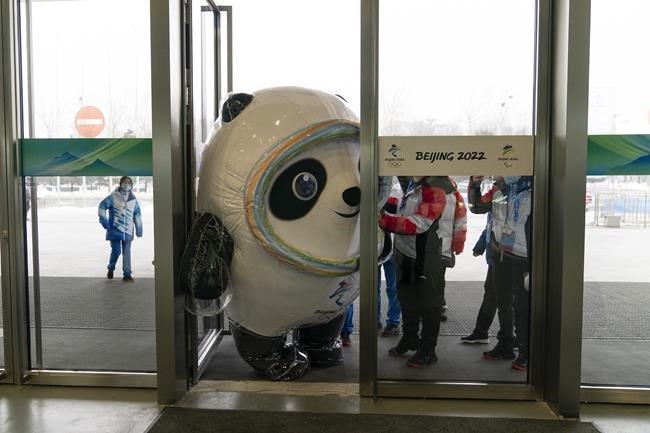
FILE - Inflated Beijing Games mascot, Bing Dwen Dwen, tries to squeeze through the door to enter the main media center at the 2022 Winter Olympics, Monday, Jan. 24, 2022, in Beijing. Athletes and others headed to the Olympics face a multitude of COVID-19 testing hurdles as organizers seek to catch any infections early and keep the virus at bay. (AP Photo/Jae C. Hong, File)

Similar protocols to create virus-free “bubbles” were part of the Tokyo Games last summer and the end of the 2020 NBA season.

Here’s how testing will work at the Winter Olympics:

WHAT WILL TESTING BE LIKE?

All athletes, team officials, staff and journalists need to provide two recent negative tests before heading to China. They will be tested again at the airport before heading to their Olympic sites. During the Games, everyone will get daily throat swabs for PCR lab tests, with results coming back within a day.

And most everyone will already be vaccinated, because those who aren’t have to quarantine for three weeks.

WHAT IF SOMEONE TESTS POSITIVE?

First, there will be a confirmatory test. Anyone who has COVID-19 with symptoms will go to a hospital. Those without symptoms go to a dedicated hotel for isolation. In both cases, they’ll be unable to compete until cleared for discharge.

HOW LONG WILL ISOLATION LAST?

It depends. To get out of isolation, people generally need consecutive days of negative tests and no symptoms. They will be tested with PCR lab tests that can detect tiny amounts of virus. That means a test can come back positive long after a person is likely to spread the virus. The uncertainty over how long isolation might last is fueling worries. Last week, NBC said its announcers and many hosts would cover the Games from the U.S.

ARE TESTS THE ONLY FACTOR?

Organizers in Beijing say they’ll look at other factors in addition to testing when evaluating whether someone can leave isolation.

“What’s the person’s past history? Have they had confirmed COVID in the past? Have they been vaccinated fully?” said Dr. Brian McCloskey, chair of the medical expert panel for the Beijing Olympics.

PCR tests work by copying the genetic material in a specimen to detect a virus. If a lab needs to run a lot of amplification cycles to pick up the virus, it could mean a person has low levels and isn’t likely to spread it.

This week, organizers said they would take a less stringent approach on isolation for those with low levels of the virus. They eased the testing threshold that requires isolation but said people with detectable levels of the virus still need to take extra precautions, such as limiting contact with others and taking two tests a day, instead of one.

As scientists have learned more about COVID-19 and how it spreads, health officials in a number of countries have revised isolation requirements. In the U.S., for example, people can end isolation after five days if they don’t have any symptoms — without testing to see if they’re negative. But they’re advised to avoid travel and others at high risk.

ARE MANY INFECTIONS EXPECTED?

Positive cases are expected to pop up, with the highly contagious omicron variant fueling infections in many parts of the world.

So far, organizers say there have been 39 positive results out of the more than 2,500 tests at the airport among those who arrived since early January. Within the bubble, there have been 33 positives out of 336,400 tests. None of the positives involved athletes. The average time spent in isolation for most has been around six days.

___

The Associated Press Health and Science Department receives support from the Howard Hughes Medical Institute’s Department of Science Education. The AP is solely responsible for all content.

Report Error Submit a Tip

More Stories

The Manitoba government is taking more time to evaluate and select a preferred corridor for the twinning of a 16-kilometre section of the Trans-Canada Highway near the Ontario boundary.

An earlier timeline indicated Manitoba Transportation and Infrastructure expected to choose an alignment by the fall of 2025. A provincial spokesperson told the Free Press a decision is now expected this winter.

“The department continues to evaluate corridor alternatives and will undertake additional geotechnical, environmental and design work as part of the (functional design study) to support the selection of a preferred corridor,” the spokesperson said in a statement.

The study, which will include Crown-Indigenous and public consultation, is expected to be completed in late 2027, with a detailed design to follow.

Saying goodbye to a friend I never met

Pam Frampton 5 minute read Preview

Saying goodbye to a friend I never met

Pam Frampton 5 minute read 2:00 AM CDT

Hedie Epp and I first connected over a column I wrote in October 2023 about my mother’s dementia.

Someone she knew had been diagnosed with Alzheimer’s and she emailed to say my column had prompted her to get in touch with them.

“I look forward to reading more of your articles,” she wrote. Her email signature included a quote from Romans in the New Testament: “If it is possible, as far as it depends on you, live at peace with everyone … Do not be overcome by evil, but overcome evil with good.”

I was intrigued, as it hinted at some inner turmoil.

Read
2:00 AM CDT

No museum can tell the whole story

Stuart Williams 5 minute read 2:00 AM CDT

The continuing debate over the Canadian Museum for Human Rights’ Uprooted: Nakba Past and Present exhibit has focused significantly on what the exhibit leaves out.

Some critics argue that the exhibit should have explained the United Nations Partition Plan, the Arab rejection of that plan, the 1948 invasion by neighbouring Arab states, the displacement of Jews from Arab countries, Hamas, October 7, the hostages and the reasons for Israeli security measures.

Others argue with equal conviction that it should also have addressed the Deir Yassin massacre, the expansion of Israeli settlements, decades of occupation, the Right of Return, changing demographic realities and the experiences of Palestinian refugees throughout the Middle East.

All of those subjects matter. Many remain the subject of legitimate scholarly debate. But the controversy points to a broader question that extends well beyond this particular exhibit.

Danger in viewing world through blue-coloured glasses

Melissa Martin 7 minute read Preview

Danger in viewing world through blue-coloured glasses

Melissa Martin 7 minute read Thursday, Jul. 2, 2020

One evening earlier this year, a man died on the street in a major United States city. His death would make history, and although much has been said about it since, it’s worth pausing for a moment to review how the first draft of that history was written, because what it says — and what it doesn’t — delivers a stark lesson.

The scene, as laid out in that first draft, begins when someone calls police to allege that a non-violent offence has been committed. Police state they are “advised,” presumably by the caller, that “the suspect was sitting on top of a blue car and appeared to be under the influence.”

Read this next part carefully, because this is what that first draft of the story says happens next.

“Two officers arrived and located the suspect, a male believed to be in his 40s, in his car. He was ordered to step from his car. After he got out, he physically resisted officers. Officers were able to get the suspect into handcuffs and noted he appeared to be suffering medical distress.

Read
Thursday, Jul. 2, 2020

Free Press invests $10 million in new presses

Martin Cash 3 minute read Preview

Free Press invests $10 million in new presses

Martin Cash 3 minute read Tuesday, Aug. 2, 2022

As it marks its 150th anniversary this year, the Free Press Tuesday signaled its commitment to the future with the announcement that it is investing $10 million in new presses and mail room equipment.

Read
Tuesday, Aug. 2, 2022

Ask a Chef

10 minute read Preview

Ask a Chef

10 minute read Saturday, Nov. 6, 2021

| Did you know that more than 50 per cent of food waste in single-family households is avoidable? This includes leftovers and untouched food that could have been eaten.

We often waste good food unintentionally. It goes to waste because we buy too much, cook too much or don’t store it correctly.

Two talented local chefs share a taste of sustainable food practices that are easy to incorporate right at home.

Read
Saturday, Nov. 6, 2021