Clap, don’t chant: China aims for ‘Zero COVID’ Olympics
Advertisement
Read this article for free:
or
Already have an account? Log in here »
To continue reading, please subscribe:

Digital Subscription
One year of digital access for only $205*
- Enjoy unlimited reading on winnipegfreepress.com
- Read the E-Edition, our digital replica newspaper
- Access News Break, our award-winning app
- Play interactive puzzles
*First annual payment billed as $205.00 + GST for one year. This annual subscription will automatically renew at $233.00 + GST every 52 weeks (10% off the regular annual price of $259.35). Offer available to new and qualified returning subscribers only. Cancel any time.
To continue reading, please subscribe:
Add Free Press access to your Brandon Sun subscription for only an additional
$1 for the first 4 weeks*
- Enjoy unlimited reading on winnipegfreepress.com
- Read the E-Edition, our digital replica newspaper
- Access News Break, our award-winning app
- Play interactive puzzles
*Your next Brandon Sun subscription payment will increase by $1.00 and you will be charged $17.95 plus GST for four weeks. After four weeks, your payment will increase to $24.95 plus GST every four weeks.
Read unlimited articles for free today:
or
Already have an account? Log in here »
Hey there, time traveller!
This article was published 14/01/2022 (1712 days ago), so information in it may no longer be current.
Athletes will need to be vaccinated — or face a long quarantine — take tests daily and wear masks when not competing or training. Clapping is OK to cheer on teammates, not chanting. Anyone who tests positive for COVID-19 will be sent into isolation and unable to compete until cleared for discharge.
Welcome to the Beijing Olympics, where strict containment measures will aim to create a virus-proof “bubble” for thousands of international visitors at a time when omicron is fueling infections globally.
The prevention protocols will be similar to those at the Tokyo Games this summer, but much tighter. That won’t be a stretch in Beijing, with China having maintained a “Zero COVID” policy since early in the pandemic.
Still, China’s ability to stick to its zero-tolerance approach nationally is already being tested by the highly transmissible omicron variant, which is more contagious than earlier variants of the virus and better able to evade protection from vaccines.
With just weeks to go before the Feb. 4 start of the Games, more than 20 million people in six cities are under lockdown after recent outbreaks.
Here’s how the Games will work.
DO ATHLETES HAVE TO BE VACCINATED?
Yes, athletes and other participants including team staff and news media need to be fully vaccinated to be allowed in the designated Olympic areas without completing a 21-day quarantine. Those areas will consist of the Olympic Village, game venues, other select spots and dedicated transport.
That’s different from the Tokyo Games, where participants didn’t have to be vaccinated.
Participants are considered fully vaccinated according to the definitions outlined by their countries. Before boarding their flights, everyone also needs to provide two recent negative tests from approved labs.
The threat of being sidelined by a positive test is adding to the pressure for athletes.
Mogul skier Hannah Soar said she’s avoiding contact with people indoors and behaving as if everyone has the virus: “We’re basically at the point of acting like it’s March 2020.”
WHAT ABOUT DAILY LIFE?
Upon arrival at the airport in Beijing, participants will have their temperatures taken and be tested with throat and nasal swabs. An Olympics official who recently arrived on site said at a press briefing the process took him 45 minutes, though organizers note times might vary.
A bus will then take people to their designated lodging, where they’ll wait up to six hours for test results to clear them to move about in approved areas. Restrictions on movement within that “closed loop” are intended to seal off any potential contact between Olympic participants and the local population.
Throat swabs for testing will be required daily for all participants. In Tokyo, participants spit into vials for antigen tests.
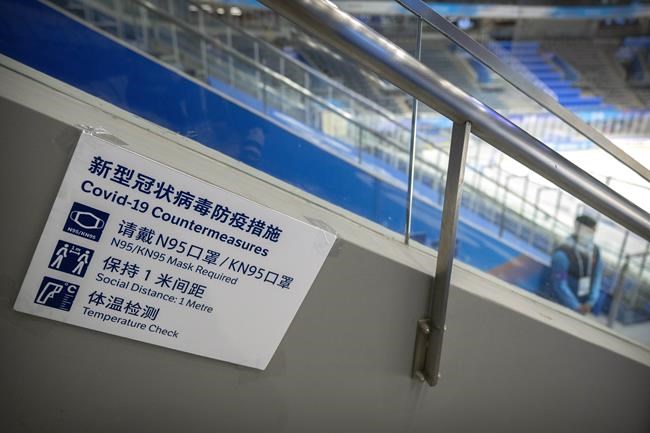
Standard prevention measures are being encouraged, such as ventilating rooms and keeping a distance of about 3 feet (1 meter) from others – or 6 feet (2 meters) from athletes.
Masks that are N95 or of a similar caliber will also be required in indoor and outdoor areas with few exceptions, such as when people are eating or drinking. Dining halls will have partitions and seating capacity will be reduced to help maintain distancing.
In spaces where distancing isn’t possible, such as elevators, talking isn’t allowed. Staff will be stationed in key areas to help guide people and ensure protocols are being followed.
WHAT HAPPENS IF AN ATHLETE TESTS POSITIVE?
In Tokyo, organizers say 33 athletes tested positive during the Games. Of those, 22 were withdrawn from competition. Even with the tightened precautions in Beijing, experts say some positive tests are likely, especially with omicron in play.
If an athlete or other participant tests positive but doesn’t have symptoms, they’ll need to go into isolation in a dedicated hotel. They’ll be provided with meals and can open their windows for fresh air but won’t be able to leave their rooms, which organizers say will be about 270 square feet (25 square meters).
Athletes can request fitness equipment for training.
People with no symptoms can leave isolation after two days of negative tests. Organizers say those testing positive will be reviewed on a case-by-case basis, but it might still be too late for athletes to compete.
As a general rule, organizers say the panel will review those who keep testing positive for more than 14 days.
Those who test positive and have symptoms have to go into isolation in a hospital. They’ll also need to two days of negative tests to be let loose, as well as three days of normal temperatures and symptoms subsiding.
Organizers have said athletes who recover after testing positive ahead of the Games will also be assessed on a case-by-case basis in a “more flexible manner.”
WILL THERE BE FANS?
Spectators from overseas won’t be allowed. As for local fans, Beijing organizers say they’re finalizing rules for their attendance.
It’s not clear how the recent outbreaks around China will factor into the decisions. But organizers of the Tokyo Games had also planned to allow some domestic fans, before scrapping the idea because a surge in local cases. The result was surreal scenes of athletes competing in empty stadiums.
Even if some fans are allowed in Beijing, their presence will be muted. Everyone is being asked to clap instead of shouting or singing, as had been the plan in Tokyo.
CAN IT WORK?
Despite the omicron-fueled surge hitting many parts of the world including China, organizers may still be able to pull off the Olympics without as much disruption as some fear.

Olympic athletes are highly motivated to avoid infection so they can compete, noted Dr. Sandro Galea, a public health expert at Boston University. And even if it’s harder with omicron, he noted it’s no mystery what people need to do to avoid infection — take prevention measures, such as limiting exposure to others.
___
AP Sports Writer Pat Graham contributed from Denver.
___
The Associated Press Health and Science Department receives support from the Howard Hughes Medical Institute’s Department of Science Education. The AP is solely responsible for all content.
Related Articles
Olympics Live: US wins to set up gold-medal game with Canada








Advertisement Advertise With Us
Advertisement Advertise With Us