Montreal homeless shelters fear COVID-19 crisis as cases rise, temperatures drop

Advertisement

Advertise with us

MONTREAL - The heads of several Montreal homeless shelters say they're facing a crisis, as rising staff absences due to COVID-19 threaten to disrupt services during the coldest part of winter.

Read this article for free:


By clicking the button above, an account will be created and you will begin to receive some of our recommended newsletters. You may opt out of any newsletter by visiting your Email and Communication Preferences page or by clicking "unsubscribe" at the bottom of any email.

or

Already have an account? Log in here »

To continue reading, please subscribe:

Digital Subscription

One year of digital access for only $1.44 a week*

  • Enjoy unlimited reading on winnipegfreepress.com
  • Read the E-Edition, our digital replica newspaper
  • Access News Break, our award-winning app
  • Play interactive puzzles

*Billed as $5.77 plus GST every four weeks. After 52 weeks, price increases to the regular rate of $19.95 plus GST every four weeks. Offer available to new and qualified returning subscribers only. Cancel any time.

To continue reading, please subscribe:

Add Free Press access to your Brandon Sun subscription for only an additional

$1 for the first 4 weeks*

  • Enjoy unlimited reading on winnipegfreepress.com
  • Read the E-Edition, our digital replica newspaper
  • Access News Break, our award-winning app
  • Play interactive puzzles
Start now

*Your next Brandon Sun subscription payment will increase by $1.00 and you will be charged $17.95 plus GST for four weeks. After four weeks, your payment will increase to $24.95 plus GST every four weeks.

Hey there, time traveller!
This article was published 07/01/2022 (1761 days ago), so information in it may no longer be current.

MONTREAL – The heads of several Montreal homeless shelters say they’re facing a crisis, as rising staff absences due to COVID-19 threaten to disrupt services during the coldest part of winter.

There were outbreaks in 27 Montreal homeless shelters between Dec. 26 and Jan. 1, with a total of 110 staff and clients testing positive during that time, according to the local health authority in the city’s south end.

Michel Monette, the general director of CARE Montreal, says the city is “on the brink of a humanitarian crisis.”
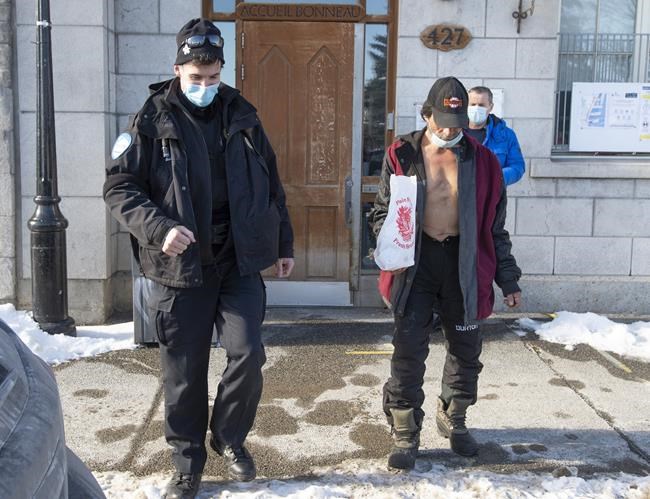
A Montreal police officer helps a homeless man find shelter from the cold Monday, Jan. 25, 2021, in Montreal. The heads of several homeless shelters say they're facing a looming crisis as staff absences due to COVID-19 threaten to disrupt services at the coldest part of winter. THE CANADIAN PRESS/Ryan Remiorz

Almost 30 per cent of his employees are currently off the job because of a positive COVID-19 test, and up to 25 per cent of shelter users have tested positive, he said in an interview Thursday. While he’s managed to keep all the shelter’s beds open for now, he says he’ll have to close dozens if the situation worsens, and he has already had to stop offering other services, including psychosocial care.

“Shelters are at capacity; our users and employees are getting sick,” he said. “I have three, four employees each day being diagnosed positive. It’s not stopping.”

Sam Watts, CEO of the Welcome Hall Mission, says the 108-bed hotel that the city requisitioned for COVID-19-positive homeless people is already full, leaving shelters wondering what to do with people who test positive.

Watts, however, said his biggest concern is staff shortages. While his own organization has fared well so far, he said may smaller shelters have had to scale back because of outbreaks, which he said puts more stress on the system overall.

He said he fears a major outbreak that would force services to be interrupted at any one of the three biggest shelters in the city — a situation he says would be “catastrophic.”

“You would not be overstating it to say that the situation is on a razor’s edge in Montreal with respect to the ability to serve,” he said in an interview Thursday.

Watts said shelters are doing everything they can to keep staff safe by using masking, deploying rapid tests, asking people to reduce contacts and arranging COVID-19 booster shot clinics. He said the vaccination rate among workers at his organization is high, which may have helped it avoid the worst so far.

Nakuset, who uses one name and is the director of the Native Women’s Shelter of Montreal, says her organization has also been lucky to have had few cases of COVID-19 so far this winter. The shelter decided in late December not to accept any new clients because of the Omicron variant of the novel coronavirus — a measure she hopes to lift soon.

However, she says it’s hard to operate when the city has provided fewer emergency resources this year compared with a year ago, adding that this year’s challenges are greater.

“We have more cases, more homeless people than last year, less services,” she said in an interview Wednesday.

Nakuset said she had to raise funds to keep open a warming tent this season that was opened last year after a homeless Indigenous man died outside on a freezing night after a nearby shelter closed. She said she learned that six staff members at that tent have tested positive for COVID-19.

“We’re just doing it day by day and trying to figure out how to balance everything and keep people safe and not closing down,” she said.

While the City of Montreal recently announced it had requisitioned two hotels to allow COVID-positive people to isolate, Nakuset says one isn’t for families with children, adding that the other only opens in February. Last year, she said the city opened more temporary shelters, including one in Old Montreal’s Bonsecours Market.

In an email, a spokeswoman for Mayor Valérie Plante’s cabinet said Thursday the city was evaluating sites for more emergency shelters.

“We have never shied away from responding to the needs of the most vulnerable and we will leave no one behind,” the statement read, noting that the city had doubled the budget dedicated to fighting homelessness in 2022.

But Watts and Monette both noted that beds alone won’t solve the problem, since shelters need staff to supervise them.

Watts said that while emergency services are needed, there ultimately needs to be a wider reform of how services are delivered in the city. That includes a co-ordinated intake system to help address people’s diverse health and shelter needs, rather than a “disparate collection” of under-resourced groups providing services to the most vulnerable.

The provincial government, Watts added, needs to implement a rent-supplement program, which he said would help get more people into apartments.

This report by The Canadian Press was first published Jan. 7, 2022.

Report Error Submit a Tip

More Stories

Brandon cancer patients lament oncologist’s depature

Rylee Gerrard 4 minute read Yesterday at 8:41 PM EST

BRANDON — Cancer patients across Brandon say they are heartbroken by the impending departure of medical oncologist Dr. Brady Anderson from the Western Manitoba Cancer Centre.

When Lesa Carey learned Anderson would be leaving his role as the sole medical oncologist outside of Winnipeg due to burnout and a lack of additional compensation, she said it made her “sick to my stomach.”

“I can honestly say that the three scariest words someone I think could ever hear is, ‘You have cancer,’” said Carey, a Brandon resident who was diagnosed with breast cancer in 2024.

“My husband and I walked into the appointment at CancerCare overwhelmed, terrified and scared for my life. After meeting with Dr. Anderson, we left informed, listened to, and felt extremely cared about.”

Finance minister has impossible choice as federal budget looms

Dan Lett 5 minute read Preview

Finance minister has impossible choice as federal budget looms

Dan Lett 5 minute read Yesterday at 3:24 PM EST

It’s federal budget week, and that means every newspaper columnist, self-proclaimed think tank subject matter expert and opposition critic has suggestions for what Ottawa “must” do.

In no particular order: Finance Minister François-Philippe Champagne “must” provide tax cuts for small business to survive, provide tax cuts for big business to become bigger and wealthier, massively increase transfer payments to the provinces, make life more affordable for average people and undertake enormous, strategic investments in the economy to make Canada less reliant on the United States.

If you’re wondering how any finance minster can do all of that, all at once, the answer is they can’t. But that’s the nature of pre-budget submissions: do what we want, even if it makes it impossible for you to do the things that other people think must be done.

That is not to say all budget submissions are worthless. It’s just that you can’t cut government taxes and levies on businesses while also providing more robust investment in industries, infrastructure and people — and still have any hope of containing the debt.

Read
Yesterday at 3:24 PM EST

Netherlands Canada's top source for illicit meth shipments in 2018

Dylan Robertson 6 minute read Preview

Netherlands Canada's top source for illicit meth shipments in 2018

Dylan Robertson 6 minute read Monday, Mar. 9, 2020

OTTAWA — While Winnipeg was in the midst of its ongoing meth crisis in 2018, quantities of the drug were coming from an unexpected country, and through Canadians' most common mode of delivery.

According to documents obtained by the Free Press, there was an increase in "inbound seizures destined to Winnipeg addresses," of postal mail containing meth in 2018 from a year prior. "However, such shipments are likely for personal consumption,” as they were under 35 grams.

And though Canadian officials have called out meth smugglers in China and Mexico, the mailed drugs came from Europe.

"The Netherlands is the top transit country by number of seizures (of meth), while Mexico is the main transit country by quantity,” reads an internal Canada Border Services Agency report from mid-2018.

Read
Monday, Mar. 9, 2020

Fact Check

1 minute read Thursday, Nov. 30, 2023

Fact Check

Having problems with the form?Contact Us Directly |

Another embarrassing loss: Arniel

Mike McIntyre 7 minute read Preview

Another embarrassing loss: Arniel

Mike McIntyre 7 minute read Sunday, Nov. 1, 2026

RALEIGH — No sticks were smashed. No walls punched. And nary a naughty word was uttered.

Instead, the Winnipeg Jets filed off the ice here at Lenovo Center on Sunday afternoon much like they’d just played the preceding game against the Carolina Hurricanes — with no emotion, no passion, no urgency.

You’d have thought yet another loss, this one in truly humiliating fashion and a ninth consecutive overall, might have triggered something.

Anything.

Read
Sunday, Nov. 1, 2026

With the start of 2022 comes a new framework for Manitoba’s real estate industry

Ben Waldman 6 minute read Preview

With the start of 2022 comes a new framework for Manitoba’s real estate industry

Ben Waldman 6 minute read Monday, Jan. 10, 2022

New year, new rules for Manitoba real estate.

On Jan. 1, the Real Estate Services Act came into effect in the province, bringing with it an updated regulatory framework for the local industry to follow, along with some key changes for parties on either side of a real estate transaction.

One of the most notable changes to consumers is likely the introduction of a service agreement requirement: any buyers, sellers, or renters of residential or commercial properties are now required to sign such an agreement with a realtor prior to any services being rendered. But there are other moves that will impact real estate business moving forward.

The regulatory Manitoba Securities Commission’s real estate division consulted with industry groups such as the Manitoba Real Estate Association in drafting the legislation, which replaces the Real Estate Brokers Act, and which the commission’s website says “reflects the changing face” of the provincial real estate landscape.

Read
Monday, Jan. 10, 2022