German government hesitant on lockdown as COVID cases rise

Advertisement

Advertise with us

BERLIN (AP) — Germany's government refused to back calls Friday for a swift and sharp lockdown to curb the country's worsening coronavirus situation, which saw daily confirmed cases hit a new peak and is putting hospitals under severe strain.

Read this article for free:


By clicking the button above, an account will be created and you will begin to receive some of our recommended newsletters. You may opt out of any newsletter by visiting your Email and Communication Preferences page or by clicking "unsubscribe" at the bottom of any email.

or

Already have an account? Log in here »

To continue reading, please subscribe:

Digital Subscription

One year of digital access for only $1.44 a week*

  • Enjoy unlimited reading on winnipegfreepress.com
  • Read the E-Edition, our digital replica newspaper
  • Access News Break, our award-winning app
  • Play interactive puzzles

*Billed as $5.77 plus GST every four weeks. After 52 weeks, price increases to the regular rate of $19.95 plus GST every four weeks. Offer available to new and qualified returning subscribers only. Cancel any time.

To continue reading, please subscribe:

Add Free Press access to your Brandon Sun subscription for only an additional

$1 for the first 4 weeks*

  • Enjoy unlimited reading on winnipegfreepress.com
  • Read the E-Edition, our digital replica newspaper
  • Access News Break, our award-winning app
  • Play interactive puzzles
Start now

*Your next Brandon Sun subscription payment will increase by $1.00 and you will be charged $17.95 plus GST for four weeks. After four weeks, your payment will increase to $24.95 plus GST every four weeks.

Hey there, time traveller!
This article was published 26/11/2021 (1799 days ago), so information in it may no longer be current.

BERLIN (AP) — Germany’s government refused to back calls Friday for a swift and sharp lockdown to curb the country’s worsening coronavirus situation, which saw daily confirmed cases hit a new peak and is putting hospitals under severe strain.

Health Minister Jens Spahn said contacts between people need to be sharply reduced, warning that “the situation is dramatically serious, more serious than it’s been at any point in the pandemic.”

But he declined to say whether he would back blanket restrictions of the kind seen during previous stages of the pandemic, when schools, non-essential stores and other areas of public life were shuttered. Austria, faced with a similar surge in cases, this week ordered a ten-day lockdown for everybody, renewable for a further ten days.

Intensive care nurses treat patients severely ill with Covid-19 disease in the Corona intensive care unit at the University Hospital in Halle/Saale on Monday, Nov. 22, 2021. The German air force Luftwaffe will begin assisting the transfer of intensive care patients from hospitals in Bavaria to northern German states.(Hendrik Schmidt/dpa via AP)

A spokesman for outgoing Chancellor Angela Merkel likewise refused to be drawn on whether she favored triggering the so-called emergency brake measures last used in April.

Government spokesman Steffen Seibert said there were “political realities that need to be acknowledged,” such as the new majority in parliament since Germany’s election on Sept. 26 that Merkel’s party narrowly lost. Her government’s junior partner, the center-left Social Democrats, have negotiated to form a new government with two other parties.

The new government is expected to take over in early December, but the transition period — with Merkel as caretaker — has been blamed for paralyzing Germany’s response to the pandemic.

The country’s disease control agency said 76,414 more cases were reported in the past 24 hours, a new record. The Robert Koch Institute said Germany also had 357 new deaths from COVID-19, taking the total since the start of the outbreak to 100,476.

Responding to a newly discovered variant that’s been spreading in South Africa, Spahn said airlines coming from there would only be able to transport German citizens. Travelers will need to go into quarantine for 14 days whether they are vaccinated or not, he said.

“The last thing we need is to bring in a new variant that will cause even more problems,” he said.

Spahn noted that Germany was having to organize large-scale transfers of patients within the country for the first time since the outbreak began in early 2020, including with help from the military.

The Defense Ministry said a Luftwaffe A310 medevac plane will fly seriously ill patients from the southern town of Memmingen to North Rhine-Westphalia state Friday afternoon.

Hospitals in southern and eastern regions of Germany have warned they are running out of intensive care beds because of the large numbers of seriously ill COVID-19 patients.

The governor of Saxony, the state with the highest per capita infection rate in Germany, called for a meeting of federal and state officials planned for Dec. 9 to be brought forward.

A helicopter of the DRF Luftrettung brings a patient who is seriously ill with the coronavirus and the COVID-19 disease to the St. Bernward Hospital in Hildesheim, Germany, Friday, Nov. 26, 2021. From Bavaria, Thuringia and Saxony, Covid-19 patients are transport to hospitals in the north and west of Germany. (Julian Stratenschulte/dpa via AP)

“Hesitancy will be punished,” Michael Kretschmer told German media group RND.

“We need to scale down public and economic life as much as possible and provide financial help to affected companies,” he was quoted as saying.

In the meantime Germany is releasing 18 million doses of vaccine over a ten-day period to meet demand for boosters and first shots for people who haven’t had any yet.

About 68.3% of the country’s 83 million inhabitants are fully vaccinated, below the 75% minimum threshold eyed by the government.

___

Follow AP’s coverage of the coronavirus pandemic: https://apnews.com/hub/coronavirus-pandemic

Report Error Submit a Tip

More Stories

Newspaper websites display fewer stories, more curation

5 minute read Tuesday, Feb. 10, 2026

A city subcommittee was provided with a routine update on the status of an ongoing administrative process Thursday, in accordance with standard reporting procedures.

Trump touts USMCA win in state of the union

James McCarten, The Canadian Press 6 minute read Preview

Trump touts USMCA win in state of the union

James McCarten, The Canadian Press 6 minute read Tuesday, Feb. 4, 2020

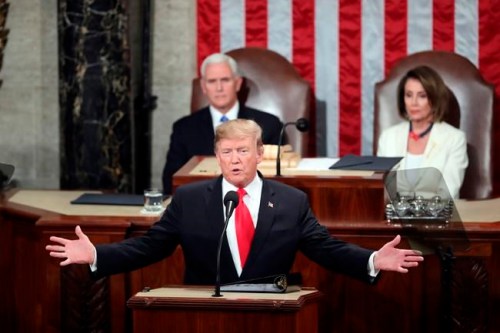
WASHINGTON - President Donald Trump declared his scorched-earth political style an unmitigated success Tuesday in a fiercely partisan, made-for-TV state of the union speech that made it clear he expects to be back in the White House next year on the strength of the U.S. economy and his trade deals with Canada, Mexico and China.

Trump, addressing a joint session of Congress in the very chamber where House Democrats voted to impeach him less than two months ago, became only the second president in American history — Bill Clinton was the first — to deliver a state of the union while standing trial in the Senate.

Unrepentant, he pointedly refused to shake the offered hand of House Speaker Nancy Pelosi on the dais before singing the praises of what he billed as "the great American comeback," pointing to strong job growth, a soaring stock market and low unemployment as evidence of his leadership. And when he was done, Pelosi ripped up the speech in full view of the television cameras.

"America's enemies are on the run, America's fortunes are on the rise, and America's future is blazing bright. The years of economic decay are over," Trump declared, taking full credit for the country's "roaring economy," including what he billed as seven million new jobs and the lowest jobless rate in half a century — a "blue-collar boom" that he's counting on to help his re-election chances in November.

Read
Tuesday, Feb. 4, 2020

A timeline of the WE Charity controversy

The Canadian Press 9 minute read Wednesday, Aug. 19, 2020

OTTAWA - A timeline of events regarding the Canada Student Service Grant program, based on public documents, events and statements from cabinet ministers, government officials, and WE Charity:

March 6, 2020: WE Charity staff prepare a concept paper on service learning for public servants at Employment and Social Development Canada.

April 5: Finance Minister Bill Morneau and Prime Minister Justin Trudeau talk over the phone about how to help students whose summer job and volunteer opportunities were vanishing due to the COVID-19 pandemic. Finance Department officials are tasked with considering options the next morning.

April 7: Small Business Minister Mary Ng and WE co-founder Craig Kielburger have an introductory phone call in which Ng asks WE to send what it calls a ``pre-established proposal'' to help young people launch businesses.

Neo-Nazi group members plotted to kill Free Press reporter

5 minute read Preview

Neo-Nazi group members plotted to kill Free Press reporter

5 minute read Wednesday, Aug. 10, 2022

Disturbing details of a plan to kill a Free Press reporter who had infiltrated a white nationalist hate group were revealed for the first time Wednesday.

Read
Wednesday, Aug. 10, 2022

Science-art collaboration injects dose of emotion into cold, hard truths

Sarah Lawrynuik 5 minute read Preview

Science-art collaboration injects dose of emotion into cold, hard truths

Sarah Lawrynuik 5 minute read Wednesday, Apr. 28, 2021

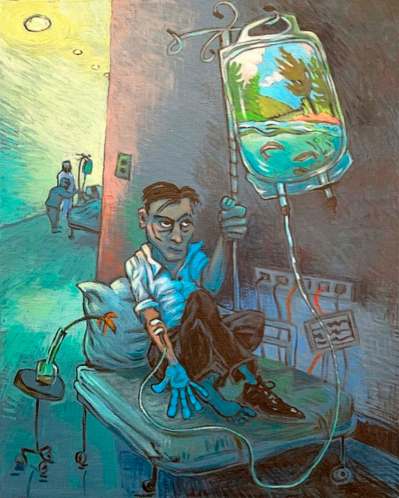
Looking at spreadsheets and map plots of trees is far beyond Rhian Brynjolson’s typical day as a visual artist, but she became entranced and inspired by data collected by Canadian scientists for a new art project.

Her hope is to try and bring the numbers, map dots and statistics to life in a new way to help the public better connect to climate science.

Falcon Lake’s Brynjolson is one of 12 Canadian artists who participated in an art-science collaboration exhibit, co-ordinated by the Global Water Futures program out of the University of Saskatchewan. The project saw the artists paired with researchers and scientists across the country who then engaged in conversations to try to inspire a new angle to their art.

“The whole idea behind it is: water is life,” says Louise Arnal, the project lead, and a post-doctoral fellow at the Centre for Hydrology and Coldwater Laboratory.

Read
Wednesday, Apr. 28, 2021

RCMP to bolster traffic enforcement after ‘concerning’ spike in deadly collisions

Free Press staff 3 minute read Preview

RCMP to bolster traffic enforcement after ‘concerning’ spike in deadly collisions

Free Press staff 3 minute read 12:46 PM CDT

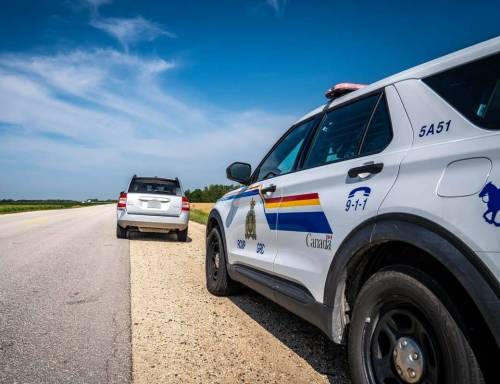
Manitoba RCMP are boosting traffic enforcement after a spike in fatal collisions.

So far this year, 73 people have been killed in 65 collisions — a 28 per cent increase from the 57 deaths in the same January to October period last year, the Mounties said Friday.

The increase in fatalities is 28 per cent higher than the province’s five-year average.

“It’s concerning to me personally, but it’s also concerning to us, the RCMP, to see this many crashes occurring and this many people losing their lives,” RCMP traffic services enforcement commander Staff Sgt. Jon Greer said.

Read
12:46 PM CDT