After 19 months, U.S. land border to reopen to vaccinated Canadians in November

Advertisement

Advertise with us

WASHINGTON - Fully vaccinated Canadian vacationers and day-trippers will be allowed to drive into the United States beginning in early November, the Biden administration said Tuesday, the first glimmer of hope in nearly 20 months for the families and businesses that depend on two-way traffic across the Canada-U.S. border.

Read this article for free:


By clicking the button above, an account will be created and you will begin to receive some of our recommended newsletters. You may opt out of any newsletter by visiting your Email and Communication Preferences page or by clicking "unsubscribe" at the bottom of any email.

or

Already have an account? Log in here »

To continue reading, please subscribe:

Digital Subscription

One year of digital access for only $1.44 a week*

  • Enjoy unlimited reading on winnipegfreepress.com
  • Read the E-Edition, our digital replica newspaper
  • Access News Break, our award-winning app
  • Play interactive puzzles

*Billed as $5.77 plus GST every four weeks. After 52 weeks, price increases to the regular rate of $19.95 plus GST every four weeks. Offer available to new and qualified returning subscribers only. Cancel any time.

To continue reading, please subscribe:

Add Free Press access to your Brandon Sun subscription for only an additional

$1 for the first 4 weeks*

  • Enjoy unlimited reading on winnipegfreepress.com
  • Read the E-Edition, our digital replica newspaper
  • Access News Break, our award-winning app
  • Play interactive puzzles
Start now

*Your next Brandon Sun subscription payment will increase by $1.00 and you will be charged $17.95 plus GST for four weeks. After four weeks, your payment will increase to $24.95 plus GST every four weeks.

Hey there, time traveller!
This article was published 12/10/2021 (1848 days ago), so information in it may no longer be current.

WASHINGTON – Fully vaccinated Canadian vacationers and day-trippers will be allowed to drive into the United States beginning in early November, the Biden administration said Tuesday, the first glimmer of hope in nearly 20 months for the families and businesses that depend on two-way traffic across the Canada-U.S. border.

Senior government officials delivered the news in a conference call with reporters on condition they hold their reports until early Wednesday — a plan that quickly went out the window when New York congressman Brian Higgins all but shouted the news from the rooftops.

“At long last, there is action by the United States to open the doors and welcome back our Canadian neighbours,” Higgins said in a statement.
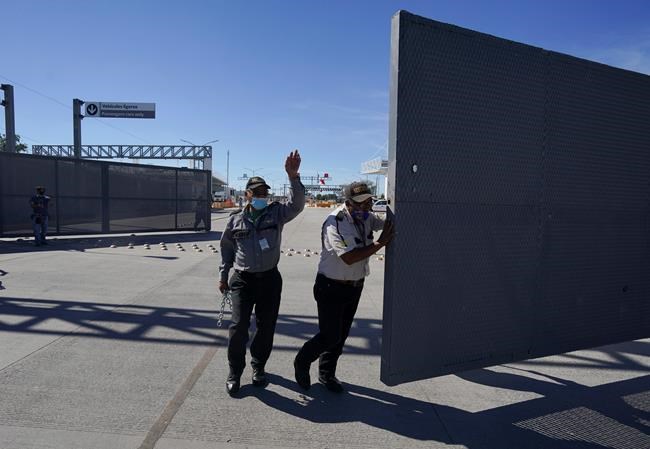
Mexican security officers open the main gate of the international border bridge that connects Del Rio, Texas and Ciudad Acuna, Mexico, after its partial reopening Saturday, Sept. 25, 2021. A new trilateral poll suggests U.S. residents are far more worried about reopening the land border with Mexico than they are about letting Canadians drive into the country.THE CANADIAN PRESS/AP/Fernando Llano

“Border communities await further details from the administration with great expectation, and I will continue to advocate for a more fully and freely open border to both governments, sooner rather than later.”

Those details remained few and far between Tuesday, but the plan is designed to dovetail with the administration’s existing plan to allow international travellers from further afield to resume travelling to the U.S. on the same timeline, provided they’ve been fully vaccinated against COVID-19.

“We understand how valuable … travel from Canada and Mexico is to the economic activity in border communities and to our broader economy,” one of the officials said.

“We also know how meaningful the ability to travel is to maintain the personal ties between people living on either side of the northern and southern U.S. borders, who are often effectively members of one community.”

Non-essential travel to the U.S. by unvaccinated foreign nationals will remain prohibited, officials said. As of early January, even essential travellers who are foreign nationals seeking to enter the U.S. will need to provide proof of vaccination.

Travellers will be considered to be fully vaccinated if they have received a full course of a COVID-19 vaccine approved by either the U.S. Food and Drug Administration or the World Health Organization, which includes Oxford-AstraZeneca, a common vaccine in Canada that never received FDA approval.

The jury is still out on whether travellers who received mixed doses will be eligible, but experts at the U.S. Centers for Disease Control and Prevention are currently working on how to address that issue, the officials said.

Higgins, who serves as co-chair of both the Canada-U.S. Interparliamentary Group and the Northern Border Caucus, became a tenacious and vocal critic of the restrictions as soon as the vaccines proved effective and accessible in both countries.

His efforts and those of allies in both countries, some of them mounting concerted media campaigns and lobbying efforts to expand awareness of the extended delay in easing the restrictions, soon resulted in a chorus of prominent U.S. congressional voices exerting pressure on the White House to take action.

“A robust cross-border exchange between the United States and Canada is fundamental to our binational relationship and mutually beneficial to our nations’ citizens, businesses and economies,” Higgins said.

“Strong vaccination rates in Canada made the continued border shutdown absurd and unjustifiable.”

Fully vaccinated U.S. citizens and permanent residents have been allowed back into Canada since August, provided they have waited at least 14 days since getting a full course of a Health Canada-approved vaccine and can show proof of a recent negative COVID-19 test.

Beginning in early November, the U.S. plans to allow fully vaccinated visitors from a host of countries where stateside travel has long been restricted, including China, India, Ireland, Iran, South Africa, Brazil and the 26 European countries without border controls, known as the Schengen group.
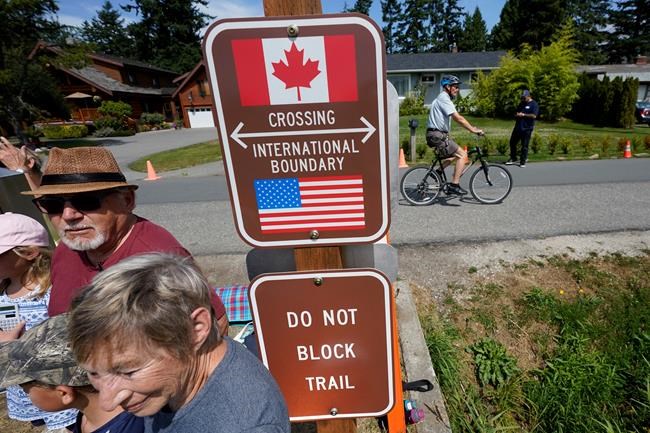
A family visits across the U.S.-Canada border at the Peace Arch Historical State Park as a cyclist rides past on the Canadian side, Monday, Aug. 9, 2021, in Blaine, Wash. THE CANADIAN PRESS/AP-Elaine Thompson

No specific dates have yet been announced.

Only about 66 per cent of eligible Americans are fully vaccinated against the virus, according to the latest numbers available from the CDC. By comparison, Health Canada says 81 per cent of eligible Canadians 12 or over have had a full course of vaccine.

The decision to reopen the land border ends a 19-month freeze due to the COVID-19 pandemic and is part of a plan to also open the border with Mexico. Vehicle, rail and ferry travel between the U.S. and Canada and Mexico has been largely restricted to essential travel, such as trade, since the earliest days of the pandemic.

Homeland Security Secretary Alejandro Mayorkas was expected to provide more details about the new rules Wednesday.

Both Mexico and Canada have been pressing the U.S. for months to ease restrictions on travel that have separated families and curtailed leisure trips since the onset of the pandemic. The latest move follows last month’s announcement that the U.S. will end country-based travel bans for air travel, and instead require vaccination for foreign nationals seeking to enter by plane.

According to the officials, travellers entering the U.S. by vehicle, rail and ferry will be asked about their vaccination status as part of the standard U.S. Customs and Border Protection admissions process. At officers’ discretion, travellers will have their proof of vaccination verified in a secondary screening process.

Unlike air travel, for which proof of a negative COVID-19 test is required before boarding a flight to enter the U.S., no testing will be required to enter the U.S. by land or sea, provided the travellers meet the vaccination requirement.

The delay in the vaccination requirement for essential cross-border travel is meant to provide truck drivers and others with additional time to get a shot and minimize potential economic disruption from the vaccination mandate, officials said.

— With files from The Associated Press.

This report by The Canadian Press was first published Oct. 12, 2021.

Report Error Submit a Tip

More Stories

Sarault wins silver medal in 1,000-metre

The Canadian Press 2 minute read Saturday, Feb. 8, 2020

DRESDEN, Germany - Canadian Courtney Sarault won a silver medal in the women's 1,000-metre event at the ISU short track World Cup on Saturday.

Sarault, from Moncton, N.B., took second place with a time of 1:55.143 — finishing behind South Korea's Kim Ji Yoo (1:54.955) and ahead of World Cup overall standings leader Suzanne Schulting of the Netherlands. (1:55.167).

"Going into the final, I didn't feel amazing, but I was trying to stay positive, and hoping to come out of it with a podium," said Sarault.

Meanwhile, Canada's Kim Boutin had her string of podium results come to an end at eight events.

iPhone started fire, Winnipegger says

Kevin Rollason 3 minute read Preview

iPhone started fire, Winnipegger says

Kevin Rollason 3 minute read Tuesday, Nov. 26, 2019

The iPhone has long been a hot item, but for one Winnipeg family, it got too hot.

Wally Hill says earlier this month, he, along with his wife and daughter, were watching television, with his daughter's iPhone 6 sitting unplugged on the cushion between them, when the smartphone set the couch on fire.

"It was frightening," Hill said. "It didn't explode... it fizzled and popped open at the back, and then smoke and flames came out the back. It then ignited the cushion."

Hill said he quickly picked up the entire couch cushion, with the burning phone still on it, to move the device to a tile floor in his residence.

Read
Tuesday, Nov. 26, 2019

Oliveira inks three-year extension with Bombers

Taylor Allen 2 minute read Preview

Oliveira inks three-year extension with Bombers

Taylor Allen 2 minute read Tuesday, Dec. 16, 2025

Brady Oliveira is staying home.

The Winnipeg Blue Bombers announced Monday afternoon the star running back has agreed to a three-year contract extension through the 2028 season.

The 28-year-old was scheduled to become a free agent in February.

“I know what I can bring and I know I’m a calibre of player that can help a team win a championship, so I want to put myself in the best situation to win a championship,” said Oliveira in his end of season press conference in November.

Read
Tuesday, Dec. 16, 2025

TV that makes the cut

Denise Duguay 4 minute read Preview

TV that makes the cut

Denise Duguay 4 minute read 2:01 AM EST

Ambition is a great motivator in fields as diverse as professional boxing, high-school dance team, photography, animal wrangling and even — stay with me here — bank robbery and alien-summoning?

Sure, some of these are more relatable than others, but the solutions, and the series and movie that contain them, are intriguing. Press play to become a better you.

● The Greatest (docudrama series premières Wednesday, Nov. 4 on Prime Video)

This dramatization of the life of acclaimed boxer and activist Muhammad Ali is billed as the first authorized scripted series on the subject. Its executive producers include his widow, Lonnie Ali, as well as serious name brands Jay-Z and Michael B. Jordan. Newcomer Jaalen Best plays the title role, supported by Giovanni Ribisi (American Hostage) playing Angelo Dundee and Michael Ealy (The Following) as Malcolm X.

Read
2:01 AM EST

Manitoba film and music ambassador calling it quits

Jen Zoratti 5 minute read Preview

Manitoba film and music ambassador calling it quits

Jen Zoratti 5 minute read Wednesday, Aug. 29, 2018

After more than three decades as a leader and champion in this province’s film and music industries, Manitoba Film & Music CEO and film commissioner Carole Vivier is retiring, effective June 2019.

Since joining MFM in 1985 — and serving at its helm for the past 26 years — Vivier has supported some of Manitoba’s biggest cultural exports, including Guy Maddin, the Weakerthans, Doc Walker, the Crash Test Dummies, Norma Bailey and Tanya Tagaq, since the beginning of their careers. She has built a local, national and international reputation for being a passionate and committed ambassador for Manitoba filmmakers, musicians, producers, creators and crew.

Vivier was not available on Tuesday to comment on the announcement, but had this to say in the press release:

“I am grateful to have been a part of this industry for the past three decades and to witness the growth and success of our amazing artists and professionals. I am immensely proud of the talent in this province. Although I will miss MFM, I am tremendously encouraged that a strong foundation is in place, from which new talent can reach even greater heights. The future of film and music in Manitoba is very bright.”

Read
Wednesday, Aug. 29, 2018

NDP should heed own advice, bring back 50-50 funding

Mark Hudson 5 minute read 2:01 AM EST

Transit riders have a love-hate relationship with our “people’s limousine.” For many, it’s their only means of mobility. Others ride because they believe urban life is better when people use public transit rather than choking the roads with single-occupancy cars.

At the same time, one of life’s mid-sized stressors is peering into the distance on a cold, snowy Winnipeg morning to see whether your late bus is yet on the horizon and, when it appears, whether it’s full to capacity and going to roll past. It’s the kind of thing that pushes you back into the car, if you have access to one.

We could make a big dent in this daily anxiety, help pay transit workers fairly and do our part to stave off climate disaster by restoring a tried-and-true funding scheme: the 50-50 model. This shared-cost model, in which the provincial government pays half of transit operating costs over and above service revenues, was brought in when I was a kid waiting to board the bus with my parents in the 1970s.

The Progressive Conservative government of Gary Filmon initially ditched it in 1993. New Democrats reinstalled it in 2007, with then-Lt.-Gov. John Harvard announcing in the 2006 throne speech: “Manitoba is committed to increased provincial funding for transit operating costs in Thompson, Flin Flon, Brandon and Winnipeg, restoring the 50-50 funding partnership that was in place prior to the cutbacks of the 1990s.”