Trudeau, Ford likely to be civil, unless there’s a COVID-19 surge: experts

Advertisement

Advertise with us

TORONTO - Voters in Canada's most populous province will likely see their premier and prime minister on civil terms in the early days of this pandemic election campaign, experts say, though the tide could turn with a surge of COVID-19 cases.

Read this article for free:


By clicking the button above, an account will be created and you will begin to receive some of our recommended newsletters. You may opt out of any newsletter by visiting your Email and Communication Preferences page or by clicking "unsubscribe" at the bottom of any email.

or

Already have an account? Log in here »

To continue reading, please subscribe:

Digital Subscription

One year of digital access for only $1.44 a week*

  • Enjoy unlimited reading on winnipegfreepress.com
  • Read the E-Edition, our digital replica newspaper
  • Access News Break, our award-winning app
  • Play interactive puzzles

*Billed as $5.77 plus GST every four weeks. After 52 weeks, price increases to the regular rate of $19.95 plus GST every four weeks. Offer available to new and qualified returning subscribers only. Cancel any time.

To continue reading, please subscribe:

Add Free Press access to your Brandon Sun subscription for only an additional

$1 for the first 4 weeks*

  • Enjoy unlimited reading on winnipegfreepress.com
  • Read the E-Edition, our digital replica newspaper
  • Access News Break, our award-winning app
  • Play interactive puzzles
Start now

*Your next Brandon Sun subscription payment will increase by $1.00 and you will be charged $17.95 plus GST for four weeks. After four weeks, your payment will increase to $24.95 plus GST every four weeks.

Hey there, time traveller!
This article was published 16/08/2021 (1902 days ago), so information in it may no longer be current.

TORONTO – Voters in Canada’s most populous province will likely see their premier and prime minister on civil terms in the early days of this pandemic election campaign, experts say, though the tide could turn with a surge of COVID-19 cases.

Ontario Premier Doug Ford and Liberal Leader Justin Trudeau have sparred at times this year, largely on vaccine supply and border controls, but they may well find it mutually beneficial not to bicker in front of weary Canadians.

Ginny Roth, a vice-president at public relations firm Crestview Strategy, said Trudeau may find he wants an enemy in Ford partway through the campaign, but the Progressive Conservative premier likely won’t play ball.
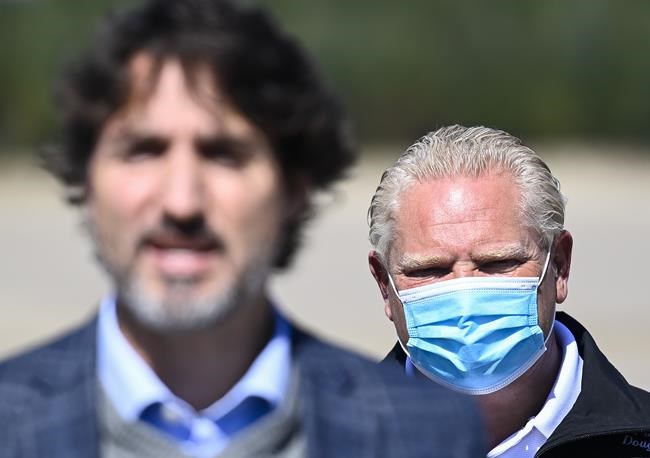
Canadian Prime Minister Justin Trudeau, front, speaks as Ontario Premier Doug Ford listens after taking part in a ground breaking event at the Iamgold Cote Gold mining site in Gogama, Ont., Friday, Sept. 11, 2020. Voters in Canada's most populous province will likely see their premier and prime minister on civil terms in the early days of this pandemic election campaign, experts say, though the tide could turn with a surge of COVID-19 cases. THE CANADIAN PRESS/Nathan Denette

“For Premier Ford, I think on almost every issue set it will not serve him well to get into a fight — including on COVID — and I think he realizes that,” said Roth, a former Progressive Conservative organizer.

Incumbents have fared well in elections during the pandemic, she said, and there seems to be a détente of sorts among them.

“I think that the smart political leaders realize that incumbents are kind of grouped together by voters,” Roth said.

“If voters think that Canada’s COVID response is positive right now, it’s in the interest of the incumbents to share the credit for that. If COVID goes badly again, yes, it will be in the prime minister’s interest to try to convince the public that it’s the provincial government’s fault.”

During the last federal election, Ford became Trudeau’s punching bag, a proxy Conservative bogeyman, but that’s what he needed in 2019 — not so this time around, said Andrew Steele, a vice-president at consulting firm StrategyCorp.

For Trudeau, this election will be more about positioning himself as the leader to keep Canadians safe, he said.

“If your message is, ‘I’m a safe port in a storm,’ you don’t make a lot of sounds like thunder and splash water around,” said Steele, a former Liberal senior staffer. “You want to be a statesman, you want to be above that interprovincial fray and show leadership.”

Alberta Premier Jason Kenney is a more convenient bad guy in terms of COVID-19 anyway, Steele said.

“If Trudeau does need a foil, Jason Kenney is a lot more unpopular than Ford is right now and he provides a much stronger example if he needs somebody to blame for not following COVID protocols,” he said.

If the pandemic starts to worsen, voters may question the timing of an election, Roth said.

“The Liberals are in a tough spot federally because they have been so much in the direction of urging caution around reopening that they can’t afford to be perceived to be threatening people’s health or to be hypocritical … launching a very reopening-style election campaign,” she said.

“The prime minister is going to be in a tough spot and you may see some premiers start to join in the (Conservative Leader) Erin O’Toole refrain” that now is not the time for an election.

Trudeau and Ford started the pandemic like much of the country, with an “all in this together” attitude, and their approval ratings soared.

But cracks have since started to show, and as Ford’s ratings have fallen he has hammered the federal government on vaccine supply, particularly during the second wave. During the third wave he went on the attack again, blaming “porous” borders for new variants entering.

For his part, Trudeau has suggested Ford was trying to deflect criticism of his own pandemic handling.

The border campaign was likely more about Ford shoring up his own base ahead of Ontario’s 2022 election rather than hurting Trudeau’s chances, said Carleton University political science professor Jonathan Malloy.

One of the COVID-19 thorns in Ford’s side that Trudeau could capitalize on is a growing chorus of people calling for the premier to introduce a vaccine certificate system as a way to bar unvaccinated people from non-essential activities.

Ford has so far refused, but polling suggests it’s a popular idea, and many groups within both the health-care and business communities support it.

“Trudeau is going to look very carefully at Ontario politics and particularly the seats he wants to target,” Malloy said.

The Liberals announced mandatory vaccination for federal workers and those in federally regulated industries days before the campaign, after earlier saying they were developing a vaccine passport system for international travel.

This report by The Canadian Press was first published Aug. 16, 2021.

Report Error Submit a Tip

More Stories

Newspaper websites display fewer stories, more curation

5 minute read Tuesday, Feb. 10, 2026

A city subcommittee was provided with a routine update on the status of an ongoing administrative process Thursday, in accordance with standard reporting procedures.

A timeline of the WE Charity controversy

The Canadian Press 9 minute read Wednesday, Aug. 19, 2020

OTTAWA - A timeline of events regarding the Canada Student Service Grant program, based on public documents, events and statements from cabinet ministers, government officials, and WE Charity:

March 6, 2020: WE Charity staff prepare a concept paper on service learning for public servants at Employment and Social Development Canada.

April 5: Finance Minister Bill Morneau and Prime Minister Justin Trudeau talk over the phone about how to help students whose summer job and volunteer opportunities were vanishing due to the COVID-19 pandemic. Finance Department officials are tasked with considering options the next morning.

April 7: Small Business Minister Mary Ng and WE co-founder Craig Kielburger have an introductory phone call in which Ng asks WE to send what it calls a ``pre-established proposal'' to help young people launch businesses.

Fawcett promises growth in second term as Brandon mayor

Alex Lambert 2 minute read Preview

Fawcett promises growth in second term as Brandon mayor

Alex Lambert 2 minute read 9:39 AM CDT

BRANDON — Jeff Fawcett promises “incredible opportunities” for Brandon over the next four years.

The incumbent was handily re-elected for a second term as Brandon mayor Wednesday evening, receiving 54 per cent of the vote. He defeated his only challenger, former councillor and MLA Len Isleifson, by 907 votes.

“The next four years presents incredible opportunities for our city,” Fawcett told supporters after the victory. “We’ll continue to support responsible growth, strengthening our neighbourhoods, investing in infrastructure, supporting local businesses, and ensuring Brandon remains a place where families and future generations can thrive.”

Isleifson, a Brandon councillor from 2010 to 2014 and Brandon East Tory MLA from 2016 to 2023, called the result disappointing but said he wouldn’t change anything about his campaign.

Read
9:39 AM CDT

Building healthier Canadians

Jason M. Sutherland 4 minute read 2:00 AM CDT

Ottawa is betting that billions of taxpayer dollars spent on steel, asphalt and concrete will secure Canada’s economic future and prosperity. Through the $51 billion Build Communities Strong fund, the federal government is paying for roads, bridges, water systems and transit to boost productivity and attract capital from Europe and Asia.

As the shovels hit the ground from Halifax to Vancouver, Canadians should be asking themselves: What good does it do to build a stronger country if we are not building healthier Canadians?

The fund’s $5 billion allocation for health infrastructure is welcome news, as many of our hospitals and long-term care homes across the country are showing severe signs of aging, and modern care centres are much needed. But pouring concrete for new facilities is not the same as building a healthy population.

A ribbon-cutting at a modern hospital does not guarantee you see a family doctor when you need one, keep a rural emergency department open overnight, or shorten the wait for a knee replacement keeping someone off the job or robbing a retiree of independence.

Must-see Folk Fest workshops

16 minute read Preview

Must-see Folk Fest workshops

16 minute read Thursday, Jul. 5, 2018

Workshops have always been an integral part of the Winnipeg Folk Festival.

They are magic-moment makers; a curated group of musicians — sometimes friends, sometimes strangers — on one stage playing together, supporting each other, creating something that will only exist for an hour or two. No one knows what will come out of the collaboration, but usually it’s something special.

When the Free Press spoke to Winnipeg Folk Festival artistic director Chris Frayer ahead of the lineup release in early March, he noted he would be paying some extra attention to workshops this year, as some of the special projects occurring during the past couple of festivals had pulled some of his attention away.

And with 37 workshops on the books, it would seem he followed through on his promise.

Read
Thursday, Jul. 5, 2018

Ottawa announces $500 million for North End sewage plant upgrade

Joyanne Pursaga 4 minute read Preview

Ottawa announces $500 million for North End sewage plant upgrade

Joyanne Pursaga 4 minute read 5:03 PM CDT

The federal government will provide $500 million to help complete the major upgrade to Winnipeg’s North End sewage treatment plant.

Winnipeg South MP Terry Duguid confirmed the total funding at a news conference at the plant Friday, calling the work critical to Winnipeg’s future.

“The stakes could not be higher. Without expanded wastewater treatment, Winnipeg would run out of capacity to build new homes and accommodate new industries within six years,” said Duguid.

The commitment offers the final funding needed to cover the $1.57-billion third and final phase of the upgrade. The city and province will also pay $500 million each for the work.

Read
5:03 PM CDT