How U.S. citizens can make travelling from U.S. to Canada as painless as possible

Advertisement

Advertise with us

WASHINGTON - Fully vaccinated U.S. citizens and permanent residents can now enter Canada for non-essential purposes for the first time since March 2020, when the COVID-19 pandemic forced the two countries to severely curtail travel.

Read this article for free:


or

Already have an account? Log in here »

To continue reading, please subscribe:

Subscribe and receive a limited-edition Free Press branded hat or tote.

Digital Subscription

One year of digital access for only $205*

  • Enjoy unlimited reading on winnipegfreepress.com
  • Read the E-Edition, our digital replica newspaper
  • Access News Break, our award-winning app
  • Play interactive puzzles

*First annual payment billed as $205.00 + GST for one year. This annual subscription will automatically renew at $233.00 + GST every 52 weeks (10% off the regular annual price of $259.35). Offer available to new and qualified returning subscribers only. Cancel any time.

To continue reading, please subscribe:

Add Free Press access to your Brandon Sun subscription for only an additional

$1 for the first 4 weeks*

  • Enjoy unlimited reading on winnipegfreepress.com
  • Read the E-Edition, our digital replica newspaper
  • Access News Break, our award-winning app
  • Play interactive puzzles
Start now

*Your next Brandon Sun subscription payment will increase by $1.00 and you will be charged $17.95 plus GST for four weeks. After four weeks, your payment will increase to $24.95 plus GST every four weeks.

Hey there, time traveller!
This article was published 09/08/2021 (1862 days ago), so information in it may no longer be current.

WASHINGTON – Fully vaccinated U.S. citizens and permanent residents can now enter Canada for non-essential purposes for the first time since March 2020, when the COVID-19 pandemic forced the two countries to severely curtail travel.

Still, there are stringent requirements and rules in place that need to be followed to ensure crossing into Canada goes smoothly. Here are five key questions to consider before making a run for the (northern) border:

1. What constitutes being “fully vaccinated,” as far as the Canada Border Services Agency is concerned?
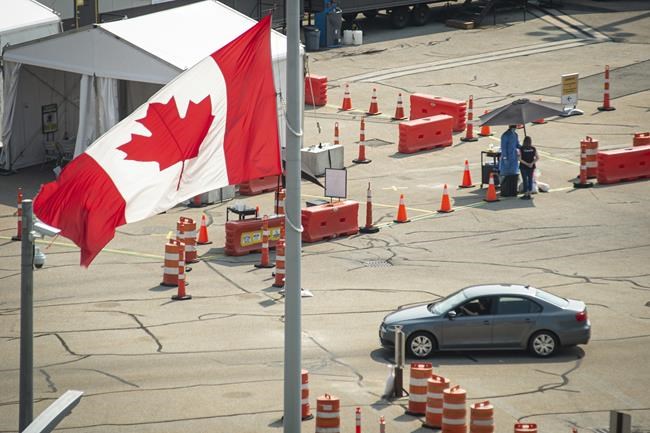
A car crosses the border into Canada, in Niagara Falls, Ont., on Monday, August 9, 2021. American citizens and permanent residents are now allowed to enter Canada for non-essential purposes if they can provide proof that they’ve been fully vaccinated for at least 14 days.THE CANADIAN PRESS/Eduardo Lima

Several things. First, eligible travellers must have completed a full course of one of the four COVID-19 vaccines approved by Health Canada: Pfizer-BioNTech, Moderna, Oxford-AstraZeneca (also known as Covishield) or the single-dose Johnson & Johnson shot. No other vaccines are allowed. Secondly, and this is critical: 14 full days must have elapsed since the last dose, otherwise a person is not considered fully vaccinated.

2. Can I just show my vaccination card to the border agent?

No. Vaccination details must be uploaded to the agency by way of ArriveCAN, an online system that can be accessed either through the iPhone or Android app or via computer at the following web address: www.canada.ca/en/public-health/services/diseases/coronavirus-disease-covid-19/arrivecan.html. Access to the system is not available until 72 hours before a traveller is scheduled to cross the border. When using the app, be sure to update it first; a new version is made available every time the regulations change. And don’t even try to fake your way in; a pair of travellers who uploaded phoney vaccination cards and lied about their test results last month were each hit with nearly $20,000 in fines.

3. What else do I need?

Proof that you are a U.S. citizen or permanent resident who lives full-time in the States, as well as a negative result from a molecular test for COVID-19, administered no more than 72 hours prior to reaching a border crossing point. So-called “antigen” tests are not permitted. Visitors are also required to keep the proof of their test results for a full 14 days upon entering Canada. Test documents, be they paper or electronic, must show:

— The traveller’s name and date of birth;

— The name and address of the facility that administered the test;

— The date the test was conducted, the type of test and, of course, the test result.

Incidentally, fully vaccinated Canadian citizens and permanent residents are also eligible to enter Canada without having to quarantine, provided they meet all the same conditions and requirements.

4. Anything else I should know?

Yes. Canadian border agents are randomly selecting otherwise eligible travellers for spot pre-entry COVID-19 testing, so be prepared to submit to a test before being allowed in. You should also have a quarantine plan ready and available to show the agent in the event that you develop symptoms of COVID-19, test positive at the border or otherwise don’t fully qualify for the exemption. Also, expect to wait awhile: the additional screening measures are slowing things down a lot at certain entry points (a full seven hours Monday at the Fort Frances bridge between Minnesota and northern Ontario). If you’re driving, check out CBSA’s wait-times website at www.cbsa-asfc.gc.ca/bwt-taf/menu-eng.html to see if there’s a better route to take.

5. I’m otherwise eligible to enter Canada, but I’ve already had COVID-19 and I’m still testing positive. What can I do?

Provided you are currently symptom-free, you can show proof of a positive COVID-19 molecular test that was conducted between 14 and 90 days prior to trying to enter Canada. However, you will still need to show the results of a molecular test that’s less than 72 hours old, even if the result is positive.

This report by The Canadian Press was first published Aug. 9, 2021.

Report Error Submit a Tip

More Stories

Is ‘tornado alley’ moving north?

Editorial 4 minute read Preview

Is ‘tornado alley’ moving north?

Editorial 4 minute read Friday, Sep. 11, 2026

There’s a famous fictional story in which a ruby-slippered, tornado-tossed traveller takes a wide-eyed look around and declares, “I’ve a feeling we’re not in Kansas anymore.”

There are probably some residents of south River Heights, on the other hand, who looked out their windows last Sunday and felt as if Kansas — the U.S. state that lies smack-dab in the middle of meteorological maps outlining the area known as “tornado alley” — was exactly where they’d somehow ended up.

There is now confirmation of a tornado touching down within Winnipeg, after several residents reported seeing funnel-shaped clouds during the intense thunderstorm, and the magnitude and extremely localized nature of the damage — including felled trees, snapped hydro poles, scattered fences and the deposit of a random automobile on one resident’s front lawn — certainly shows forces more formidable than strong wind gusts were at play.

As Manitoba Hydro and City of Winnipeg crews continued the days-long effort to clean up the mess and restore power to thousands of homes affected by the long-weekend weather blast, some of the conversation related to the storm focused on how extreme events such as this have become more commonplace in a region where tornadoes were long considered a rarity.

Read
Friday, Sep. 11, 2026

Nifty neighbours also jonesing for geniality

Maureen Scurfield 4 minute read Yesterday at 2:02 AM CDT

DEAR MISS LONELYHEARTS: Recently, a new couple with no children moved onto our cul de sac, and everybody is taking notice! This attractive pair with no kids both drive amazing cars, work from home and leave their garage doors up a lot. Everybody on the street walks by to sneak a peek into the big garage at just about any time of day.

Lately, the man’s been out on his front lawn in a muscle shirt in the late afternoon, planting shrubs and putting up stylish fall-themed ornaments. At night they often leave the living-room curtains open. That makes for convenient viewing for curious neighbours like us!

A few days ago, my wife invited the new couple over for a barbecue and swim in our pool. They are really nice people, but mentioned that other people nearby have been pretty stand-offish. They wonder why. Should I tell them it’s probably just jealousy over their beautiful vehicles and enviable lifestyle, or should I just shut up?

—Wanting to Help, Sage Creek

Travelling from U.S. to Canada? Here are the rules

James McCarten, The Canadian Press 4 minute read Preview

Travelling from U.S. to Canada? Here are the rules

James McCarten, The Canadian Press 4 minute read Monday, Aug. 9, 2021

Canadian business groups welcome reopening of border to vaccinated U.S. tourists, but seek clarity amid concern over rising Delta variant cases of COVID-19.

Read
Monday, Aug. 9, 2021

Bundled Bourdain thrillers a delight

David Pitt 4 minute read Saturday, Sep. 5, 2026

Most people know the late Anthony Bourdain as a chef, culinary author/memoir writer and TV personality. But did you know he also wrote mystery fiction?

Between 1995 and 2002 Bourdain published three mystery novels: Bone in the Throat, Gone Bamboo and The Bobby Gold Stories. They’re collected here as Three Crime Novels by Anthony Bourdain (Bloomsbury, 608 pages, $32) and they are, well, delightful.

You know you’re in good hands when an author describes a character as “a cross between Sonny Bono and Hermann Göring” — this is a guy who knows how to turn a phrase.

And this is a guy who knows how to spin a yarn: these stories, starring an ex-con, a retired government assassin and (yes) a chef, are pure gold — not merely mostly forgotten curiosities written by a guy who’s famous for something else entirely, but exciting, entertaining mysteries that demand to be read simply because they’re so damned good.

What do we elect a school trustee to do?

Laura Reimer 5 minute read Yesterday at 2:00 AM CDT

On Oct. 28, Manitobans will once again elect the people who serve on our local school boards. School trustee races rarely attract the attention given to other elections. Yet school boards are among our most immediate forms of representative democracy.

Before asking who should be a school trustee, perhaps we should ask a more basic question:

What, exactly, are we electing a school trustee to do?

Trustees are elected to govern a school division. They are not elected to run it.

The port of Churchill — but done right

Editorial 4 minute read Preview

The port of Churchill — but done right

Editorial 4 minute read Yesterday at 2:00 AM CDT

The seagoing grain carrier wasn’t christened with a champagne bottle. There was no confetti or streamers. Nevertheless, the Aug. 31 event marking the first shipment of grain to be loaded at the Port of Churchill since 2020 was celebrated like the launch of a brand new vessel.

The presence of the federal minister of northern and arctic affairs, provincial cabinet ministers and leaders and elders from several northern First Nations signalled that the fast-tracked process of refurbishing and buffing up Manitoba’s deep-water seaport gem is gaining momentum.

For OneNorth, the partnership of 29 First Nations and 12 northern communities which owns the Port of Churchill and the Hudson Bay Railway (both operated by the Arctic Gateway Group) the event heralded a new beginning. It’s been eight years since OneNorth purchased the port and railroad, and six years since grain was moved by rail through Manitoba and then by ship to European markets. Two more grain shipments, plus shipments of potash and critical minerals, will continue through the fall.

When Prime Minister Mark Carney solicited the premiers to suggest “nation-building” projects following his election in 2025, Premier Wab Kinew pitched a Manitoba trade corridor that would move wheat, critical minerals, potash and energy (oil or liquid natural gas) through the Port of Churchill.

Read
Yesterday at 2:00 AM CDT