Despite Delta, Canada welcomes back fully vaxxed U.S. citizens, permanent residents
Advertisement
Read this article for free:
or
Already have an account? Log in here »
To continue reading, please subscribe:

Digital Subscription
One year of digital access for only $205*
- Enjoy unlimited reading on winnipegfreepress.com
- Read the E-Edition, our digital replica newspaper
- Access News Break, our award-winning app
- Play interactive puzzles
*First annual payment billed as $205.00 + GST for one year. This annual subscription will automatically renew at $233.00 + GST every 52 weeks (10% off the regular annual price of $259.35). Offer available to new and qualified returning subscribers only. Cancel any time.
To continue reading, please subscribe:
Add Free Press access to your Brandon Sun subscription for only an additional
$1 for the first 4 weeks*
- Enjoy unlimited reading on winnipegfreepress.com
- Read the E-Edition, our digital replica newspaper
- Access News Break, our award-winning app
- Play interactive puzzles
*Your next Brandon Sun subscription payment will increase by $1.00 and you will be charged $17.95 plus GST for four weeks. After four weeks, your payment will increase to $24.95 plus GST every four weeks.
Read unlimited articles for free today:
or
Already have an account? Log in here »
Hey there, time traveller!
This article was published 09/08/2021 (1862 days ago), so information in it may no longer be current.
WASHINGTON – Fully vaccinated American citizens lined up at the Canada-U.S. border Monday for their first chance to venture north since the COVID-19 pandemic forced the two countries to impose unprecedented travel restrictions nearly 17 months ago.
At the Peace Bridge in Buffalo, N.Y., cars were already lining up when Canada’s exemption for fully vaccinated U.S. citizens and permanent residents kicked in shortly after midnight. Eligible travellers must have allowed 14 days to pass since their last dose of a Health Canada-approved vaccine.
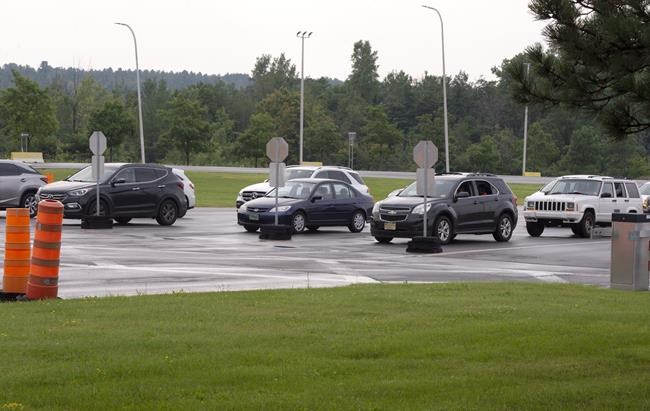
As the supper hour approached Monday, wait times across the country varied widely. It was taking a mind-numbing seven hours to get over the Fort Frances bridge between northern Ontario and Minnesota, and two hours to enter St. Stephen, N.B., from Maine.
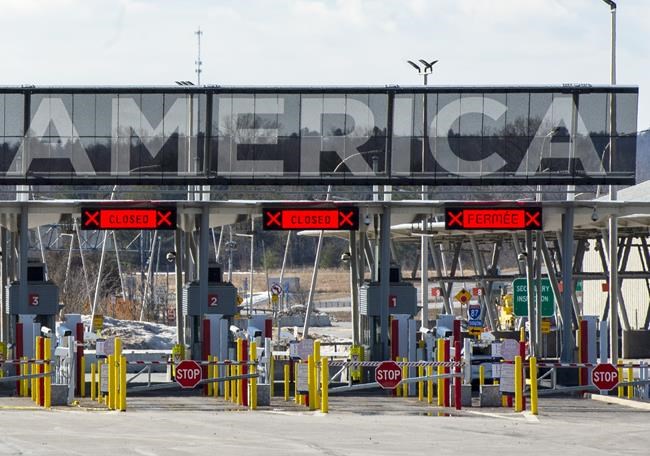
Normally busier entry points like the Peace Bridge, the Queenston-Lewiston Bridge and the Rainbow Bridge in Niagara Falls were all reporting delays of less than an hour, if any. Canada Border Services Agency officials urged travellers to exercise patience.
“I’m honestly just relieved to be here,” Kansas resident Tom Hanson said during a stopover at Toronto’s Pearson International Airport, where he was en route to a long-delayed conference in Edmonton.
“There weren’t a lot of flights, so I had to take the longer route.”
To be eligible, travellers must also live in the U.S., use Canada’s ArriveCAN app or web portal to upload their vaccination details and show proof of a negative molecular test that’s no more than 72 hours old.
David Plotkin, who flew to Toronto from Atlanta to see his brother and pregnant sister-in-law, was relieved to get the chance to visit again when he did.
“It’s a weight off my shoulders, honestly, to be able to see them,” Plotkin said. “It’s the kind of thing you hate to miss if you can help it.”
The U.S., which restricts Canadian visitors at the land border but continues to allow travellers to enter the country by air, has not said when or even if it intends to ease its own travel ban before Aug. 21, when the limits are due for renewal.
Immigration Minister Marco Mendicino intends to raise the question with U.S. Homeland Security Secretary Alejandro Mayorkas when the two leaders meet Tuesday in Washington, D.C.
“Both countries recognize that co-ordinated border policies remain central to controlling COVID-19 and new variants while promoting economic growth and recovery,” Mendicino’s department said in a news release.
“Discussions will focus on managing a secure border that allows for travel, while protecting the integrity of the shared North American perimeter.”
Critics of the U.S. policy were quick to seize on Monday’s imbalance to urge the White House to do something.
“We should work in a co-operative way to find out how we can meet in the middle ground,” Pennsylvania congressman Dwight Evans told an online panel hosted by the Canadian American Business Council.
“I believe that it can be done, and I think it is something that we just have to kind of get our heads together (on).”
New York Rep. Brian Higgins, one of the most persistent congressional voices on easing restrictions in the Canada-U.S. corridor, reiterated his demand for a U.S. plan to let travel resume.
Keeping the restrictions in place “harms separated families and hurts opportunities for economic recovery,” Higgins tweeted. “The time to act is long overdue.”
U.S. border communities have been “decimated” by the restrictions, “with steep losses in employment, wages and sales tax revenues, among other economic impacts,” says a new report from the Border Policy Research Institute at Western Washington University in Bellingham, Wash.
Denis Vinette, vice-president of the CBSA’s travellers branch, said the agency learned a lot when eligible Canadian citizens were allowed to return under similar conditions last month.
About half had to be turned away during the first week because they hadn’t received a Health Canada-approved vaccine, or had not waited the full 14 days after their last shot before travelling.
Canada has approved four vaccines: Pfizer-BioNTech, Moderna, the Oxford-AstraZeneca shot, also known as Covishield, and the single-dose Johnson & Johnson option. All except AstraZeneca have been approved and widely deployed in the U.S.
As of now, border agents won’t be setting up separate queues for vaccinated and unvaccinated visitors — Vinette said a pilot project last month found that doing so had a negligible impact on wait times.
It took just as long — and sometimes longer — to ensure that travellers claiming to be fully vaccinated were indeed eligible to skip the otherwise mandatory 14-day quarantine, he said.
However, as both travellers and agents grow accustomed to the new rules, separate lines could be put in place in the future as travel volume increases.
“If it brings particular flow and additional relief in some of our constrained operations, then we will look at it at that time, but it’s not currently in place.”
The White House is exploring whether, when the time does finally come, to require visitors from outside the country to be fully vaccinated, although it is unclear whether that discussion specifically includes Canadian travellers.

The Canadian government is currently planning to allow vaccinated visitors from outside the U.S. to come to Canada for non-essential reasons as of Sept. 7. However, Transport Canada announced Monday that would not include flights from India, where the Delta variant of COVID-19 has been rampant.
Visitors from India who are travelling on indirect routes will also continue to be required to get a pre-entry molecular test in a third country before their arrival in Canada, the government said.
This report by The Canadian Press was first published Aug. 9, 2021.
— With files from Rhythm Sachdeva in Toronto
Note to readers: This is a corrected story. An earlier version said U.S.-bound rail passengers were exempt from travel restrictions.
Related Articles
Canada reopens its border for vaccinated US visitors
Advertisement Advertise With Us
Advertisement Advertise With Us