Japan has its best Olympic medal haul: 27 gold, 58 overall

Advertisement

Advertise with us

TOKYO (AP) — Despite the pandemic, the one-year delay and the soaring costs, the Japanese public may still find a sweet spot for the Tokyo Olympics, the way it did for the storied 1964 Games.

Read this article for free:


or

Already have an account? Log in here »

To continue reading, please subscribe:

Subscribe and receive a limited-edition Free Press branded hat or tote.

Digital Subscription

One year of digital access for only $205*

  • Enjoy unlimited reading on winnipegfreepress.com
  • Read the E-Edition, our digital replica newspaper
  • Access News Break, our award-winning app
  • Play interactive puzzles

*First annual payment billed as $205.00 + GST for one year. This annual subscription will automatically renew at $233.00 + GST every 52 weeks (10% off the regular annual price of $259.35). Offer available to new and qualified returning subscribers only. Cancel any time.

To continue reading, please subscribe:

Add Free Press access to your Brandon Sun subscription for only an additional

$1 for the first 4 weeks*

  • Enjoy unlimited reading on winnipegfreepress.com
  • Read the E-Edition, our digital replica newspaper
  • Access News Break, our award-winning app
  • Play interactive puzzles
Start now

*Your next Brandon Sun subscription payment will increase by $1.00 and you will be charged $17.95 plus GST for four weeks. After four weeks, your payment will increase to $24.95 plus GST every four weeks.

Hey there, time traveller!
This article was published 08/08/2021 (1885 days ago), so information in it may no longer be current.

TOKYO (AP) — Despite the pandemic, the one-year delay and the soaring costs, the Japanese public may still find a sweet spot for the Tokyo Olympics, the way it did for the storied 1964 Games.

Why? A historic haul of medals.

Japan had its best Olympic production in every category: the most gold medals (27), the most overall (58), and a third-place finish in gold medals behind two much larger countries — the United States and China.
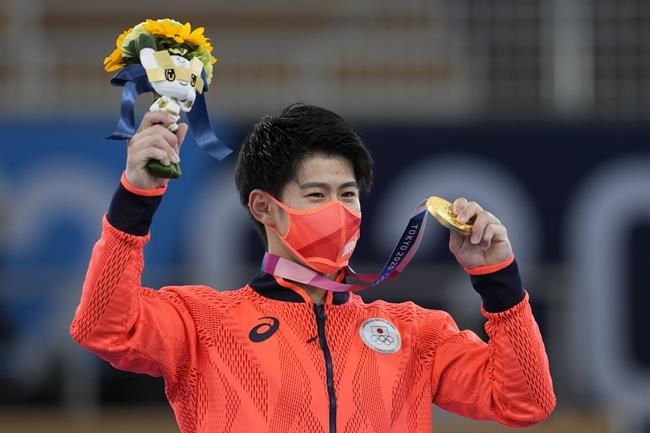
FILE - In this July 28, 2021, file photo, Daiki Hashimoto, of Japan, poses with his gold medal for the artistic gymnastics men's all-around final at the 2020 Summer Olympics in Tokyo. Despite the pandemic, the one-year delay and the soaring costs, the Japanese public may still find a sweet spot for these Olympics, the way it did for the storied 1964 Games. Why? A historic haul of medals. Japan had its best Olympics in every category: the most gold medals (27), the most overall (58), and a third-place finish in both categories behind two much larger countries - the United States and China. (AP Photo/Natacha Pisarenko, File)

“Japan’s national team was able to make its own record result this time,” deputy delegation head Mitsugi Ogata said Sunday as the Olympics ended. “We don’t want this to be like disappearing fireworks. We think it is important that we keep this momentum going through Paris 2024, and Los Angeles 2028.”

The previous best in gold was 16, both in 1964 and at the 2004 Athens Games. The country won only 12 gold medals five years ago in Rio de Janeiro.

The United States won 39 gold medals — one more than China — and was way ahead in the overall medal standings with 113 compared to 88 for China. The Russian Olympic Committee had 71 overall medals followed by Britain with 65. Japan was fifth.

Home countries always get a medal bump, usually by investing more time and money than they would ordinarily. With no fans, some of that home-field advantage was lost. Still, Japan made up for the lack of fans by winning medals in the five sports added to this year’s Olympic program: baseball-softball, sports climbing, karate, surfing and skateboarding.

Each Olympic host gets to add a few sports. Paris will have breakdancing, surfing, karate, and sports climbing.

Japan won gold in both baseball and softball — beating the United States both times in the final — added three gold medals in skateboarding, and another gold in karate. Of its 58 overall medals, 14 came in the sports added for Tokyo.

Atsunori Inaba, the manager of Japan’s winning baseball team, said the gold medal might get more children playing. Though very popular in Japan, baseball participation numbers are down.

“I hope this gold will contribute to increasing the number of both children and adults who want to start playing baseball,” Atsunori said.

Japan’s goal before the pandemic was 30 gold medals. But officials backed off that target in the last several months as it became more difficult during the pandemic to predict Japan’s performance, as well as forecast how other countries would perform.

“Originally we had a goal of winning 30 gold medals.” Ogata said. “Although we were not able to achieve that goal, the number of gold medals, total medals, are all all historic highs.”

Japan got off on the right foot on the first day of the Olympics — in judo, of course. Judo is the only Olympic sport with roots in Japan, and the country’s athletes won nine gold medals, two silver and one bronze.

In the first judo final, Funa Tonaki earned silver in the women’s 48-kilogram class. It was Japan’s 500th Olympic medal — winter and summer — followed by a gold medal from Naohisa Takato in the men’s 60-kilogram final.

That helped get the ball rolling, catching a public’s attention that had been distracted by rising COVID-19 cases and uncertainty about the Olympics even taking place.

Among the successes, Japan won five gold medals in wrestling — four by women — and upset China for gold in table tennis in mixed doubles.

It even reached the gold-medal final against the United States in women’s basketball, losing 90-75. It was Japan’s first medal in women’s basketball, a team coached by American Tom Hovasse.

Tsuyoshi Fukui, the head of the Japanese delegation, confirmed Sunday that gold medalists would receive 5 million yen — about $45,000. Silver is worth 2 million (about $18,000), with 1 million (about $9,000) for bronze.

It will be large payday.

___

More AP Olympics: https://apnews.com/hub/2020-tokyo-olympics and https://twitter.com/AP_Sports

Report Error Submit a Tip

More Stories

Wasteful operations should be held accountable

Barry E. Prentice 5 minute read Preview

Wasteful operations should be held accountable

Barry E. Prentice 5 minute read Yesterday at 2:00 AM CDT

Rising water bills are a top-of-mind issue for residents of Winnipeg going into the fall election. Management of the water and waste system is under question, with citizen’s groups, as well as the Free Press, calling for proper oversight of rates (Time for the PUB to review Winnipeg water rates, Editorial, Sept. 26).

The need to increase rates to build the North End sewage plant is understandable. Siphoning off utility proceeds to make up other tax revenue shortfalls is another matter. But it is not the only questionable practice. If there was Public Utilities Board oversight of Winnipeg’s water and sewer rates, it would certainly be asking why the city is spending more than $3 million annually to operate the 164-kilometre-long, Greater Winnipeg Water District railway (GWWD) on ratepayers’ behalf.

The GWWD has come to the attention of the Railway Relocation Study, led by Lloyd Axworthy. All existing rail lines within the city are under review, as is the feasibility of a new railway bypass.

The GWWD is an example of a railway that has outlived its usefulness and sits on a pocket of land close to downtown that could be converted to higher-value uses.

Read
Yesterday at 2:00 AM CDT

Three Manitoba nurses censured for inappropriate behaviour

Morgan Modjeski 3 minute read Yesterday at 8:38 PM CDT

A Manitoba nurse has been disciplined for inappropriate behaviour towards students including what is being described as unwanted touching.

The College of Registered Nurses of Manitoba listed three recent censures of Manitoba nurses. The most recent details a supervising nurse’s unprofessional conduct while he worked as a clinical education facilitator at the University of Manitoba in 2023.

The behaviour, examined by a college complaints committee, included reports from several students of unwanted touching, violating the confidentiality of students in a group chat and failing to properly report a needlestick injury.

The committee made the decision of censure — a discipline record applied to a nurse’s license — on April 9.

Odermatt wins super-G, keeps season title hopes alive

The Associated Press 3 minute read Preview

Odermatt wins super-G, keeps season title hopes alive

The Associated Press 3 minute read Sunday, Mar. 7, 2021

SAALBACH-HINTERGLEMM, Austria - Marco Odermatt dominated the penultimate men’s World Cup super-G of the season Sunday to keep himself in the race for the discipline title.

The Swiss skier finished his gutsy run on the Schneekristall course 0.62 seconds ahead of runner-up Matthieu Bailet.

The Frenchman was the 2016 junior world champion and earned his first podium result on the World Cup circuit.

Vincent Kriechmayr, the double world champion from Austria, trailed Odermatt by 0.81 in third, a day after he won the downhill on the same hill. Another Austrian, Raphael Haaser, finished two-hundredths behind Kriechmayr in fourth.

Read
Sunday, Mar. 7, 2021

Real journalists matter in an AI world

Paul Deegan 4 minute read Preview

Real journalists matter in an AI world

Paul Deegan 4 minute read 2:00 AM CDT

An algorithm can decide what you see, but it doesn’t report the news. Nunatsiaq News, an award-winning newspaper in Nunavut, recently reported that a so-called “news” website was posting AI-generated articles about the north by stealing real news stories produced by real journalists.

The articles were supposedly written by Nunavut correspondent Leah Qammaniq — a fake journalist, with a fake photo and a fake bio.

Governor General Louise Arbour warned us of fake news in her installation speech in June. She said, “We must continue to protect the public space in which our national debates take place: from schools and universities to the media, political parties, unions and civil society organizations …With instant access to vast amounts of information, it is very tempting to pay little attention to the reliability of sources. The lines between knowledge and belief, between truth and falsehood, between facts and assumptions, are increasingly blurred. AI could be threatening not only the way we live and work, but also the control we exercise over our own destiny.”

The Government of Canada has recognized the problem as well. Its recent discussion paper, Enhancing trust in artificial intelligence through increased transparency, stated, “Canadians encounter news reporting, product reviews, and audio-visual content across the internet, often without any indication of whether it was written by a person, generated by an AI system, or produced through some combination of both … A particular concern within this broader landscape is that generative AI greatly enables the creation and dissemination of deceptive or misleading content.”

Read
2:00 AM CDT

Biographer delves deep into the comedy and the tragedy of Robin Williams' troubled life

Reviewed by GC Cabana-Coldwell 6 minute read Preview

Biographer delves deep into the comedy and the tragedy of Robin Williams' troubled life

Reviewed by GC Cabana-Coldwell 6 minute read Saturday, Jun. 16, 2018

Whenever I’m asked with whom I’d love to dine, entertainer Robin Williams always tops my short list of three. Still.

It’s immaterial that we didn’t move in the same social circles. Or that our career paths never crossed, even though one of his many movies, The Big White, was partially shot in Winnipeg in 2005. Something about him — that hairy persona, those kind blue eyes, the “aw shucks” grin — had intrigued me since watching the debut of his Mork & Mindy TV sitcom in 1978. His off-the-wall goofiness simply sealed the deal.

Comedian Williams became movie-star Williams, and I bought every flick — the good, the not-so-good and the real stinkers. His raunchy standup recordings, often released between his movies, were just an added, adult-only bonus.

So I, like many, was gutted when, at age 63, Williams took his own life in 2014. I didn’t “get” it: how could an award-winning, funny guy, admired by so many for so long, get so beaten up inside that he’d off himself?

Read
Saturday, Jun. 16, 2018

Dozen of Manitoba highways remain closed weeks after storms

Nicole Buffie 5 minute read Preview

Dozen of Manitoba highways remain closed weeks after storms

Nicole Buffie 5 minute read Thursday, Jul. 16, 2026

Thirty five highways remain closed weeks after torrential rain caused destructive flooding in several Manitoba communities.

Crews continue to assess flood damage and repair roads and highways as conditions allow, after historic precipitation washed away many routes.

Some areas in the Parkland region of the province received more than 200 millimetres of rain between June 6 and July 1.

The majority of road closures are in the Roblin area. A storm at the end of June undid a lot of repair work in the Municipality of Minitonas-Bowsman after an early June deluge, officials said.

Read
Thursday, Jul. 16, 2026