Learning setbacks coming into focus with new testing results
Advertisement
Read this article for free:
or
Already have an account? Log in here »
To continue reading, please subscribe:
Digital Subscription
One year of digital access for only $1.44 a week*
- Enjoy unlimited reading on winnipegfreepress.com
- Read the E-Edition, our digital replica newspaper
- Access News Break, our award-winning app
- Play interactive puzzles
*Billed as $5.77 plus GST every four weeks. After 52 weeks, price increases to the regular rate of $19.95 plus GST every four weeks. Offer available to new and qualified returning subscribers only. Cancel any time.
To continue reading, please subscribe:
Add Free Press access to your Brandon Sun subscription for only an additional
$1 for the first 4 weeks*
- Enjoy unlimited reading on winnipegfreepress.com
- Read the E-Edition, our digital replica newspaper
- Access News Break, our award-winning app
- Play interactive puzzles
*Your next Brandon Sun subscription payment will increase by $1.00 and you will be charged $17.95 plus GST for four weeks. After four weeks, your payment will increase to $24.95 plus GST every four weeks.
Read unlimited articles for free today:
or
Already have an account? Log in here »
Hey there, time traveller!
This article was published 29/06/2021 (1939 days ago), so information in it may no longer be current.
AUSTIN, Texas (AP) — The scores from the first U.S. standardized tests taken during the pandemic are offering an early glimpse of just how far students have fallen behind, with some states reporting that the turbulent year has reversed years of academic progress.
Texas education officials offered a grim report Monday as the state became one of the first to release full results from its spring exams. The percentage of students reading at their grade level slid to the lowest levels since 2017, while math scores plummeted to their lowest point since 2013. In total, about 800,000 additional students are now behind their grade level in math, the state said.
“The impact of the coronavirus on what school means, and what school is, has been truly profound,” said Mike Morath, the state’s education commissioner. “It will take several years of change and support in order to help kids catch up.”
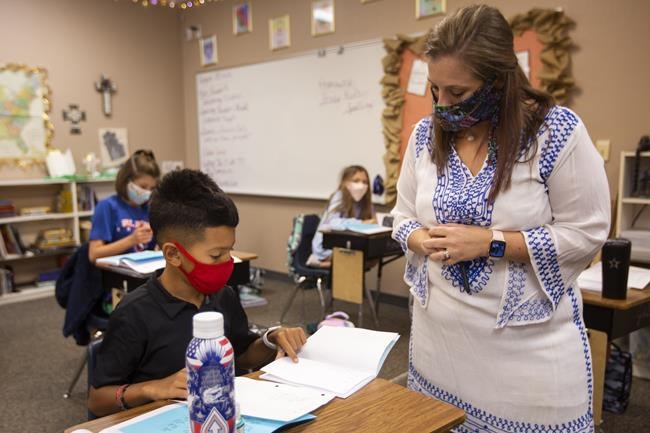
Other states have shared previews of alarming results.
In Florida, officials said reading scores dropped by 4 percentage points compared to 2019, the last time the statewide tests were administered. In Indiana, state officials are warning of a drop in reading scores and a “significant decline” in math.
Experts warn that low participation rates in some regions could leave entire states with unreliable data, and that even within states there are pockets where many families opted out. In Texas, 86% of students took the tests this spring, down from a typical rate of 96%.
Still, the early results provide some of the firmest data yet detailing the effects of the March 2020 school shutdowns, the switch to virtual learning and related disruptions. They also line up with trends seen in national studies over the past year: Students are behind in reading and even farther behind in math.
Setbacks are sharpest among students of color and those from low-income families. And across all student groups, those who spent more time learning in-person had better exam scores.
“It’s a little sickening to see the bottom drop out for so many kids,” said Robin Lake, director of the Center on Reinventing Public Education at the University of Washington. “Clearly remote learning has been hitting the most vulnerable kids the hardest. It’s what we were expecting, but it’s still tough to see.”
Morath said the results underscore the need for a strong return to in-person learning this fall. In districts with many students learning online, the share who failed to meet math standards grew by 32 percentage points. In districts with more in-person learning, by comparison, the failure rate increased by 9 points.
That divide was wider than the gaps between students based on race or income, but the data also found that white students had higher scores than their Black and Hispanic peers, and students from wealthier families had much higher scores than those from poverty.
“These are not numbers, these are children,” Morath said, “and this represents how well we have supported them in their continued academic growth.”
He called out school districts that were slower to return to in-person learning, including in El Paso, saying they saw steeper learning setbacks compared to rural schools that reopened classrooms quickly. In El Paso Independent School District, 64% of eighth-graders fell short of math standards this spring, compared to 20% in 2019, according to state data.
Clay Robison, spokesperson for the Texas State Teachers Association, said the data show there’s no replacement for in-person learning. But he also said that giving families opportunities to learn remotely probably prevented more deaths from COVID-19.
“We were in the middle of a deadly pandemic and we are sure it saved the lives of some students, it saved the lives of some school employees, it saved the lives of some members of their families and it was necessary,” Robison said. “Fortunately, most Texas students and teachers lived to learn another day.”
Officials with the Houston Independent School District said in a statement responding to the test results that they are planning to address learning loss by adding 15 days of instruction and returning to 100% in-person instruction in the fall.
In typical years, Texas uses its annual tests to rate schools and determine whether students can move to the next grade. But state officials suspended those measures during the pandemic and said tests should be used to identify students who need the most help. All students who fell short of testing standards will be entitled to intensive tutoring next school year under new legislation passed by lawmakers last month.
In Indiana, which is expected to release test results this week, lawmakers passed a “hold harmless” bill so that poor test results won’t be used against teachers or schools. The state also set aside $150 million to address learning loss, much of which is being spent on grants to expand summer learning programs.
Students across the U.S. had a year off from the federally required tests last year after the Trump administration suspended exams while the coronavirus raged. But the Biden administration ordered states to resume exams this year with new flexibility. States were told not to order students to come to school just to take tests, and the Education Department granted some states additional leeway to modify exams or test fewer students.
Some states continued to push for a full cancellation of tests, including in New York, Michigan and Georgia. The Education Department denied their requests but allowed Washington, D.C., to skip exams because 88% of students were still learning remotely.
The uneven flexibility drew criticism from testing advocates who say it created a patchwork of state testing plans. With so much variation, they say, it will be difficult to get a clear national picture of the pandemic’s impact on America’s schoolchildren.
Education experts are especially concerned about students who won’t appear in the new results. Those who opted out of exams are more likely to have been learning remotely, researchers say, and may be among students who will need the most help.

Lake, of the University of Washington, said she’s worried about homeless students, along with students who are learning English and those who have special needs. She fears they may be among the “missing kids” who didn’t take tests.
“This is the tip of the iceberg,” Lake said. “These numbers are the very start of what we’re beginning to understand. And there’s potential for these kids to continue to decline if there aren’t quick interventions.”
___
Acacia Coronado is a corps member for the Associated Press/Report for America Statehouse News Initiative. Report for America is a nonprofit national service program that places journalists in local newsrooms to report on undercovered issues.
Binkley reported from Boston. Associated Press writer Casey Smith in Indianapolis contributed to this report.
Related Articles
Reading, writing, repeating: a year lost to COVID
Advertisement Advertise With Us
Advertisement Advertise With Us