WEATHER ALERT

Identifying children’s remains at B.C. residential school stalled by lack of records

Advertisement

Advertise with us

VANCOUVER - A lack of access to records and first-hand data would hinder the ability to identify the remains of 215 children found at a former residential school in Kamloops, says the director of the Indian Residential School History and Dialogue Centre at the University of British Columbia.

Read this article for free:


By clicking the button above, an account will be created and you will begin to receive some of our recommended newsletters. You may opt out of any newsletter by visiting your Email and Communication Preferences page or by clicking "unsubscribe" at the bottom of any email.

or

Already have an account? Log in here »

To continue reading, please subscribe:

Digital Subscription

One year of digital access for only $1.44 a week*

  • Enjoy unlimited reading on winnipegfreepress.com
  • Read the E-Edition, our digital replica newspaper
  • Access News Break, our award-winning app
  • Play interactive puzzles

*Billed as $5.77 plus GST every four weeks. After 52 weeks, price increases to the regular rate of $19.95 plus GST every four weeks. Offer available to new and qualified returning subscribers only. Cancel any time.

To continue reading, please subscribe:

Add Free Press access to your Brandon Sun subscription for only an additional

$1 for the first 4 weeks*

  • Enjoy unlimited reading on winnipegfreepress.com
  • Read the E-Edition, our digital replica newspaper
  • Access News Break, our award-winning app
  • Play interactive puzzles
Start now

*Your next Brandon Sun subscription payment will increase by $1.00 and you will be charged $17.95 plus GST for four weeks. After four weeks, your payment will increase to $24.95 plus GST every four weeks.

Hey there, time traveller!
This article was published 03/06/2021 (1978 days ago), so information in it may no longer be current.

VANCOUVER – A lack of access to records and first-hand data would hinder the ability to identify the remains of 215 children found at a former residential school in Kamloops, says the director of the Indian Residential School History and Dialogue Centre at the University of British Columbia.

Mary Ellen Turpel-Lafond said the federal government and churches have fought over making the school records available to groups working to identify victims of the residential school system for more than 20 years.

“It’s just so frustrating, it’s so frustrating to the communities, so frustrating to the families and it’s something the Truth and Reconciliation Commission fought for every single year of its existence,” she said in an interview.
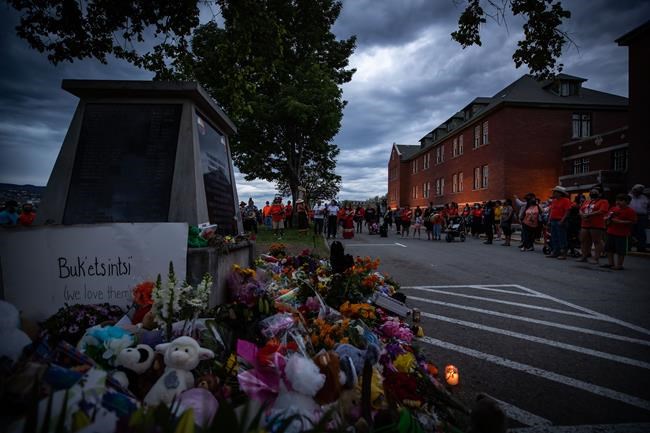
People sing and drum outside the former Kamloops Indian Residential School to honour the 215 children whose remains have been discovered buried near the facility, in Kamloops, B.C., on Monday, May 31, 2021. THE CANADIAN PRESS/Darryl Dyck

The response from politiciansand church officialsthat the discovery is “shocking” rings hollow, she said, as Indigenous people have tried to raise awareness about the issue for years.

Indigenous children from 36 communities across B.C.’s Interior are recorded as having attended the school, while data collected by the history and dialogue centre lists 38 additional communities from where children were sent to the school between 1943 and 1952.

Turpel-Lafond, a lawyer and former judge who is of Cree and Scottish descent, said she’s also heard anecdotal evidence of children from Alberta and Yukon attending the school, which had a peak enrolment of up to 500 students in the 1950s.

It was operated by the Catholic Church from 1890 to 1969 as a residential school before it was taken over by the federal government to serve as a local day school until 1978.

The Tk’emlups te Secwepemc First Nation said last week that the remains of the 215 children were found by a ground-penetrating radar specialist.

The work to identify the remains would have to compare sources including oral history, church records, records from local authorities and lists of children who may have returned home to their respective communities in one year but not the next, Turpel-Lafond said.

“To me, the dead children themselves in this Kamloops school, and others, have human rights,” she said. “We have an obligation to them to provide respect for the deceased and take practical steps to address the indignity that might’ve been done to them and their bodies.”

The Truth and Reconciliation Commission has records of 51 children dying at the school.

First Nations communities are still battling the federal government and Catholic Church in court to access school records, Turpel-Lafond said.

The Missionary Oblates of Mary Immaculate ran about 47 per cent of Canada’s residential schools, including the one in Kamloops.

Father Ken Thorson, the provincial superior of the Oblates, said in a statement Thursday that the order is “committed to do more” in making its records available. The order will work to draw the records of daily lives in Oblate communities, known as the Codex Historicus, together and make them available in a more accessible format, he said.

Thorson added that the expense will be covered by the Oblates and their work will focus first on records related to the Kamloops school, which are located at the Royal British Columbia Museum.

“The Oblates remain committed to participating in ongoing efforts towards reconciliation for our role in this painful part of our shared history,” he said.

Archbishop J. Michael Miller of the Vancouver archdiocese said Catholic organizations should release their records.

“We will be fully transparent with our archives and records regarding all residential schools, and strongly urge all other Catholic and government organizations to do the same,” he said in a statement on Wednesday.

Even if that information was available, a forensic human identification expert said the community faces further hurdles in finding relevant DNA comparisons to identify the victims where direct descendants are no longer alive.

Megan Bassendale, the director of the Vancouver-based company Forensic Guardians International, said the process of DNA analysis can take time.

“It’s long, it’s expensive and it has to be done really well the first time. If you lose the trust of the families, then it’s over,” said Bassendale, who previously worked to help identify remains found in mass grave sites in former republics of the Soviet Union.

Finding close DNA data, such as a mother or father of the victim, or identifying features from health and dental records may be hard at a site that operated for decades, she added.

Bassendale said it may require scientists to test DNA from a mother and father’s family lines to narrow down who the person could be, which is a more complex process.

However, she is hopeful identities can be found.

“We know how to do this; it’s not new. It’s not even uncommon,” Bassendale said. “It’s uncommon for Canada.”

Turpel-Lafond said she’s optimistic answers can be found, if groups co-operate.

“Can it be done? Yes,” she said. “I’m absolutely confident if we had access to all of the records, government records, oral history and we have people co-operating.”

This report by The Canadian Press was first published June 3,2021.

Report Error Submit a Tip

More Stories

Comfort, kindness, acceptance and grandpa’s store

Deborah Schnitzer 5 minute read 2:00 AM EST

My grandfather, Ben W. Kert, had a women’s dress shop along Queen Street in Sault Ste. Marie where a number of Jewish men, many of them “Greenies” from the old country, owned and operated women’s haberdasheries with variable success.

Ben had come from Quebec via Northern Manitoba and Fort Frances, a singular man whose French was as good as his English and whose great heart filled my childhood with glory.

Unlike the other Jewish store owners, Ben W. was born in Trois-Rivières, the only male child who survived with five or six sisters born ahead of him.

Legend has it that my grandfather’s arrival and survival were celebrated with the nickname Sonny. When he left home at 15 (rumour claims his stepmother threw him out) and arrived in Montreal, his first employer would not accept the nickname, so my grandfather invented Ben W. on the spot. The W. never stood for anything. When he died, my mother discovered that his first name was actually Harry.

Performance (ice-cream) art

Maggie Macintosh 5 minute read Preview

Performance (ice-cream) art

Maggie Macintosh 5 minute read Thursday, Jan. 2, 2020

As 2020 resolutions counter temptation, Teri-Lynn Friesen and Élise Page will be waiting to console those who slip — and they’ll have ice-cream scoops at the ready.

Late last year, the creative duo opened Fête — Winnipeg’s newest coffee and ice-cream parlour, offering an ever-changing menu of 16 made-in-house ice-cream flavours, affogato and, if it’s Sunday morning, pancakes.

There’s also no pressure to pick a flavour at first sight; the shop offers unlimited samples.

“If you gave up coffee, we’re here for you when you need to come back. If you gave up sweets, we’re also here for you,” said Friesen, co-owner of the shop at 300 Assiniboine Ave.

Read
Thursday, Jan. 2, 2020

Bob Saget, beloved TV dad of 'Full House,' dead at 65

Lynn Elber, The Associated Press 6 minute read Preview

Bob Saget, beloved TV dad of 'Full House,' dead at 65

Lynn Elber, The Associated Press 6 minute read Monday, Jan. 10, 2022

LOS ANGELES (AP) — Bob Saget, the actor-comedian known for his role as beloved single dad Danny Tanner on the sitcom “Full House” and as the wisecracking host of “America’s Funniest Home Videos,” died while on a stand-up tour. He was 65.

Deputies in Orange County, Florida, were called Sunday about an “unresponsive man” in a hotel room at the Ritz-Carlton in Orlando and found Saget dead, according to a sheriff’s statement on Twitter. Detectives found “no signs of foul play or drug use in this case.”

Saget was in Florida as part of his “I Don't Do Negative Comedy Tour.” After warm audience receptions to his gigs Friday in Orlando and Saturday in the Ponte Vedra Beach resort area, he celebrated online.

“I’m back in comedy like I was when I was 26. I guess I’m finding my new voice and loving every moment of it,” he posted Saturday on Instagram.

Read
Monday, Jan. 10, 2022

New COVID treatment drug painless experience: recovered patient

Malak Abas 5 minute read Preview

New COVID treatment drug painless experience: recovered patient

Malak Abas 5 minute read Tuesday, Feb. 15, 2022

One of the first Manitobans to receive the antiviral COVID-19 pill that became available in the province last month has fully recovered, with no side effects.

Mary McIntosh, 72, lives in Victoria Beach and is among the 83 Manitobans recently issued Pfizer Inc. drug Paxlovid to treat COVID-19.

She reached out to Health Links when she was diagnosed with COVID-19 on Jan. 30. McIntosh has autoimmune hepatitis (a chronic liver disease), thus qualifying her to receive the new treatment.

“I did have to advocate for myself with respect to treatment options,” said McIntosh, who is fully vaccinated against COVID-19, including a booster.

Read
Tuesday, Feb. 15, 2022

Third fire hits troubled Manitoba Housing apartment block

Malak Abas 4 minute read Preview

Third fire hits troubled Manitoba Housing apartment block

Malak Abas 4 minute read Yesterday at 3:19 PM EST

Residents of a North End Manitoba Housing apartment block with a long history of trouble say they’re shaken after the building was hit with its third fire in eight months Friday night.

An apartment complex at 145 Powers St. was evacuated by firefighters after a fire broke out at around 7:45 p.m.

When longtime resident Sharon Markwell heard the fire alarm go off, she chalked it up to a false alarm — kids will get into the building and pull the fire alarm around once or twice a month, she said — until smoke began billowing into the hallway of her fifth-floor apartment.

“Once I realized that I could smell smoke very, very strongly, and the smoke was seeping into my room, into my apartment, I said to myself, ‘This is no false alarm. This is the real thing,’” Markwell, 64, told the Free Press Sunday.

Read
Yesterday at 3:19 PM EST

Why are Manitoba's school immunization programs so far from achieving herd immunity?

Maggie Macintosh  26 minute read Preview

Why are Manitoba's school immunization programs so far from achieving herd immunity?

Maggie Macintosh  26 minute read Saturday, May. 1, 2021

Sometimes, neither a lollipop nor a dinosaur sticker is enough to convince someone to get a needle.

Dr. Michele Feierstein, a pediatrician for more than 35 years, knows that all too well.

Feierstein has given thousands of immunizations to young patients throughout her career, but she has also had her fair share of difficult conversations with parents who are vaccine-hesitant or outright anti-vaxxers.

She does not bar families who have lukewarm feelings about or adamant views against immunization, whether they be rooted in misinformation, distrust, religious belief, or any other reason, from her practice at the Manitoba Clinic.

Read
Saturday, May. 1, 2021