IOC offers Tokyo medical help amid call for cancellation
Advertisement
Read this article for free:
or
Already have an account? Log in here »
To continue reading, please subscribe:
Digital Subscription
One year of digital access for only $1.44 a week*
- Enjoy unlimited reading on winnipegfreepress.com
- Read the E-Edition, our digital replica newspaper
- Access News Break, our award-winning app
- Play interactive puzzles
*Billed as $5.77 plus GST every four weeks. After 52 weeks, price increases to the regular rate of $19.95 plus GST every four weeks. Offer available to new and qualified returning subscribers only. Cancel any time.
To continue reading, please subscribe:
Add Free Press access to your Brandon Sun subscription for only an additional
$1 for the first 4 weeks*
- Enjoy unlimited reading on winnipegfreepress.com
- Read the E-Edition, our digital replica newspaper
- Access News Break, our award-winning app
- Play interactive puzzles
*Your next Brandon Sun subscription payment will increase by $1.00 and you will be charged $17.95 plus GST for four weeks. After four weeks, your payment will increase to $24.95 plus GST every four weeks.
Read unlimited articles for free today:
or
Already have an account? Log in here »
Hey there, time traveller!
This article was published 18/05/2021 (1991 days ago), so information in it may no longer be current.
TOKYO (AP) — Confronted in Japan with some of the strongest medical-community opposition yet to the Tokyo Olympics, IOC President Thomas Bach offered Wednesday to have added medical personnel available to help out when the games open in just over nine weeks.
Bach gave few details, speaking remotely at the opening of three days of meetings between the International Olympic Committee and local organizers. He said the help would come from various national Olympic committees and be available in the Olympic village and sports venues.
In his 12-minute address, Bach attempted to assure the Japanese public and athletes coming to Tokyo that the IOC will hold “safe and secure” Olympics in the midst of the pandemic.
“For obvious reasons we cannot give them (athletes) every detail yet, but the most important principle is very clear: the Olympic Village is a safe place and the Olympic and Paralympic Games will be organized in a safe way,” Bach said.
Bach said he anticipated more than 80% of those staying in the Olympic Village would be vaccinated. Reports locally say that Japan’s Olympic delegation will begin getting vaccinated in June.
Between 1-2% of Japanese are fully vaccinated, and its unlikely that even the elderly population will be fully vaccinated before the Olympics end on Aug. 8.
Bach appeared to be responding to one of the strongest demands so far to call off the postponed Olympics.
The 6,000-member Tokyo Medical Practitioners’ Association called for the Olympics to be canceled in a letter sent last week to Prime Minister Yoshihide Suga, Tokyo Governor Yuriko Koike, Olympic Minister Tamayo Marukawa, and Seiko Hashimoto, the head of the organizing committee.
The letter was made public this week on the group’s website.
“We believe the correct choice is to the cancel an event that has the possibility of increasing the numbers of infected people and deaths,” the letter said.
“Viruses are spread by people’s movements. Japan will hold a heavy responsibility if the Olympics and Paralympics work to worsen the pandemic, increasing the number of those who must suffer and die.”
Much of Japan, including Tokyo and Osaka, is under a state of emergency, which forced Bach to cancel a trip to Japan this month. Opposition to the Olympics is running at 60-80% in numerous polls, depending on how the question is phrased.
The Olympics are to open on July 23. The Paralympics follow on Aug. 24. They are a financial imperative for the IOC, which derives about 75% of its incomes from selling television rights and another 18% from sponsorship.
Japan has officially spent $15.4 billion or organize the Olympics, although government audits suggest the figure is much higher.
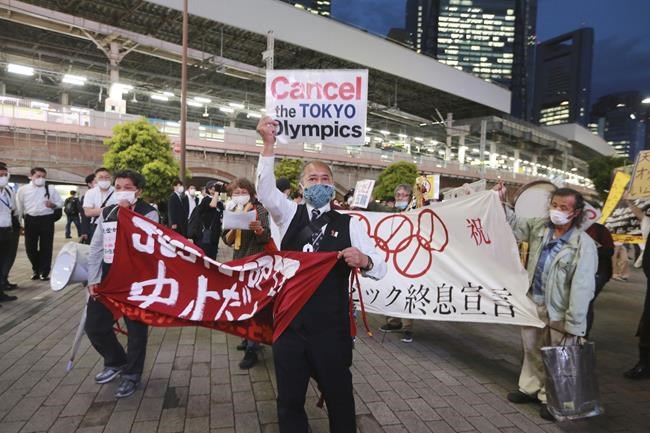
There is no indication the games will be canceled, though opposition continues with small street protests and online petition drives. Last month the British Medical Journal came out against holding the Olympics and many local scientists have voice their opposition.
Japan has has attributed more than 11,500 deaths to COVID-19, good by some standards but worse than most Asian neighbors.
The Tokyo Medical Practitioners’ Association warned of a possible collapse of Japan’s medical system, which could come under more pressure with Tokyo’s hot and humid summer months approaching as the Olympics open.
“Our nation is now undergoing a surge in coronavirus patients in a fourth wave, the worst so far,” the letter said. “The medical systems responding to COVID-19 are stretched thin, almost to their limits. The reality is that the entire medical system faces an almost insurmountable hardship in trying our best to respond with coronavirus measures.”
Bach said hundreds of sports events have been held safely during the pandemic, and cited recent test events in Tokyo that came off without many problems.
“None of these test events was a virus spreader for the Japanese people or the people of Tokyo,” he said.
Tokyo organizers have said about 10,000 medical personnel will be needed during the Olympics. They have also asked for 500 extra nurses, and 200 sports medicine specialists.
Several prefectures near Tokyo have said they will not give priority to treating Olympic athletes, and many towns in Japan have canceled plans to host foreign delegations.
“The doctors and nurses of the medical system who are being asked to respond are already at this point exhausted, and there is absolutely no extra manpower or facility for treatment,” the letter added.
Fans from abroad have already been banned, and Olympic organizers are expected to announce next month if local fans can attend in limited numbers — or not at all.

The Olympics and Paralympics will involve 15,000 athletes and tens of thousands of others entering Japan, which has had its borders virtually sealed for more than a year.
___
More AP Olympics: https://apnews.com/hub/olympic-games and https://twitter.com/AP_Sports
___
AP reporter Yuri Kageyama contributed to this report.
Related Articles
Lillard explains reasons for deciding to play in Olympics Desiree Scott's life back on track after battle to keep her family together








Advertisement Advertise With Us
Advertisement Advertise With Us