WEATHER ALERT

Other provinces looking at Saskatchewan’s plan to tie COVID-19 vaccines to reopening

Advertisement

Advertise with us

CALGARY - Neighbouring provinces are eyeing Saskatchewan's plan to ease COVID-19 restrictions in tandem with vaccination rates, but experts are warning the approach could lead some to a false sense of security.

Read this article for free:


By clicking the button above, an account will be created and you will begin to receive some of our recommended newsletters. You may opt out of any newsletter by visiting your Email and Communication Preferences page or by clicking "unsubscribe" at the bottom of any email.

or

Already have an account? Log in here »

To continue reading, please subscribe:

Digital Subscription

One year of digital access for only $1.44 a week*

  • Enjoy unlimited reading on winnipegfreepress.com
  • Read the E-Edition, our digital replica newspaper
  • Access News Break, our award-winning app
  • Play interactive puzzles

*Billed as $5.77 plus GST every four weeks. After 52 weeks, price increases to the regular rate of $19.95 plus GST every four weeks. Offer available to new and qualified returning subscribers only. Cancel any time.

To continue reading, please subscribe:

Add Free Press access to your Brandon Sun subscription for only an additional

$1 for the first 4 weeks*

  • Enjoy unlimited reading on winnipegfreepress.com
  • Read the E-Edition, our digital replica newspaper
  • Access News Break, our award-winning app
  • Play interactive puzzles
Start now

*Your next Brandon Sun subscription payment will increase by $1.00 and you will be charged $17.95 plus GST for four weeks. After four weeks, your payment will increase to $24.95 plus GST every four weeks.

Hey there, time traveller!
This article was published 11/05/2021 (2001 days ago), so information in it may no longer be current.

CALGARY – Neighbouring provinces are eyeing Saskatchewan’s plan to ease COVID-19 restrictions in tandem with vaccination rates, but experts are warning the approach could lead some to a false sense of security.

Saskatchewan’s “reopening road map” outlined last week says public health measures are to start to relax three weeks after 70 per cent of residents 40 and older have received their first shot and all adults are eligible.

Step 1, which could take effect as soon as month’s end, would allow restaurants and bars to seat six at a table, fitness classes to resume with three metres between participants and gathering limits to ease.
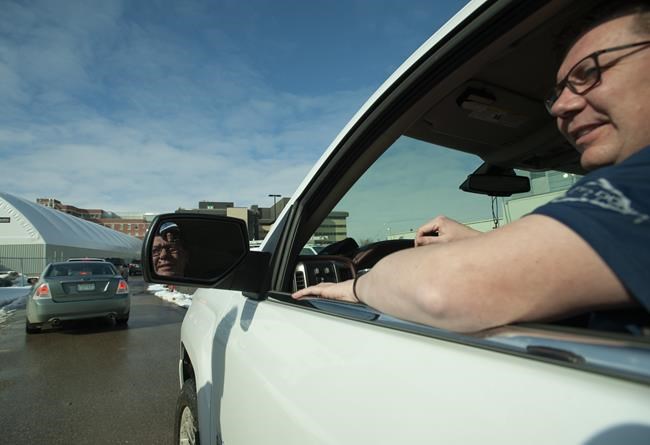
Saskatchewan Premier Scott Moe waits in line at a COVID-19 vaccination drive-thru clinic at Evraz Place in Regina on Thursday, April 15, 2021. THE CANADIAN PRESS/Mark Taylor

Restrictions are to further loosen three weeks after 70 per cent of those 30 and over are vaccinated once, and then again three weeks after the same percentage of anyone 18 and over has had a first shot.

“This has worked in other jurisdictions and we firmly believe that it will work here in Saskatchewan,” said Premier Scott Moe, citing the United Kingdom and Israel as examples.

Nazeem Muhajarine, a professor of community health and epidemiology at the University of Saskatchewan, points out that more than 20 per cent of the U.K.’s population has received a second vaccination, which affords greater protection against the virus than just one shot. The country is also reopening after having imposed much more severe restrictions.

In Israel, more than half the population has received two shots.

Muhajarine said Saskatchewan’s dual-dose coverage is likely to be closer to 10 per cent.

“One dose of a vaccine is not enough to give the population full protection, particularly against the variants,” he said.

“The variants are unpredictable, unknown and the dark horse in all of this.”

Manitoba Premier Brian Pallister has said his Progressive Conservative government is working on a plan he hopes will provide hope and help people comply with health orders.

Health officials have said Manitoba’s plan will be connected to vaccine rates, but will also consider hospital capacity and case numbers.

Alberta recently eased restrictions on visits to long-term care facilities because almost all residents have received both doses.

Premier Jason Kenney has said Saskatchewan has a “thoughtful” framework that his province is exploring.

“We’ve seen some governments, some public health experts, say that even if you’ve received the double dose, it makes no difference. You’ve got to stay shut down at home indefinitely,” Kenney said.

“That I think disincentivizes people from getting the vaccine, especially the people who are vaccine hesitant.”

Muhajarine said dangling vaccines as a carrot could have the opposite effect. “People could actually get a false sense of security.”

He said he understands that people need to see a path toward ending restrictions.

“Canadian summer is what we live through the winter for,” he said.

“We also have to make sure that we don’t put our lives and our loved ones lives at risk unnecessarily or too hastily.”

Dr. Daniel Gregson, an associate professor with the University of Calgary’s Cumming School of Medicine, said Saskatchewan has a “wise” plan overall.

“(Moe’s) not just saying when (the vaccination rate) hits 70 per cent, we’re going to flap open the doors,” he said.

“We’re going to do it in a stepwise manner with a combination of vaccination and restrictions.”

Gregson noted a segment of the population would still remain unprotected.

“If you are in an age group where you’re at really high risk of dying and death, and you’re not vaccinated, this plan will help protect the health-care system, but it’s not going to protect you as an individual,” said Gregson.

Outbreaks will still occur as “birds of a feather flock together” and like-minded unvaccinated people gather, said Gregson. But, he adds, it’s less likely those would grow into super-spreader events in the broader community.

“This virus is not going away, no matter what percentage of the population we get immunized,” said Gregson.

“And if you think herd immunity is going to work for you, you are wrong.”

This report by The Canadian Press was first published May 11, 2021.

Report Error Submit a Tip

More Stories

Russian Olympic biathlon champion loses Sochi doping case

Graham Dunbar, The Associated Press 5 minute read Preview

Russian Olympic biathlon champion loses Sochi doping case

Graham Dunbar, The Associated Press 5 minute read Thursday, Sep. 24, 2020

GENEVA - Two-time Olympic biathlon champion Olga Zaitseva lost her appeal Thursday against disqualification from the 2014 Sochi Olympics for her part in Russia’s state-backed doping program.

The Court of Arbitration for Sport said its judges upheld the International Olympic Committee’s disciplinary ruling of 2017, which used evidence against Zaitseva from Russian whistleblower Grigory Rodchenkov.

Zaitseva’s disqualification from all her Sochi events strips Russia of its silver medal in the women’s biathlon 4x6-kilometre relay. She won — and will retain — her gold medals from the same relay event at the two previous Winter Games in 2006 and 2010.

Her lawyer in Switzerland, Yvan Henzer, said Zaitseva would appeal the CAS ruling at Switzerland’s supreme court. The federal court typically only intervenes if legal process was abused.

Read
Thursday, Sep. 24, 2020

Oleksiak makes history with seventh Olympic medal

The Canadian Press 8 minute read Preview

Oleksiak makes history with seventh Olympic medal

The Canadian Press 8 minute read Sunday, Aug. 1, 2021

TOKYO - The Canadian women finished their impressive medal haul in the pool – including a record-setting performance from Penny Oleksiak – and Andre De Grasse finally got Canada's men on the board with his second consecutive Olympic bronze in the men's 100 metres.

After finishing third in the medley relay, Maggie Mac Neil draped a bronze medal brimming with significance around Oleksiak's neck as their teammates Kylie Masse and Sydney Pickrem celebrated on the podium.

"Most decorated," they chanted in unison with their arms around each other during post-ceremony interviews with reporters.

On the final day of swimming competition at the Tokyo Olympics, Toronto's Oleksiak took her place at the top among Canada's greatest Olympians. In helping the medley relay team win bronze, she earned her seventh career Olympic medal, and at just 21 became the most decorated Canadian Olympian of all time.

Read
Sunday, Aug. 1, 2021

WRHA moves to cut growing echocardiogram wait list

Larry Kusch 6 minute read Preview

WRHA moves to cut growing echocardiogram wait list

Larry Kusch 6 minute read Tuesday, Aug. 21, 2018

Manitobans are waiting a year or more to receive a key test that detects and tracks heart disease.

As of June 15, there were about 6,500 Manitobans on the wait list for an echocardiogram, and the list is growing at a rate of about 265 per month.

Patients facing heart emergencies are receiving tests immediately, while most of those whose conditions are considered urgent or semi-urgent are getting them within established Canadian benchmark times -- about a week, officials say.

However, thousands of patients who are considered candidates for "elective" tests are waiting anywhere from 10 to 15 months, with a median wait of 12 months, according to the Winnipeg Regional Health Authority.

Read
Tuesday, Aug. 21, 2018

Performance (ice-cream) art

Maggie Macintosh 5 minute read Preview

Performance (ice-cream) art

Maggie Macintosh 5 minute read Thursday, Jan. 2, 2020

As 2020 resolutions counter temptation, Teri-Lynn Friesen and Élise Page will be waiting to console those who slip — and they’ll have ice-cream scoops at the ready.

Late last year, the creative duo opened Fête — Winnipeg’s newest coffee and ice-cream parlour, offering an ever-changing menu of 16 made-in-house ice-cream flavours, affogato and, if it’s Sunday morning, pancakes.

There’s also no pressure to pick a flavour at first sight; the shop offers unlimited samples.

“If you gave up coffee, we’re here for you when you need to come back. If you gave up sweets, we’re also here for you,” said Friesen, co-owner of the shop at 300 Assiniboine Ave.

Read
Thursday, Jan. 2, 2020

Letters, Oct. 31

6 minute read Saturday, Oct. 31, 2026

Civic election a missed opportunity

The outcome of the latest municipal election in Winnipeg is nothing short of baffling. The decline of what was once a proud, beautiful prairie hub is impossible to ignore.

Winnipeg is rapidly sliding into a state of structural and social dilapidation, yet voters have inexplicably chosen to hand incumbent Mayor Scott Gillingham a second term. The decision smells of complacency, and sadly, it represents a massive missed opportunity for real urban renewal.

Walking through downtown Winnipeg today is an exercise in heartbreak. A city centre that should be a bustling economic and cultural core has instead transformed into an absolute eyesore. Encampments and tents are permitted to dot the heart of the city. Streets that used to thrive are now dominated by the tragic, visible reality of severe addiction, with individuals wandering and staggering through public spaces without adequate intervention or care.

China’s electric car sales grow in 2024, as sales of gasoline cars plunge

Ken Moritsugu And Zen Soo, The Associated Press 2 minute read Monday, Jan. 13, 2025

BEIJING (AP) — Sales of all types of electric vehicles rose more than 40% in China last year, while those of gasoline-powered automobiles plunged, industry data showed Monday.

A total of 31.4 million vehicles were sold last year in the world's biggest market by sales, up 4.5% compared from a year earlier, the China Association of Automobile Manufacturers reported. Growth in sales outpaced production, which rose 3.7%.

China's exports of passenger cars jumped almost 20% in 2024, to almost 5 million vehicles. Out of that, exports of what China calls “new energy vehicles,” including battery EVs, fuel-cell cars and plug-in hybrids -- electric vehicles with a small gasoline-powered engine to back up the batteries -- reached 1.28 million. That was a 6.7% increase from 2023.

Domestically, sales of passenger cars rose 13.6% in December, driven in part by rebates for trade-ins, raising sales of all passenger cars in China by 3.1% for the year, to 22.6 million.