Saskatchewan says COVID-19 reopening plan dependent on vaccine uptake

Advertisement

Advertise with us

REGINA - Saskatchewan Premier Scott Moe says there is a “finish line in sight” for COVID-19 as the province announced its three-stage reopening plan slated to unfold over the next few months.

Read this article for free:


By clicking the button above, an account will be created and you will begin to receive some of our recommended newsletters. You may opt out of any newsletter by visiting your Email and Communication Preferences page or by clicking "unsubscribe" at the bottom of any email.

or

Already have an account? Log in here »

To continue reading, please subscribe:

Digital Subscription

One year of digital access for only $1.44 a week*

  • Enjoy unlimited reading on winnipegfreepress.com
  • Read the E-Edition, our digital replica newspaper
  • Access News Break, our award-winning app
  • Play interactive puzzles

*Billed as $5.77 plus GST every four weeks. After 52 weeks, price increases to the regular rate of $19.95 plus GST every four weeks. Offer available to new and qualified returning subscribers only. Cancel any time.

To continue reading, please subscribe:

Add Free Press access to your Brandon Sun subscription for only an additional

$1 for the first 4 weeks*

  • Enjoy unlimited reading on winnipegfreepress.com
  • Read the E-Edition, our digital replica newspaper
  • Access News Break, our award-winning app
  • Play interactive puzzles
Start now

*Your next Brandon Sun subscription payment will increase by $1.00 and you will be charged $17.95 plus GST for four weeks. After four weeks, your payment will increase to $24.95 plus GST every four weeks.

Hey there, time traveller!
This article was published 04/05/2021 (2003 days ago), so information in it may no longer be current.

REGINA – Saskatchewan Premier Scott Moe says there is a “finish line in sight” for COVID-19 as the province announced its three-stage reopening plan slated to unfold over the next few months.

Moe described the reopening plan as “very cautious and measured,” and said the three-step approach will help people understand exactly what needs to happen to get back to normal in Saskatchewan.

“It does provide a very clear path on how we can achieve that finish line together in communities across the province,” Moe said Tuesday. “Follow the public health orders, go get vaccinated.”
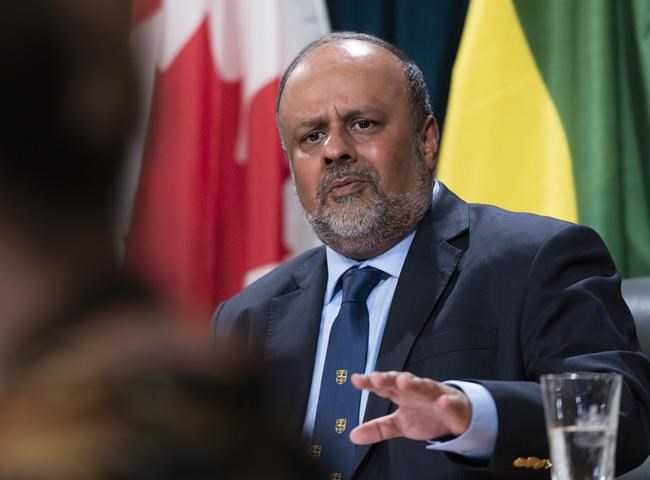
Dr. Saqib Shahab, Saskatchewan's chief medical health officer, speaks at a COVID-19 news update at the Legislative Building in Regina on Wednesday March 18, 2020. THE CANADIAN PRESS/Michael Bell

The government said the first step will happen three weeks after 70 per cent of residents aged 40 and over have received their first dose of vaccine and when all Saskatchewan adults are eligible to get vaccinated.

In that phase, the government said it would reintroduce some of the rules that were in place last summer, including indoor gatherings of up to 10 people and allowing up to six patrons per table in a restaurant.

Step 2 is to take place three weeks after 70 per cent of those aged 30 and older have received a first dose. In that step, the limits on indoor gatherings will increase, and venues like casinos and event facilities can reopen with physical distancing.

Step 3 will take place three weeks after 70 per cent of all adults have had a shot.

By Step 3, which Moe said could happen in early or mid-July, the government expects to lift most of the remaining COVID-19 public health restrictions.

Moe said the province’s reopening plan is modelled on other countries, such as Israel and the United Kingdom, which have seen success in their own reopening efforts.

“This has worked in other jurisdictions and we firmly believe that it will work here in Saskatchewan,” he said.

Officials say the plan relies on the province receiving the supply of vaccines it is expecting on time.

The plan will also rely on Saskatchewan residents getting vaccinated as soon as they can and continuing to follow public health restrictions in place in their area.

At a news conference Tuesday, Moe strongly encouraged any Saskatchewan residents who have been hesitant about getting vaccinated to “get off that fence.”

“Every day across Canada in this province and around the world, vaccinations are saving people’s lives,” he said. “If you’re on the fence, this should really be one of the easiest decisions you’ll ever make in your life.

“On one side of that fence, people are living. On the other side, people are dying.”

According to Dr. Saqib Shahab, Saskatchewan’s chief medical health officer, the province expects to see more vaccine doses become available over time.

“As long as supplies hold, we are entering a very accelerated phase for vaccinations,” he said.

Because of this, Shahab expects Saskatchewan residents will be able to get their second vaccine dose within a much shorter time frame than they were able to get their first.

Shahab also said achieving a high vaccination rate in the spring and summer will be important for minimizing the impact of the pandemic in the fall, when new COVID-19 variants may gain traction around the world.

“As a province that is well-resourced, we have had the luxury to be able to physically distance, to isolate greatly and now to get vaccinated,” he said. “The rest of the world, unfortunately, does not have that privilege and will not have that privilege for many, many months.”

With high vaccine uptake, Shahab says Saskatchewan residents can expect “a good summer and a good fall.”

This report by The Canadian Press was first published May 4, 2021

— By Julia Peterson in Saskatoon.

Report Error Submit a Tip

More Stories

Remembering Canada’s first national internment

Peter Manastyrsky 4 minute read Preview

Remembering Canada’s first national internment

Peter Manastyrsky 4 minute read 2:00 AM CDT

Canada’s first national internment operation, from 1914 to 1920, is a part of Canadian history that is at times forgotten. Oct. 28 marks the anniversary of the Canadian government passing an order-in-council (essentially an executive decree) in 1914, under the War Measures Act. The order legally authorized the arrest and internment of Canadian civilians as enemy aliens during the First World War, and thousands of Canadians were sent to internment camps across the country.

The war of 1914-18 created difficulty for new Canadians hoping to become naturalized citizens. Many new immigrants to Canada came from regions of Europe that was under the rule of the Austro-Hungarian Empire at the start of the First World War.

The Canadian government, under Prime Minister Sir Robert Borden introduced internment camps throughout Canada, fearing that many eastern European immigrants would have some form of affiliation with the Austro-Hungarian Empire.

Even though there was never any evidence of disloyalty, people were imprisoned needlessly and forced to do heavy labour in 24 internment camps throughout Canada’s frontier hinterland. There were two identified internment camps in Manitoba, one in Brandon and the other in Winnipeg.

Read
2:00 AM CDT

Director Schrader returns to silver screen with complex view of religion and belief

Alison Gillmor 4 minute read Preview

Director Schrader returns to silver screen with complex view of religion and belief

Alison Gillmor 4 minute read Thursday, Jun. 14, 2018

Bleak, wintry and rigorously controlled — until it’s not — this Book of Job-like drama from American filmmaker Paul Schrader looks at the challenges of faith.

The 71-year-old Schrader, known for scripting four Martin Scorsese films (including Taxi Driver and Raging Bull) and for directing his own (including American Gigolo, Affliction and Auto Focus), grew up in a strict Calvinist home — he famously did not see a film until he was 17 — and has always been drawn to stories of agonizing and uncertain redemption.

As the Rev. Toller (Ethan Hawke) wrestles with what it means to lead a righteous life in our badly broken world, his spiritual fate remains in doubt. It is certain, however, that First Reformed marks a cinematic rebirth for Schrader after recent disasters like The Canyons and Dog Eat Dog. Serious, complex and moving, this is not a perfect film, but even its flaws are powerful.

Toller is a solitary man who has come to the ministry late in life, after a family tragedy and a failed marriage. First Reformed, a historic church in upstate New York that was once a stop on the Underground Railroad, has since been reduced to an austerely beautiful tourist shop, more of a museum than a place of worship.

Read
Thursday, Jun. 14, 2018

Somewhat spooked to play submissive role

Maureen Scurfield 5 minute read 2:00 AM CDT

DEAR MISS LONELYHEARTS: I was secretly looking forward to being Boss Witch this Halloween. I’m a good-looking woman, and my new love thinks I’m quite sexy. But he just requested I fulfil a Halloween sex fantasy of his — including costume and masks — where he directs the whole show. Now the pressure is on, and I am turning off.

We’re just too much alike! In the past, I’ve come up with great fantasy nights for Halloween, and my men in those times were willing to play a subordinate role if that’s what I asked. But this new man wants a turn “directing” the show! I do not feel excited thinking about that. What should I do?

— Always Been In Charge, Elmwood

Dear Always Been In Charge: It’s not too late to make a deal where you both introduce a short fantasy to play out on Halloween night. And make it well clear that you each will have an opt-out safe-word that must be respected by the one of you “in charge” at the time. This way you can accommodate your new love’s fantasy without locking yourself into something you’re unsure about.

Express the merry widow you truly are

Maureen Scurfield 5 minute read Yesterday at 2:00 AM CDT

DEAR MISS LONELYHEARTS: My husband died a while back, and I don’t miss him! He had grown old in a strange and cranky way, and I’m a cheerful person by nature. It was hard to hear him shoot down every idea I had to go out and do things together.

He wasn’t physically ill — just finished with having any fun. He had gotten depressed and wouldn’t take anti-depressants, although he was fine with getting drunk and critical towards me.

He was particularly negative about seeing friends and relatives, and living the active way we used to — always the first to get tickets to concerts and encouraging other friends to go with us for dinners at new restaurants. We also went to a lot of sports games, and visited friends and relatives. We arrive with lots of good food and drink.

So now when people ask me in that pitying voice used for widows, “Poor darling, how are you doing?” I respond, “He was miserable towards the end, and it was a relief when he died.” They look shocked, but it’s the truth, and they know it.

The importance of political trust

Paul G. Thomas 5 minute read 2:00 AM CDT

Political trust refers to people’s positive expectations that the political system, the institutions which comprise it and the actors who participate in its operations will do what they have said they will do, that they will act in the public interest and that they will conduct themselves in a manner which does not disrespect the democratic process.

Political scientists use the terms “diffuse” and “specific” to differentiate between trust in the political system as a whole, and trust in individual actors. Asked to rank occupations in terms of trustworthiness, respondents typically place politicians at or near the bottom of the list. Individuals who have first-hand experience dealing with politicians tend to have more positive viewpoints.

Unfortunately, systematic surveys on trust levels in Manitoba are rare, so any discussion must be based on national results.

Beginning in the late 1960s, a slow erosion of trust in Canadian politicians and political institutions began, with only occasional, short-lived upticks. In the summer of 2025, a national Environics survey found that only a minority of Canadians had a lot of trust in political actors and institutions, such as the political parties and Parliament. The survey report also revealed that trust levels had held steady over the past 15 years.

Transit budget cap means cuts

Aldo Santin  5 minute read Preview

Transit budget cap means cuts

Aldo Santin  5 minute read Wednesday, Nov. 13, 2019

Winnipeg is literally facing dark times, officials involved in budget presentations revealed Wednesday at city hall.

The public works director said a proposed freeze on the street lighting budget means the City of Winnipeg will have to turn off an increasing number of lights over the next four years.

Winnipeg Transit said an imposed two per cent cap on its budget will mean the elimination of dozens of positions and the low-income bus pass might never see the light of day, along with a host of service cuts.

The budget prospects left Coun. Matt Allard, chairman of the public works committee and a public transit advocate, looking rattled and at a loss to explain how city hall can dig its way out of the financial situation.

Read
Wednesday, Nov. 13, 2019