Opposition leaders criticize federal budget over pharmacare, old age security

Advertisement

Advertise with us

OTTAWA - Federal opposition leaders are criticizing the Liberal government's first budget in two years for omitting pharmacare, failing to adequately boost old age security and not speeding up the pace of vaccinations.

Read this article for free:


or

Already have an account? Log in here »

To continue reading, please subscribe:

Subscribe and receive a limited-edition Free Press branded hat or tote.

Digital Subscription

One year of digital access for only $205*

  • Enjoy unlimited reading on winnipegfreepress.com
  • Read the E-Edition, our digital replica newspaper
  • Access News Break, our award-winning app
  • Play interactive puzzles

*First annual payment billed as $205.00 + GST for one year. This annual subscription will automatically renew at $233.00 + GST every 52 weeks (10% off the regular annual price of $259.35). Offer available to new and qualified returning subscribers only. Cancel any time.

To continue reading, please subscribe:

Add Free Press access to your Brandon Sun subscription for only an additional

$1 for the first 4 weeks*

  • Enjoy unlimited reading on winnipegfreepress.com
  • Read the E-Edition, our digital replica newspaper
  • Access News Break, our award-winning app
  • Play interactive puzzles
Start now

*Your next Brandon Sun subscription payment will increase by $1.00 and you will be charged $17.95 plus GST for four weeks. After four weeks, your payment will increase to $24.95 plus GST every four weeks.

Hey there, time traveller!
This article was published 20/04/2021 (1998 days ago), so information in it may no longer be current.

OTTAWA – Federal opposition leaders are criticizing the Liberal government’s first budget in two years for omitting pharmacare, failing to adequately boost old age security and not speeding up the pace of vaccinations.

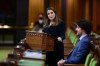
Debate began in the House of Commons Tuesday with leaders pushing to shape the economic blueprint more to their liking.

Federal NDP Leader Jagmeet Singh said he knows where he’s seen two of the Liberals’ signature budget promises before: his own party’s election platforms.
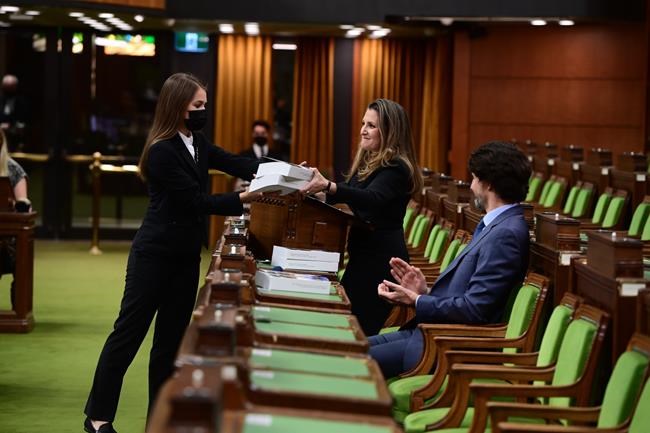
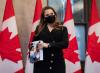
Finance Minister Chrystia Freeland, centre, tables the federal budget in the House of Commons in Ottawa on Monday April 19, 2021. The federal government unveiled spending plans to manage the remainder of the COVID-19 crisis and chart an economic course for a post-pandemic Canada. THE CANADIAN PRESS/Sean Kilpatrick

Singh said the spending plan tabled by Finance Minister Chrystia Freeland heavily borrows from the New Democrats’ promise in 2015 and 2019 to introduce universal child care.

He said another commitment the NDP made first is the $15 federal minimum wage.

Despite his criticism, Singh has said he won’t do anything that would send the country into an election, as provinces deal with a deadly third wave of COVID-19, driven by more transmissible strains of the virus.

The Liberals need the support of at least one federal party for the budget to pass in the minority Parliament.

Singh cast doubt on whether Prime Minister Justin Trudeau’s government will deliver on its child care pledge since the Liberals have been promising to improve the system since the 1990s.

“How can Canadians believe them now?” Singh asked in the House of Commons.

Pharmacare is another piece missing from the 2021 spending plan, the NDP leader said, arguing the Liberals chose to please “Big Pharma” over working families despite commitments to making it happen.

“I would say that this Liberal budget is the best budget we could have had for 2015,” said NDP MP Charlie Angus.

“In 2015, the New Democrats ran on child care and the Liberals ridiculed us. $10-a-day child care, they thought was so ridiculous … now they understand the wisdom of it.”

As the official Opposition, the Conservatives put forward an amendment to the budget and the Bloc Quebecois, as the third-largest party, proposed a sub-amendment.

Neither contained an explicit statement of non-confidence, although both leaders have said their parties are prepared to vote against the budget.

Conservative Leader Erin O’Toole criticized Trudeau for having long promised child care, but not bringing it to provinces for consultation.

“The Liberal Party of Canada has promised a national daycare plan nine times. Even cats only have nine lives.”

“I think Canadian families, particularly in a pandemic, want certainty and want flexibility, particularly with more families that may have partial work at home, needs where they can rely on families or others,” he said Tuesday.

His finance critic, Ed Fast, asked the House of Commons in his motion that the budget be revised to focus on speeding up Canada’s vaccination campaign to defeat the current spread of COVID-19, as well as policies that guarantee jobs and economic growth.
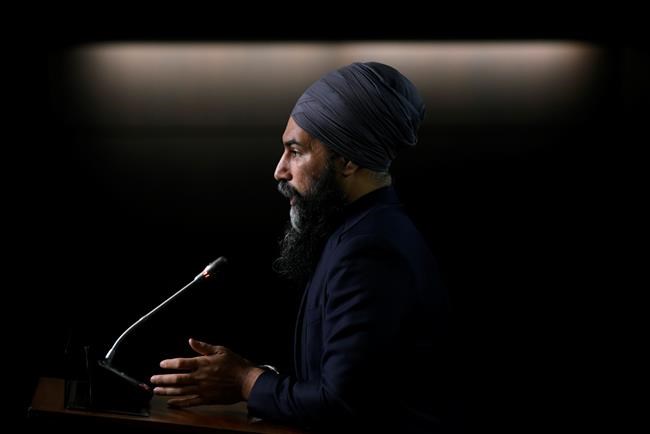
NDP Leader Jagmeet Singh speaks during a news conference as he reacts to the tabling of federal budget in Ottawa, on Monday, April 19, 2021. Singh says the spending plan tabled by Finance Minister Chrystia Freeland heavily borrows from the New Democrats promise in 2015 and 2019 to introduce universal childcare. THE CANADIAN PRESS/Justin Tang

The motion also took aim at the “half a trillion dollars in new debt,” which Conservatives say will have to be paid for through higher taxes, and the Liberals not ruling out the introduction of capital gains taxes on the principal residences of Canadians to cover its spending.

Bloc Leader Yves-Francois Blanchet brought forward a sub-amendment to redress what it sees as two “unacceptable omissions” in the budget, the first being the failure to accede to premiers’ demand for an additional $28 billion each year in health-care transfer payments, which he called a “slap in the face” to Quebec and other provinces.

The second deals with what Blanchet says is a failure to provide increased old age security benefits for all seniors, the group most devastated by the novel coronavirus.

The budget actually promises a 10 per cent hike in old age security for Canadians 75 years of age and over. But the Bloc wants that increase to apply to all seniors as of age 65.

“I don’t know what planet the prime minister lives on, but in our riding offices all people have been talking to me about is … these people who are between 65, but not 75 yet, who are furious,” Blanchet told parliamentarians in French.

“They’ve really, really peeved — that’s the word that I’ll use since I can’t use something stronger.”

As for provincial health-care transfers, the budget reiterates a federal announcement in March that promised a $4-billion one-time top-up, but does not include any extra long-term spending.

Votes on the amendment and sub-amendment will come later in the week and, depending on their wording, could be deemed a test of confidence in Trudeau’s minority Liberal government.

While the opposition parties proposed their own budgetary fixes, Trudeau and his finance minister, Chrystia Freeland, launched a full-court press to sell the budget, as written, to Canadians.

“This budget lays out a plan for good, middle-class jobs and a clean, resilient economy that works for everyone,” Trudeau told a news conference.

“From creating a million jobs by the end of the year, to ensuring $10-a day child care in five years, to reaching net-zero emissions in less than 30 years, it all comes down to this: good jobs, a strong and fair economy and a healthy environment.”

This report by The Canadian Press was first published April 20, 2021.

Report Error Submit a Tip

More Stories

‘Please excuse us from writing these notes …’

Editorial 4 minute read Preview

‘Please excuse us from writing these notes …’

Editorial 4 minute read 2:01 AM CDT

It’s a common-sense prescription for the health-care system. The only wonder is that it took so long to happen.

On Oct. 1, new provincial legislation came into effect that will stop employers from requiring employees to get a sick note from a physician unless the employee has been absent for more than a week or has called in sick 10 or more times in a calendar year.

And the legislation could have a big effect.

Doctors Manitoba has calculated that its members write over 600,000 sick notes every year — a process that costs the provincial health-care system approximately $8 million annually. And the effort doesn’t even help sick workers get better: one-third of sick notes are written for patients who don’t even have symptoms anymore, making them little more than a comfortable fiction. To put it simply, doctors have to trust that a symptom-less patient was sick and write a note saying they were ill, in order to satisfy an employer who doesn’t share that same level of trust.

Read
2:01 AM CDT

Dozens of Uber, Lyft drivers switched to cheaper insurance coverage: MPI probe

Erik Pindera 5 minute read Preview

Dozens of Uber, Lyft drivers switched to cheaper insurance coverage: MPI probe

Erik Pindera 5 minute read Updated: Yesterday at 6:09 PM CDT

Ride-service drivers have been defrauding Manitoba Public Insurance by improperly insuring their vehicles as for personal use.

The public insurer and the City of Winnipeg, which regulates ride-hailing services like Uber and Lyft, discovered the widespread fraud after MPI conducted a review in December last year.

“When a driver changes their coverage from ride-share insurance to a personal vehicle coverage and continues to operate as a ride-share driver, that is fraud, plain and simple,” said MPI chief executive officer Satvir Jatana at a news conference Thursday.

MPI’s review looked at a random sample of 408 ride-hailing vehicles and found 108 were operating without the proper vehicle-for-hire insurance coverage. In order to register with the city as a ride-service driver, a vehicle must have such insurance and proof must be provided to the ride-booking company.

Read
Updated: Yesterday at 6:09 PM CDT

Today’s horoscope

Georgia Nicols 4 minute read Preview

Today’s horoscope

Georgia Nicols 4 minute read Yesterday at 2:00 AM CDT

MOON ALERT: Caution. Avoid shopping (except for food and gas) and important decisions all day. The moon is in Virgo.

ARIES (March 21-April 19)

You might have to put your own emotional considerations second to those of someone else because an element of service is a theme for you. You also might explore ways to improve your health, especially through diet. Be aware there’s a moon alert all day.

TAURUS (April 20-May 20)

Read
Yesterday at 2:00 AM CDT

Can’t cut your way to being a better city

Molly McCracken 5 minute read 2:00 AM CDT

The powers that be in Winnipeg have pushed for cheap property taxes for decades. As a result, the city doesn’t have enough money to balance the books, let alone maintain infrastructure, deliver services and respond to challenges like homelessness and the toxic drug crisis.

Winnipeg’s fiscal problem stems from decades of keeping property-tax increases below inflation and relying on inadequate revenues to fund a growing city. The result? Today, Winnipeg spends less money per person on city services than it did in 2001.

A look at the books at city hall is stark. Winnipeg has run a deficit almost every year since the COVID-19 pandemic because of climate-change-driven heavy ice and snowstorms, higher fuel costs and increased policing overtime. During this time, city council tried to cut and freeze public service spending where it could; as a result, community services have been cut to the bone.

Departments responsible for what makes a city a good place to live have been squeezed. Since 1999, community services — responsible for libraries, recreation, swimming lessons and aspects of Winnipeg’s poverty-reduction work — has 149 fewer staff positions, an 18 per cent reduction, even as the city’s population has grown 35 per cent, or by 220,000 people.

Manitoba pharmacists push for increased role in administration of vaccines

Chris Kitching 6 minute read Preview

Manitoba pharmacists push for increased role in administration of vaccines

Chris Kitching 6 minute read Yesterday at 6:39 PM CDT

Manitoba’s public health officials are preparing for influenza season to peak earlier than usual amid concerns about declining uptake for flu and COVID-19 vaccinations.

While the season started early in some provinces, including Ontario and B.C., Dr. Brent Roussin, Manitoba’s chief public health officer, said it’s too soon to conclusively say if the same will happen here.

“But certainly seeing what’s around us and seeing an uptick (in cases) here, it’s making a concern it might be an early year,” he told the Free Press on Thursday.

Manitoba’s flu season usually peaks in late December, with the vaccination campaign continuing into the new year.

Read
Yesterday at 6:39 PM CDT

Alarm bells ring as contact tracing clock ticks on

Tom Brodbeck 4 minute read Thursday, Oct. 29, 2020

The provincial government says it doesn’t know how long it’s taking for public health officials to connect with people infected with COVID-19 or their close contacts.

With infection rates and the number of COVID-19 patients admitted to hospital growing at an alarming rate, the province’s inability (or refusal) to share contact tracing data with the public raises serious questions about how many people may be spreading the novel coronavirus unwittingly.

The Free Press has asked the provincial government repeatedly over the past week for pandemic contact tracing information, including how long it’s taking public health officials to follow up with people who test positive and to track down their close contacts.

“We do not have these statistics readily compiled, and do not have the capacity to pull them at this time,” a government spokeswoman said in an email Wednesday.