Federal Budget 2021: Long-term care standards, vaccine production in health plan

Advertisement

Advertise with us

OTTAWA - The federal budget is promising billions to close gaps in long-term care and Canada’s vaccine production laid bare by the COVID-19 pandemic.

Read this article for free:


By clicking the button above, an account will be created and you will begin to receive some of our recommended newsletters. You may opt out of any newsletter by visiting your Email and Communication Preferences page or by clicking "unsubscribe" at the bottom of any email.

or

Already have an account? Log in here »

To continue reading, please subscribe:

Digital Subscription

One year of digital access for only $1.44 a week*

  • Enjoy unlimited reading on winnipegfreepress.com
  • Read the E-Edition, our digital replica newspaper
  • Access News Break, our award-winning app
  • Play interactive puzzles

*Billed as $5.77 plus GST every four weeks. After 52 weeks, price increases to the regular rate of $19.95 plus GST every four weeks. Offer available to new and qualified returning subscribers only. Cancel any time.

To continue reading, please subscribe:

Add Free Press access to your Brandon Sun subscription for only an additional

$1 for the first 4 weeks*

  • Enjoy unlimited reading on winnipegfreepress.com
  • Read the E-Edition, our digital replica newspaper
  • Access News Break, our award-winning app
  • Play interactive puzzles
Start now

*Your next Brandon Sun subscription payment will increase by $1.00 and you will be charged $17.95 plus GST for four weeks. After four weeks, your payment will increase to $24.95 plus GST every four weeks.

Hey there, time traveller!
This article was published 19/04/2021 (2020 days ago), so information in it may no longer be current.

OTTAWA – The federal budget is promising billions to close gaps in long-term care and Canada’s vaccine production laid bare by the COVID-19 pandemic.

Finance Minister Chrystia Freeland said the pandemic preyed “mercilessly” on Canada’s most vulnerable seniors and it cannot be allowed to happen again.

“We have failed so many of those living in long-term care facilities,” she said in her budget-day speech in the House of Commons.
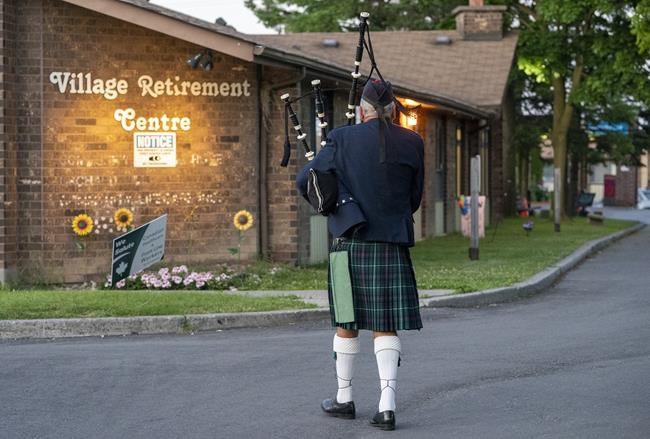
The federal budget is promising billions to close gaps in long-term care and Canada's vaccine production laid bare by the COVID-19 pandemic. A piper marches off during a vigil for COVID-19 victims at the Orchard Villa long-term care home in Pickering, Ont. on Monday June 15, 2020. THE CANADIAN PRESS/Frank Gunn

“To them, and to their families, let me say this. I am so sorry. We owe you so much better than this.”

To begin to fix it, the government is promising $3 billion over the next five years to help provinces implement new standards. The funds won’t begin to flow until next year, after those standards are in place.

Freeland said they will be based on work underway by the Canadian Standards Association and the Health Standards Organization, which began last month.

The CSA is seeking to establish normal practices for the physical design and operations of long-term care homes, including ventilation, while the HSO is looking at infection control, safety and quality of care.

Outbreaks of COVID-19 ran rampant through Canada’s long-term care homes, infecting more than 53,000 residents and 27,000 workers.

More than 15,000 residents died, almost two-thirds of Canada’s total death toll from the pandemic to date.

Provincial governments have jurisdiction for long-term care, so any funding from Ottawa would have to be sent to them. The Canada Health Act does not currently include long-term care, making it difficult for Ottawa to use existing health transfers to help push any specific standards for care.

It is not clear yet exactly how the funds will flow or what provinces will have to agree to do, but the budget does promise to respect provincial jurisdiction.

“This work would ensure seniors and those in care live in safe and dignified conditions,” the budget plan says.

The budget also seeks to fix Canada’s gaping hole in vaccine production, with $2.2 billion over the next seven years, split up through various funds and programs for research and capital investments.

That includes $500 million for capital and infrastructure at universities and research hospitals, and $1 billion in Strategic Innovation Fund money to help the most promising life science and biomanufacturing companies.

However, the funds are split over so many years there could be two or even three elections by the time they’re supposed to be spent, and the budget provides scant detail on how the funds would flow or what kind of production capacity they would generate.

While Canada’s vaccinate rate has improved — it’s now vaccinating a bigger share of its population per day than any other G20 country except the United States — it got off to a very slow start and that’s largely because it can’t make any COVID-19 vaccines at home yet.

The Liberals have said that is because the strong biomanufacturing industry Canada used to have up and left for more supportive countries over the last 30 years.

Instead, Canada is at the mercy of other countries for its entire supply of vaccines right now, leaving Canada to wait and watch some of its allies get vaccines into arms and return to a more normal life much faster.

The budget also provides some money to address the mental health crises erupting from the COVID-19 pandemic, and small amounts for palliative care and to ensure access to medical assistance in dying.

This report by The Canadian Press was first published April 19, 2021.

Report Error Submit a Tip

More Stories

A timeline of the WE Charity controversy

The Canadian Press 9 minute read Wednesday, Aug. 19, 2020

OTTAWA - A timeline of events regarding the Canada Student Service Grant program, based on public documents, events and statements from cabinet ministers, government officials, and WE Charity:

March 6, 2020: WE Charity staff prepare a concept paper on service learning for public servants at Employment and Social Development Canada.

April 5: Finance Minister Bill Morneau and Prime Minister Justin Trudeau talk over the phone about how to help students whose summer job and volunteer opportunities were vanishing due to the COVID-19 pandemic. Finance Department officials are tasked with considering options the next morning.

April 7: Small Business Minister Mary Ng and WE co-founder Craig Kielburger have an introductory phone call in which Ng asks WE to send what it calls a ``pre-established proposal'' to help young people launch businesses.

Kinew will listen to city request for new taxes — but no promises

Nicole Buffie 5 minute read Preview

Kinew will listen to city request for new taxes — but no promises

Nicole Buffie 5 minute read Friday, Nov. 1, 2024

Premier Wab Kinew remained coy about whether he would support a new municipal tax in Winnipeg as the city struggles to maintain services.

Kinew dodged questions on the matter Friday afternoon.

“We want to see services strong, we want to see roads getting fixed,” Kinew said. “Affordability is really top of mind … we got to keep life affordable for the average person out there.”

Some of the items being considered for a new tax are: alcohol, online deliveries, vehicle registration, vacant homes, commercial parking and land transfers with an exemption for first-time homebuyers.

Read
Friday, Nov. 1, 2024

Budget promises long-term care standards

Mia Rabson, The Canadian Press 4 minute read Preview

Budget promises long-term care standards

Mia Rabson, The Canadian Press 4 minute read Monday, Apr. 19, 2021

While the federal Liberals say the first race is to defeat the coronavirus and beat back the pandemic, the federal budget makes clear Prime Minister Justin Trudeau and his finance minister, Chrystia Freeland, have their eyes on a longer track and would be happy to face the electorate with their plan in hand.

Read
Monday, Apr. 19, 2021

Opera singer David Daniels no longer in singers’ union following sexual assault guilty plea

The Associated Press 2 minute read Preview

Opera singer David Daniels no longer in singers’ union following sexual assault guilty plea

The Associated Press 2 minute read Thursday, Dec. 21, 2023

NEW YORK (AP) — Countertenor David Daniels is no longer a member of the union for singers following his guilty plea to a charge of sexual assault.

The 57-year-old and his husband, Scott Walters, pleaded guilty to sexual assault of an adult, a second-degree felony, in Houston's Harris County District Court on Aug. 4. Their accuser was aspiring opera singer Sam Schultz.

They both were sentenced to eight years’ probation and required to register as sex offenders.

American Guild of Musical Artists spokesperson Alicia Cook said Wednesday that Daniels is no longer a member of the union.

Read
Thursday, Dec. 21, 2023

Shocking development

Kelly Taylor 6 minute read Preview

Shocking development

Kelly Taylor 6 minute read 2:00 AM CDT

HOCKLEY VALLEY, Ont. — It’s not too often you get into a new vehicle, look at the interior, and say to yourself, “Wow, this is different… in a good way.”

Automakers tend to stick pretty close to defined norms, and when they differ, it’s not always successful. I’m looking at you, Toyota Yaris and Nissan X-Trail.

So, stepping into the 2027 BMW iX3 was refreshing. A bright parallelogram of a main touchscreen is closer to the driver than most, aided in no small part by pushing the instrument cluster to a narrow band just under the windscreen.

The effect is to clean up the look of the dash but without moving to a centre-mount instrument panel like the Yaris and X-Trail. The most valuable information (speed, battery charge, range) is right in front of the driver, visible above the top rim of the steering wheel.

Read
2:00 AM CDT

The volatile U.S. midterms

Allan Levine 5 minute read Preview

The volatile U.S. midterms

Allan Levine 5 minute read 2:00 AM CDT

The last time the Democratic Party had 218 or more seats — the number required to control the U.S. House of Representatives — was from 2021 to 2023, following the election of Democrat Joe Biden as president. During that same period, the Democrats also had the edge in the Senate. Despite a 50-50 split with the Republicans, Democrats were able to control the Senate with the help of Vice-President Kamala Harris, who cast the key vote in a tie. From 2023 to 2025, the Democrats had a slim 51 to 49 Senate majority.

If history repeats itself and the latest polls are fairly accurate, on Tuesday, Nov. 3, the Democratic Party will take back the House and (probably) the Senate from the Republicans, who have controlled both legislative bodies since the 2024 election. In the House, the Democrats have to gain at least three more seats. In the Senate, they have to win four more, which is entirely doable, though they almost certainly have to win a seat in Texas, Ohio, Kansas or Alaska, each of which currently has two Republican senators.

The prospect of a Democratic victory has President Donald Trump in a tizzy. For the past two years, he has abused his executive power to impose illegal tariffs on Canada and other countries; started a war with Iran; cozied up to Russian president Vladimir Putin and turned his back on Ukrainian president Volodymyr Zelenskyy; and increased the national debt through questionable tax cuts — to list only a few of his more egregious actions. He has been able to get away with this mainly because Republicans in the Senate and the House refuse to even question his decisions.

With the Democrats in charge, Trump’s brazen actions won’t be completely halted, but he will face significant legislative challenges and obstacles not easily dismissed. His controversial appointees, such as Attorney General Todd Blanche, who perceives himself as Trump’s private lawyer rather than the legal representative of the people, won’t get a free pass in committee hearings.

Read
2:00 AM CDT