Alberta top doctor expects close contacts of variant cases will obey longer isolation

Advertisement

Advertise with us

EDMONTON - Alberta's top doctor says she believes, with education and support, household contacts of people infected with more transmissible COVID-19 variants will abide by new quarantine rules.

Read this article for free:


By clicking the button above, an account will be created and you will begin to receive some of our recommended newsletters. You may opt out of any newsletter by visiting your Email and Communication Preferences page or by clicking "unsubscribe" at the bottom of any email.

or

Already have an account? Log in here »

To continue reading, please subscribe:

Digital Subscription

One year of digital access for only $1.44 a week*

  • Enjoy unlimited reading on winnipegfreepress.com
  • Read the E-Edition, our digital replica newspaper
  • Access News Break, our award-winning app
  • Play interactive puzzles

*Billed as $5.77 plus GST every four weeks. After 52 weeks, price increases to the regular rate of $19.95 plus GST every four weeks. Offer available to new and qualified returning subscribers only. Cancel any time.

To continue reading, please subscribe:

Add Free Press access to your Brandon Sun subscription for only an additional

$1 for the first 4 weeks*

  • Enjoy unlimited reading on winnipegfreepress.com
  • Read the E-Edition, our digital replica newspaper
  • Access News Break, our award-winning app
  • Play interactive puzzles
Start now

*Your next Brandon Sun subscription payment will increase by $1.00 and you will be charged $17.95 plus GST for four weeks. After four weeks, your payment will increase to $24.95 plus GST every four weeks.

Hey there, time traveller!
This article was published 03/02/2021 (2093 days ago), so information in it may no longer be current.

EDMONTON – Alberta’s top doctor says she believes, with education and support, household contacts of people infected with more transmissible COVID-19 variants will abide by new quarantine rules.

Chief medical officer Dr. Deena Hinshaw clarified Wednesday that household contacts are considered exposed every day they share a home with someone infected with a virus variant, even if they have separate bedrooms and washrooms.

Previously, a close contact’s isolation would start at the same time as that of the confirmed case, if they could separate properly within the home.
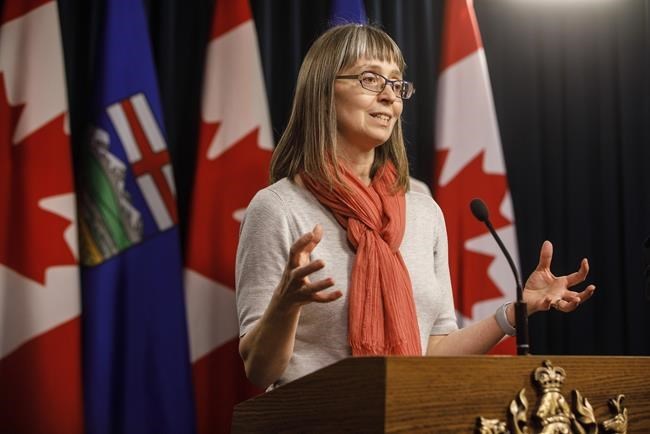
Alberta chief medical officer of health Dr. Deena Hinshaw updates media on the COVID-19 situation in Edmonton on Friday, March 20, 2020. Alberta's top doctor says she believes, with education and support, household contacts of people infected with more transmissible COVID-19 variants will abide by new quarantine rules. THE CANADIAN PRESS/Jason Franson

But now, if everyone remains in the home and does not use a government-provided hotel room, a household contact has to quarantine for 14 days from when the infected person’s 10-day isolation period ends.

Hinshaw announced the new rule on Tuesday, but she said some misunderstood that all household contacts of variant cases would need to isolate for 24 days.

Hinshaw said contact tracers are able to provide information in different languages about why the new rule is important in stemming the spread of new variants and what supports are available.

“We want to make sure that people do have that option of going into an isolation or quarantine hotel if they’re not able to safely separate from their household because we have seen how much more infectious these variants are,” Hinshaw said in her Wednesday update.

“What we’re doing is working to make sure that they have the information about the increased risk that this variant poses and why in-home isolation for someone who’s infectious is not considered adequate because of the transmission that we have seen.”

Hinshaw said she did not know how many hotel rooms are being used for this purpose, but that demand has been on the rise in recent months.

A total of 57 cases of the variants first identified in the United Kingdom and South Africa have been detected in Alberta.

Hinshaw also said she’s heard questions about a small number of people receiving the COVID-19 vaccine before they’re eligible and that, while such allegations undermine public trust, they might have been due to confusion.

Alberta reported 259 new COVID-19 infections in its latest update and 11 deaths from the virus.

There were 539 people in hospital with COVID-19, including 94 in intensive care.

— By Lauren Krugel in Calgary

This report by The Canadian Press was first published Feb. 3, 2021.

Report Error Submit a Tip

More Stories

Director Schrader returns to silver screen with complex view of religion and belief

Alison Gillmor 4 minute read Preview

Director Schrader returns to silver screen with complex view of religion and belief

Alison Gillmor 4 minute read Thursday, Jun. 14, 2018

Bleak, wintry and rigorously controlled — until it’s not — this Book of Job-like drama from American filmmaker Paul Schrader looks at the challenges of faith.

The 71-year-old Schrader, known for scripting four Martin Scorsese films (including Taxi Driver and Raging Bull) and for directing his own (including American Gigolo, Affliction and Auto Focus), grew up in a strict Calvinist home — he famously did not see a film until he was 17 — and has always been drawn to stories of agonizing and uncertain redemption.

As the Rev. Toller (Ethan Hawke) wrestles with what it means to lead a righteous life in our badly broken world, his spiritual fate remains in doubt. It is certain, however, that First Reformed marks a cinematic rebirth for Schrader after recent disasters like The Canyons and Dog Eat Dog. Serious, complex and moving, this is not a perfect film, but even its flaws are powerful.

Toller is a solitary man who has come to the ministry late in life, after a family tragedy and a failed marriage. First Reformed, a historic church in upstate New York that was once a stop on the Underground Railroad, has since been reduced to an austerely beautiful tourist shop, more of a museum than a place of worship.

Read
Thursday, Jun. 14, 2018

History, quirky features of city's first five parkades subject of upcoming walking tours

Brenda Suderman 7 minute read Preview

History, quirky features of city's first five parkades subject of upcoming walking tours

Brenda Suderman 7 minute read Sunday, Apr. 3, 2022

Known to generations of Winnipeg drivers as convenient, if slightly pricey, places to park their vehicles, parkades have the particular distinction of originating in Winnipeg.

To be clear, it’s not the ginormous concrete-and-steel parking structures that stack cars on multiple levels that are Winnipeg- famous. Instead, it’s the moniker “parkade” that was invented here.

“It’s a combination of (the terms) retail arcade and parking lot,” explains history researcher and writer Christian Cassidy of the name coined for the city’s first downtown parking garage at 285 Memorial Blvd., connected to the Hudson’s Bay Company store.

Cassidy plans to include that fact about Winnipeg’s unique name for parking garages, as well as dozens of tidbits and back stories about the city’s first five parkades, in a two-hour walking tour 1:30 p.m. on Saturday, April 9, and Saturday, April 23. Part of Design Month sponsored by Winnipeg Architecture Foundation, the tour from Memorial Boulevard to Smith Street will explore some of the quirky features of early multi-level parking in this city.

Read
Sunday, Apr. 3, 2022

Woman with schizophrenia pleads guilty to stabbing caretaker in neck

Dean Pritchard 5 minute read Preview

Woman with schizophrenia pleads guilty to stabbing caretaker in neck

Dean Pritchard 5 minute read 2:00 AM CDT

A Winnipeg woman previously found not criminally responsible for stabbing three people is now facing a possible prison sentence for stabbing her apartment caretaker in the neck while in the grip of a psychotic delusion.

Victoria Nuoi, 34, has pleaded guilty to one count of aggravated assault for the April 2025 attack.

At a hearing Tuesday, Crown attorney Marla Bettencourt recommended Nuoi, who lives with schizophrenia, be sentenced to four years in prison, while her lawyer Chris Gamby urged provincial court Judge Dale Harvey to sentence her to three years supervised probation.

Harvey reserved his decision, saying he needed time to consider the widely disparate recommendations.

Read
2:00 AM CDT

No Christmas trees, no Christmas trees — the lots are empty as can be

Doug Speirs  3 minute read Preview

No Christmas trees, no Christmas trees — the lots are empty as can be

Doug Speirs  3 minute read Monday, Dec. 7, 2020

It might take a Christmas miracle to get your hands on even a scraggly Charlie Brown-style tree this holiday season.

Winnipeg garden centre owners interviewed Monday morning said they are totally sold out and they’ve never seen stock vanish this quickly in all their years in the business.

They likened it to the holiday version of panicked shoppers binge-buying toilet paper when the COVID-19 pandemic first arrived in the province back in March.

“I’m sold out,” declared Ray DuBois, owner of Ron Paul Garden Centre on St. Mary’s Road. “I could see it coming back in August. When we placed our order, I bumped it up by 10 per cent.”

Read
Monday, Dec. 7, 2020

Remembering Canada’s first national internment

Peter Manastyrsky 4 minute read Preview

Remembering Canada’s first national internment

Peter Manastyrsky 4 minute read 2:00 AM CDT

Canada’s first national internment operation, from 1914 to 1920, is a part of Canadian history that is at times forgotten. Oct. 28 marks the anniversary of the Canadian government passing an order-in-council (essentially an executive decree) in 1914, under the War Measures Act. The order legally authorized the arrest and internment of Canadian civilians as enemy aliens during the First World War, and thousands of Canadians were sent to internment camps across the country.

The war of 1914-18 created difficulty for new Canadians hoping to become naturalized citizens. Many new immigrants to Canada came from regions of Europe that was under the rule of the Austro-Hungarian Empire at the start of the First World War.

The Canadian government, under Prime Minister Sir Robert Borden introduced internment camps throughout Canada, fearing that many eastern European immigrants would have some form of affiliation with the Austro-Hungarian Empire.

Even though there was never any evidence of disloyalty, people were imprisoned needlessly and forced to do heavy labour in 24 internment camps throughout Canada’s frontier hinterland. There were two identified internment camps in Manitoba, one in Brandon and the other in Winnipeg.

Read
2:00 AM CDT

Wheat City mayoral candidates hit streets

Alex Lambert 4 minute read Preview

Wheat City mayoral candidates hit streets

Alex Lambert 4 minute read Updated: 7:31 AM CDT

BRANDON — The two mayoral candidates made their final pushes Tuesday to woo voters in Manitoba’s second-largest city.

Incumbent Jeff Fawcett said he and his team have been to nearly every doorstep in the city, while challenger Len Isleifson, a former Tory MLA, said he has covered most parts of Brandon and was even on a second go-round in some areas.

“I’m working my tail off to try to make sure that people do get out to vote, and the people I speak to, I feel fairly optimistic,” said Fawcett, who is running for his second term. “But people have to vote.”

The Brandon Sun joined both Fawcett and Isleifson as they went door knocking one day before Manitoba’s elect new municipal councils.

Read
Updated: 7:31 AM CDT