Pfizer-BioNTech delaying vaccine deliveries to Canada due to production issues

Advertisement

Advertise with us

OTTAWA - Only half of Canada's promised COVID-19 vaccine doses by Pfizer-BioNTech will arrive in the next month, federal officials revealed Friday, blaming production issues in Belgium that will affect immediate vaccination plans.

Read this article for free:


or

Already have an account? Log in here »

To continue reading, please subscribe:

Subscribe and receive a limited-edition Free Press branded hat or tote.

Digital Subscription

One year of digital access for only $205*

  • Enjoy unlimited reading on winnipegfreepress.com
  • Read the E-Edition, our digital replica newspaper
  • Access News Break, our award-winning app
  • Play interactive puzzles

*First annual payment billed as $205.00 + GST for one year. This annual subscription will automatically renew at $233.00 + GST every 52 weeks (10% off the regular annual price of $259.35). Offer available to new and qualified returning subscribers only. Cancel any time.

To continue reading, please subscribe:

Add Free Press access to your Brandon Sun subscription for only an additional

$1 for the first 4 weeks*

  • Enjoy unlimited reading on winnipegfreepress.com
  • Read the E-Edition, our digital replica newspaper
  • Access News Break, our award-winning app
  • Play interactive puzzles
Start now

*Your next Brandon Sun subscription payment will increase by $1.00 and you will be charged $17.95 plus GST for four weeks. After four weeks, your payment will increase to $24.95 plus GST every four weeks.

Hey there, time traveller!
This article was published 15/01/2021 (2091 days ago), so information in it may no longer be current.

OTTAWA – Only half of Canada’s promised COVID-19 vaccine doses by Pfizer-BioNTech will arrive in the next month, federal officials revealed Friday, blaming production issues in Belgium that will affect immediate vaccination plans.

Procurement Minister Anita Anand said Canada faces an “unfortunate” delay that is nonetheless expected to be made up by the end of March, while Prime Minister Justin Trudeau insisted most Canadians will still be vaccinated by the fall.

News of the Pfizer delay drew immediate concern from Saskatchewan Premier Scott Moe, who said the province’s strategy for the two-dose regime depends on steady shipments.
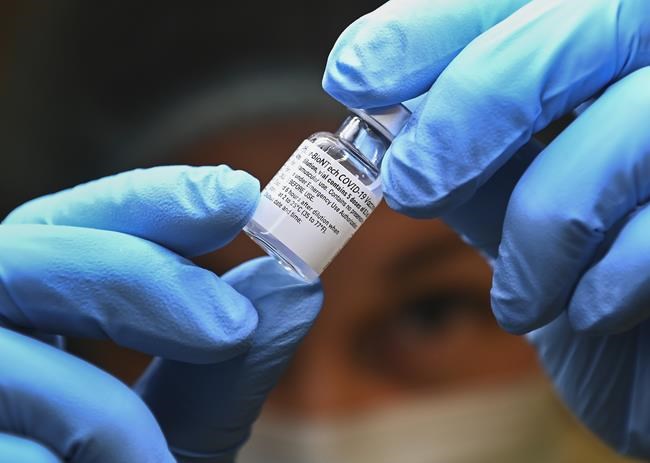
A health-care worker prepares a dose of the Pfizer-BioNTech COVID-19 vaccine at a vaccine clinic in Toronto on Thursday, January 7, 2021. Procurement Minister Anita Anand says production issues in Europe will temporarily reduce Pfizer's ability to deliver vaccines to Canada.THE CANADIAN PRESS/Nathan Denette

“We have been planning our vaccine rollout based on this schedule, including second dosages,” said Moe, noting he expected 11,700 doses a week in February.

“If this has changed, they need to advise us immediately.”

In British Columbia, where all available doses are being deployed as they arrive, Health Minister Adrian Dix said the delay will have “some significant effect” on when priority groups get their shot.

“Obviously, when you receive fewer doses you immunize fewer people,” said Dix.

The delay could also affect the wait time between each shot of the two-dose regime, he said.

Although Pfizer-BioNTech suggests a second dose 21 days after the first, provincial health officer Dr. Bonnie Henry has said that could be extended to 35 days.

A spokeswoman for Quebec Health Minister Christian Dube said the temporary slowdown reinforced the province’s decision to wait up to 90 days to administer the vaccine’s second dose.

“The strategy remains the same: we must give a boost now and vaccinate as many vulnerable people and health workers as possible, as quickly as possible,” said Marjaurie Cote-Boileau.

Alberta decided earlier this week to push back its second shots to 42 days. The province’s health minister, Tyler Shandro, said Friday he had hoped to soon announce all seniors over 75 and Indigenous people over 65 would be eligible for the vaccine, but the delay makes that out of the question.

Ontario Premier Doug Ford said the province was evaluating the impact of the delay and “will adjust as necessary.”

Maj.-Gen. Dany Fortin, who is leading the national vaccine distribution, said Pfizer’s production delays would reduce deliveries by an average of 50 per cent over the coming weeks.

He said that won’t be felt until after next week because Canada’s upcoming shipment has already been prepared. But the final week of January will bring “about a quarter of what we expected.”

“The numbers will pick right back up after that to about half of what we had expected (and) progressively grow into the rest of February,” said Fortin.

“Pfizer is telling us it will impact us for four weeks.”

According to the government’s website, more than 200,000 doses of the Pfizer-BioNTech COVID-19 vaccine were expected in each of the next two weeks and 1.4 million doses were expected in February.

Trudeau said Ottawa was “working day in and day out to get vaccines delivered as quickly as possible” but acknowledged that Pfizer-BioNTech doses have been derailed in the short-term.

Trudeau said this is why Canada has one of the most diverse vaccine portfolios in the world, pointing to seven bilateral agreements he says ensure “flexibility when it comes to supply chains.”

“I want to be very clear: this does not impact our goal to have enough vaccines available by September for every Canadian who wants one,” Trudeau said from outside Rideau Cottage.

Anand said all countries that receive vaccines from Pfizer’s European facility have been affected but that Canada has been assured it will receive four million doses by the end of March.

“This is unfortunate. However such delays and issues are to be expected when global supply chains are stretched well beyond their limits,” Anand said at a news conference.

“It’s not a stoppage.”

Pfizer Canada spokeswoman Christina Antoniou said the production facility in Puurs, Belgium, is undergoing modifications in the coming weeks to increase the number of doses it can pump out.

Pfizer hopes to double its 2021 production to two billion doses.

“Pfizer Canada will continue to pursue its efforts in anticipation that by the end of March, we will be able to catch up to be on track for the total committed doses for Q1,” Antoniou said.

The news came as Ottawa released federal projections that suggested the pandemic may soon exceed levels seen in the first wave, rising to 19,630 cumulative deaths and 10,000 daily infections in a little over a week.

The modelling shows total cases could grow to nearly 796,630 from about 694,000, and that another 2,000 people could die by Jan. 24.

Chief public health officer Dr. Theresa Tam urged sustained vigilance as a long-range forecast suggested rapid growth would continue without “quick, strong and sustained” measures.

Tam said that’s especially so in national hot spots of Quebec and Ontario, where a steady increase in hospitalizations has strained the health system’s ability to keep up with critical care demands. The post-holiday projections do not take into account Quebec’s recently implemented four-week curfew or Ontario’s new stay-at-home orders.

Tam emphasized the need to reduce community spread to help relieve some of the pressure on hospitals and long-term care homes.

“The vaccine alone is not going to make a dent in some of that,” she said.

Ontario reported 100 deaths linked to COVID-19, although that took into account a difference in database reporting between one of its health units and the province.

The province’s newly resolved tally added 46 deaths from Middlesex-London that occurred earlier in the pandemic.

Ontario also reported 2,998 new cases of COVID-19 with 800 of those new cases in Toronto, 618 in Peel Region and 250 in York Region.

Quebec reported 1,918 new COVID-19 cases and 62 more deaths, including nine that occurred in the past 24 hours.

Concern also remained in Atlantic Canada’s hot spot of New Brunswick, which reported 25 new cases and remains at the province’s second-highest pandemic alert level.

Saskatchewan, with the highest rate of active cases in the country with 329 per 100,000 people, reported another 382 infections and four deaths.

— By Cassandra Szklarski in Toronto with files from Catherine Levesque and Mia Rabson in Ottawa, Shawn Jeffords in Toronto, Stephanie Taylor in Regina, and Hina Alam in Vancouver.

This report by The Canadian Press was first published Jan. 15, 2021.

Note to readers: This is a corrected story. A previous version misstated the number of Pfizer-BioNTech doses expected in February. It is 1.4 million doses.

Report Error Submit a Tip

More Stories

Entering Beijing's Olympics bubble is a surreal experience

The Associated Press 4 minute read Preview

Entering Beijing's Olympics bubble is a surreal experience

The Associated Press 4 minute read Thursday, Jan. 27, 2022

BEIJING (AP) — For the thousands of athletes, journalists and others descending on Beijing for the Winter Olympics, China’s strict pandemic measures are creating a surreal and at times anxious experience.

China is isolating everyone coming from abroad from any contact with the general public for the duration of the Games, which open next week. That means being taken from the Beijing airport in special vehicles to a hotel surrounded by temporary barricades that keep participants in and the public out.

“I know the only experience of Beijing I’m going to experience is the Beijing I will see out of my bus window and my hotel window,” said Associated Press photo editor Yirmiyan Arthur, who arrived this week. “I’m not really going to experience China, I’m just going to experience the Olympics within the bubble.”

The experiences of AP journalists who have arrived or are preparing to depart offers a glimpse into life inside the bubble.

Read
Thursday, Jan. 27, 2022

Dealing now with increasing judicial dangers

Ben Wickstrom 5 minute read Tuesday, Sep. 29, 2026

For years, the Manitoba Association of Crown Attorneys (“MACA”) has been engaged in a dispute with the Manitoba government over the workload of its lawyers. That dispute is expected to come to a head at the end of November, when two weeks of grievance hearings are scheduled.

We remain hopeful that we can reach an agreement with our employer. But if we cannot, our union’s lawyers are prepared to make our case. As those hearings approach, we want to explain how we got here, what is at stake, and why this dispute matters beyond the working conditions of our members.

These problems are longstanding and predate the election of Manitoba’s current government. Our concern with the current government is not that it created these problems, but that it is now responsible for addressing them.

Despite the evidence before it, the government has not meaningfully addressed the workload concerns we have raised throughout its time in office.

AI governance: Canada’s next structural test

Anne Thompson 4 minute read 2:00 AM CDT

Artificial intelligence is accelerating faster than the governance structures meant to contain it. Canada now faces a structural test — whether our institutions can protect autonomy, dignity, and continuity in an era when decision-making is increasingly mediated by systems we did not design, cannot fully audit, and do not yet constitutionally constrain.

This is not a technological problem. It is a governance problem.

AI systems influence how information flows, how institutions behave, and how decisions are made. They shape the conditions under which harm becomes predictable. They amplify both the strengths and weaknesses of the systems into which they are deployed. And they do all of this at a scale and speed that outpaces traditional regulatory tools.

Canada’s current approach to AI governance relies heavily on policy, guidelines, and sector-specific regulation. These are important, but they are not sufficient. What is missing is structural clarity — a constitutional-grade framework that defines authority, responsibility, accountability, and the minimum conditions under which AI systems may operate without undermining human dignity or institutional credibility.

Climate change a clear and present danger to the already-shrinking polar bear population

Sarah Lawrynuik 18 minute read Preview

Climate change a clear and present danger to the already-shrinking polar bear population

Sarah Lawrynuik 18 minute read Friday, Oct. 30, 2020

The rocks fly out from beneath the tires of Angela Mak’s Ford F-150 as she cruises down the gravel road along the coast of Hudson Bay just east of Churchill.

It’s a routine. Every day from July until November she comes out here looking for polar bears.

Mak and her husband Bill Fong are originally from Hong Kong, but moved to Vancouver in the early ‘90s. In 2017 they travelled to Churchill during bear season — October and November, when the bears move out onto the sea ice.

After that one trip, their hearts were set on Churchill. First they bought a house in town to host friends and other guests, then they bought a small hotel when it went on the market in 2019.

Read
Friday, Oct. 30, 2020

Beausejour biz has a bit of everything and a lot of buzz

David Sanderson   9 minute read Preview

Beausejour biz has a bit of everything and a lot of buzz

David Sanderson   9 minute read Sunday, May. 30, 2021

BEAUSEJOUR — Andrea Swain, co-owner of Pennyweight Market, a combination bulk food outlet, ice cream parlour and good, old-fashioned general store situated in Beausejour, laughingly opines that one of the challenges of launching a new venture in a small community such as theirs is that “everybody in town knows your business.”

Among the benefits? That’s easy, she says: everybody in town knows your business.

Not long after they acquired the space four summers ago, rumours abounded as to what it was going to be when it reopened, Swain continues, seated next to her associates Kimberley Friesen and Laurie McLean, inside their cute-as-a-button shop at 802 Park Ave. The previous owner had been around for more than 20 years, and ice cream and milk shakes were two of her main drawing cards, so there was some concern — OK, a lot — on the part of the high school students down the street that the three of them were going to turn it into a (here she lowers her voice to a whisper) health-food store.

Friesen, who, like Swain, grew up in Beausejour, located 45 kilometres northeast of Winnipeg, was at a neighbourhood pool party in July 2017, a few weeks before Pennyweight’s grand opening. She recalls being peppered with questions, including one from a 10-year-old girl splashing about in the shallow end who was under the impression the former locale’s beloved “candy island” was about to become a thing of the past. The second Friesen told the youngster not to worry, that the colourful array of gummies, licorice and chocolates wasn’t going anywhere, she came bounding out of the pool to give her a big, albeit wet, hug.

Read
Sunday, May. 30, 2021

Messing credits teammates for support

Lori Ewing, The Canadian Press 6 minute read Preview

Messing credits teammates for support

Lori Ewing, The Canadian Press 6 minute read Friday, Jan. 17, 2020

MISSISSAUGA, Ont. - The rink had always felt like home for Keegan Messing. But in the days and weeks after his brother's death, the Canadian figure skater struggled to find solace on the ice.

In a sport that requires steely nerves to reel off big jumps, and the ability to dig deep to push through searing pain, Messing had lost his will.

"It was the question of: why am I doing this?" Messing said. "In the grand scheme of life, it was: should I still do this? Can I still do this?"

Less than four months after his younger brother Paxon died in a motorcycle crash in Anchorage, Messing is aiming for his first national title at the Canadian figure skating championships, and a spot on the world championship team. He credits fellow Canadian skaters Nam Nguyen and Piper Gilles for getting him to the start gate.

Read
Friday, Jan. 17, 2020