Lack of Canadian vaccine production means others could get inoculations first: PM
Advertisement
Read this article for free:
or
Already have an account? Log in here »
To continue reading, please subscribe:
Digital Subscription
One year of digital access for only $1.44 a week*
- Enjoy unlimited reading on winnipegfreepress.com
- Read the E-Edition, our digital replica newspaper
- Access News Break, our award-winning app
- Play interactive puzzles
*Billed as $5.77 plus GST every four weeks. After 52 weeks, price increases to the regular rate of $19.95 plus GST every four weeks. Offer available to new and qualified returning subscribers only. Cancel any time.
To continue reading, please subscribe:
Add Free Press access to your Brandon Sun subscription for only an additional
$1 for the first 4 weeks*
- Enjoy unlimited reading on winnipegfreepress.com
- Read the E-Edition, our digital replica newspaper
- Access News Break, our award-winning app
- Play interactive puzzles
*Your next Brandon Sun subscription payment will increase by $1.00 and you will be charged $17.95 plus GST for four weeks. After four weeks, your payment will increase to $24.95 plus GST every four weeks.
Read unlimited articles for free today:
or
Already have an account? Log in here »
Hey there, time traveller!
This article was published 24/11/2020 (2166 days ago), so information in it may no longer be current.
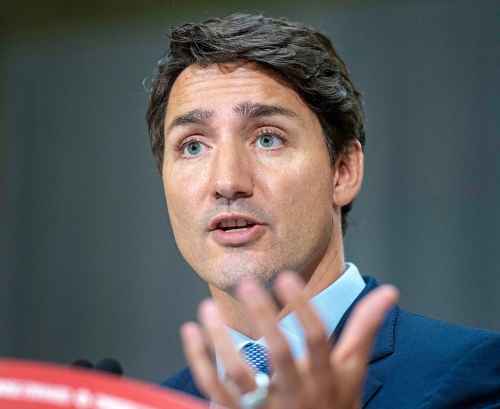
OTTAWA – Prime Minister Justin Trudeau sought to reassure Canadians on Tuesday that COVID-19 vaccines will start to arrive in the coming months even as he acknowledged that other nations are likely to start inoculating their citizens first.
“One of the things to remember is Canada no longer has any domestic production capacity for vaccines,” Trudeau said during his regular COVID-19 news conference outside his home in Ottawa.
“We used to have it decades ago, but we no longer have it. Countries like the United States, Germany and the U.K. do have domestic pharmaceutical facilities, which is why they’re obviously going to prioritize helping their citizens first.”

At the same time, Trudeau underscored the importance of getting inoculations to Canadians.
“We know we’re not going to get through this pandemic without a vaccine,” he said.
The federal government has signed orders for millions of doses from a variety of foreign pharmaceutical companies in recent months, he said, and Canada has been pushing the international community to ensure equal access for all.
“The very first vaccines that roll off an assembly line in a given country are likely to be given to citizens of that particular country,” he said.
“But shortly afterwards, they will start honouring and delivering on the contracts that they signed with other countries, including with Canada. We’ve secured millions of doses of the vaccines of the various vaccine candidates around the world.”
The expectation is that doses will start to arrive in Canada in the first few months of 2021, he added.
At the same time, Trudeau said, “we’ve begun to invest once again in ensuring that Canada will have domestic vaccine production capacity because we never want to be caught short again, without the ability to support Canadians directly.”
The federal government announced in August that it was contributing $120 million over two years to build a biomanufacturing facility in Montreal that includes the National Research Council.
Ottawa previously committed $23 million to Saskatoon’s VIDO-InterVac operations in March and pledged $175 million to Vancouver-based AbCellera Biologics in May to boost its research and production capabilities.
Trudeau said it will take time for Canada’s own vaccine-production capability to get up to speed.
Conservative health critic Michelle Rempel Garner blasted the Liberals later Tuesday for not moving faster on that front. She also called on the government to provide a timeline for when Canadians can start to see vaccines in the country.
“Because until we have that information, there’s no certainty for Canadians and I think that’s leading to a lot of mental health issues, it’s leading to business closures,” she said.
During a separate news conference, Public Procurement Minister Anita Anand said Canada has signed contracts for more doses per capita than any country in the world and that efforts are now underway to prepare for their arrival in the next few months.
That involves buying 126 freezers, including 26 ultracold ones, to hold millions of doses of vaccines. Ottawa is also seeking private bidders to run the logistics and considering what role the military could play.
Health Canada has started work on approving three vaccines, Anand added, and deliveries won’t start until a vaccine candidate gets that green light.
The number of new COVID-19 cases across the country continued to grow, with more than 1,000 each in Ontario and Quebec along with nearly 60 new deaths.
Alberta brought in new restriction Tuesday as it also announced more than 1,000 new cases of its own and 16 deaths.
Under the new rules, indoor private social events are illegal. Students in Grades 7 through 12 will transition next week to at-home learning and the school holiday break will be extended from Dec. 18 to Jan. 11.
But Premier Jason Kenney opted to keep business, including retail and clothing stores open, with 25 per cent capacity.
Casinos will be allowed to run their slot machines at 25 per cent capacity and churches will still be allowed to hold services with one-third their normal audience. Restaurants can still offer in-person dining.
To justify avoiding a stricter lockdown, Kenney used the example of a Venezuelan refugee who he said had sunk all her money into her small food stand and broke down in tears as she told him she would be ruined if forced to close.
“I would ask people who have the certainty of a paycheque — particularly a government paycheque — to think for a moment about those individuals whose entire life savings are tied up in businesses such as that,” Kenney said.
“For some, perhaps, it is a little bit too easy to say just flick a switch. Shut them down.”
In neighbouring Saskatchewan, another 175 new cases were reported and 471 in Manitoba, where chief public health officer Dr. Brent Roussin warned the provincial health-care system is being pushed close to capacity.
The Manitoba government also reported it had issued one ticket — with more expected — in connection with a Sunday church service in a rural area near Steinbach, southeast of Winnipeg, that allegedly violated a ban on public gatherings.
There were 37 new cases were reported in Nova Scotia, with new restrictions set to come into effect in Halifax. Five new cases were reported in New Brunswick and two in Newfoundland and Labrador.
Yukon was also adopting mandatory mask orders despite no new cases being reported.
“There are more regions of the country with high infection rates,” Canada’s chief public health officer Dr. Theresa Tam said Tuesday.
“And it is clear that COVID-19 knows no bounds. Communities, jurisdictions and whole regions that were little, if at all, impacted in the past (are) now seeing community spread. Some areas are experiencing very high rates of infection for the first time.”
Meanwhile, the Ontario government said it would start distributing rapid tests for COVID-19, adding that the new tools are already being used in some hospitals and long-term care homes.
Ontario Premier Doug Ford said the province would continue to deploy the 98,000 ID Now tests and 1.2 million Panbio tests it has received from the federal government in the coming weeks.
The Quebec government clarified its plan for the Christmas holidays Tuesday, saying citizens can attend only two events in a four-day window.
Premier Francois Legault’s government initially announced it would permit gatherings of a maximum of 10 people for four days between Dec. 24 and 27, and asked Quebecers to voluntarily quarantine themselves for a week before and after in exchange.

On Tuesday, Manitoba Premier Brian Pallister decided to weigh in on Quebec’s plan, which he called “dangerous.”
“I don’t want to get into quarterbacking other provinces. There are premiers there doing their absolute best, except to say this: I think it’s dangerous what the Quebec premier has decided to announce on Christmas,” Pallister said.
In response, Legault said the number of new cases per million residents is currently lower in Quebec than Manitoba.
This report by The Canadian Press was first published Nov. 24, 2020.
—With files from Steve Lambert in Winnipeg, John Chidley-Hill and Paola Loriggio in Toronto, and Morgan Lowrie in Montreal.
Related Articles
Province needs vaccine info from Ottawa, Friesen says
Advertisement Advertise With Us
Advertisement Advertise With Us