With COVID-19 cases on the rise, Quebec considers temporarily shutting schools

Advertisement

Advertise with us

MONTREAL - The Quebec government says it's considering shutting schools for up to a month around the holiday season to reduce the spread of COVID-19.

Read this article for free:


By clicking the button above, an account will be created and you will begin to receive some of our recommended newsletters. You may opt out of any newsletter by visiting your Email and Communication Preferences page or by clicking "unsubscribe" at the bottom of any email.

or

Already have an account? Log in here »

To continue reading, please subscribe:

Digital Subscription

One year of digital access for only $1.44 a week*

  • Enjoy unlimited reading on winnipegfreepress.com
  • Read the E-Edition, our digital replica newspaper
  • Access News Break, our award-winning app
  • Play interactive puzzles

*Billed as $5.77 plus GST every four weeks. After 52 weeks, price increases to the regular rate of $19.95 plus GST every four weeks. Offer available to new and qualified returning subscribers only. Cancel any time.

To continue reading, please subscribe:

Add Free Press access to your Brandon Sun subscription for only an additional

$1 for the first 4 weeks*

  • Enjoy unlimited reading on winnipegfreepress.com
  • Read the E-Edition, our digital replica newspaper
  • Access News Break, our award-winning app
  • Play interactive puzzles
Start now

*Your next Brandon Sun subscription payment will increase by $1.00 and you will be charged $17.95 plus GST for four weeks. After four weeks, your payment will increase to $24.95 plus GST every four weeks.

Hey there, time traveller!
This article was published 12/11/2020 (2179 days ago), so information in it may no longer be current.

MONTREAL – The Quebec government says it’s considering shutting schools for up to a month around the holiday season to reduce the spread of COVID-19.

In the past two days, 324 classrooms across Quebec have been closed following COVID-19 outbreaks, Premier Francois Legault said Thursday. He said his government is looking at extending the winter break but said no firm decision has been made.

Legault said he is reluctant to close schools because students already missed several weeks of classes in the spring during the first wave. “It remains the last solution, but currently, when one looks at the situation, we should not exclude any solution,” he told reporters in Quebec City.
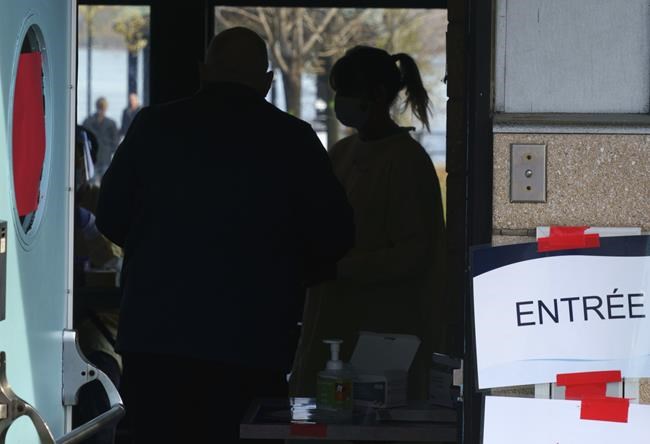
A nurse welcomes a man at a COVID-19 testing clinic in Montreal, on Monday, November 9, 2020. THE CANADIAN PRESS/Paul Chiasson

Quebec reported 1,365 new COVID-19 infections Thursday and 42 more deaths linked to the novel coronavirus, including nine that occurred in the past 24 hours.

According to Health Department data, outbreaks at schools and workplaces accounted for nearly 77 per cent of the province’s 1,509 outbreaks reported Thursday. Legault said 1,174 classrooms across Quebec are closed.

“Schools are a place of transmission,” the premier said. “It is why we’re evaluating the possibility of closing the schools for a limited period of time. We have to consider all our options to break the wave.”

The province will meet with education unions about extending the school year into the summer to make up for lost weeks, and Legault assured that parents will be given advanced warning of any closures.

Students in secondary three, four and five already alternate between in-class instruction and online courses while younger students are in school full-time. Legault said public health hasn’t linked the recent spike in classroom outbreaks to ventilation issues.

In light of recent directives from the World Health Organization regarding ventilation and aerosol transmission of COVID-19, Dr. Horacio Arruda, Quebec’s director of public health, said he’s looking at new data and working with engineers to update the province’s protocols.

Asked about the WHO’s suggestion to reduce class sizes by half, Legault said that logistically, it wouldn’t work. “If tomorrow morning we divide the classes in two, it takes twice as many classes and then it takes twice as many teachers,” Legault said. “The WHO did not tell us where to find these classrooms and teachers to implement this suggestion.”

Legault said the next few weeks could be tough for Quebecers, who he said need to reduce their contact with others. Partial lockdown orders have been place since Oct. 1 and will remain until at least Nov. 23.
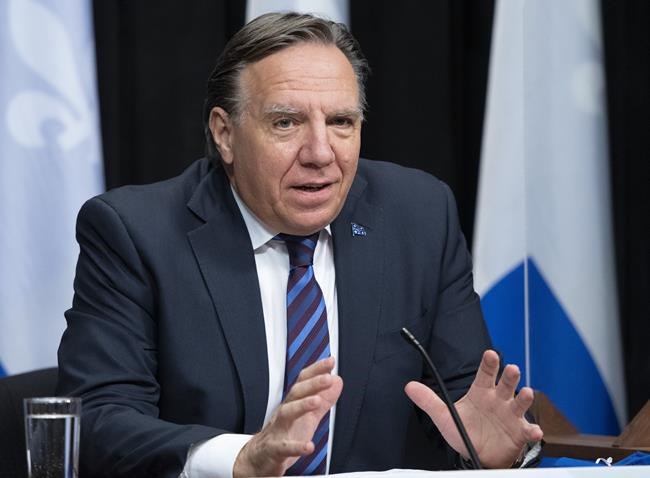
Quebec Premier Francois Legault speaks during a news conference on the COVID-19 pandemic, Thursday, November 12, 2020 at the legislature in Quebec City. THE CANADIAN PRESS/Jacques Boissinot

“At this point, we cannot rule anything out,” he said, regarding additional restrictions, “especially when we look at the situation in the United States and then in Europe.”

Health officials Thursday reported 583 COVID-related hospitalizations, a rise of 10 compared to the previous day. Of those, 86 were in intensive care, a rise of two.

Quebec has reported 119,894 COVID-19 infections and 6,557 deaths linked to the virus since the beginning of the pandemic. Officials reported Thursday that 843 more people had recovered from the disease, for a total of 101,407.

This report by The Canadian Press was first published Nov. 12, 2020.
Report Error Submit a Tip

More Stories

Letters, Oct. 31

6 minute read 2:01 AM CDT

Civic election a missed opportunity

The outcome of the latest municipal election in Winnipeg is nothing short of baffling. The decline of what was once a proud, beautiful prairie hub is impossible to ignore.

Winnipeg is rapidly sliding into a state of structural and social dilapidation, yet voters have inexplicably chosen to hand incumbent Mayor Scott Gillingham a second term. The decision smells of complacency, and sadly, it represents a massive missed opportunity for real urban renewal.

Walking through downtown Winnipeg today is an exercise in heartbreak. A city centre that should be a bustling economic and cultural core has instead transformed into an absolute eyesore. Encampments and tents are permitted to dot the heart of the city. Streets that used to thrive are now dominated by the tragic, visible reality of severe addiction, with individuals wandering and staggering through public spaces without adequate intervention or care.

Doctor’s departure stressful for teen

Kevin Rollason 6 minute read Preview

Doctor’s departure stressful for teen

Kevin Rollason 6 minute read Sunday, Oct. 24, 2021

Morgan Walker is a typical teen — but only because a piece of his brain the size of a deck of cards was removed four years ago.

Walker, who had seizures multiple times a day before his surgery, fears other people might not be so lucky.

That’s because his surgeon, Dr. Demitre Serletis, is leaving the province and Health Sciences Centre. Serletis will start practising at the Cleveland Clinic in the new year.

“I was kind of shocked, but I understood why,” Walker said from his home in Brandon. “The government really hasn’t been respecting doctors.”

Read
Sunday, Oct. 24, 2021

Fact Check

1 minute read Thursday, Nov. 30, 2023

Fact Check

Having problems with the form?Contact Us Directly |

Nine more deaths, 107 new COVID-19 cases in Manitoba

Katie May 6 minute read Preview

Nine more deaths, 107 new COVID-19 cases in Manitoba

Katie May 6 minute read Monday, Dec. 28, 2020

Manitoba is restarting its COVID-19 vaccination efforts, following a five-day break — and amidst questions about the delay.

The planned pause over Christmas was in the name of efficiency, a provincial government spokesman says, offering no other explanation on the reasoning behind the decision not to vaccinate anyone Dec. 24-28.

On Monday, the province announced nine more pandemic deaths and 107 new cases of the novel coronavirus.

As part of Manitoba's vaccination plan, the most recent immunization clinic happened Dec. 23; the next was set to start Dec. 29.

Read
Monday, Dec. 28, 2020

Actor-director Cooper takes new approach to familiar tale

Randall King 4 minute read Preview

Actor-director Cooper takes new approach to familiar tale

Randall King 4 minute read Thursday, Oct. 4, 2018

TORONTO — In his self-directed version of A Star Is Born, Bradley Cooper plays a rock star named Jackson Maine.

Note the name: it marks the character as a member of a cinematic lineage that descends all the way to 1937.

That year, the first A Star Is Born was made, with Frederick March in the role of alcoholic actor Norman Maine. The name stayed in 1954, when James Mason took over the role of an actor who first nurtures the career of Judy Garland’s up-and-coming star Vicki Lester before his drunken shenanigans threaten to derail it. By 1976, Kris Kristofferson played the role of musician John Norman Howard, a rock singer with a musical stake in the ascent of Barbra Streisand’s Esther Hoffman.

Cooper, 43, remembered the Maine name, but also brought his own vision as a first-time feature filmmaker to the new version, which opens Thursday, Oct. 4, opposite Lady Gaga after the originally designated director, Clint Eastwood, dropped out. While actors might not want to see different interpretations of a role, Cooper embraced the opportunity to see all the past iterations.

Read
Thursday, Oct. 4, 2018

Human rights museum responds to reopening backlash

Julia-Simone Rutgers 4 minute read Preview

Human rights museum responds to reopening backlash

Julia-Simone Rutgers 4 minute read Thursday, Jul. 29, 2021

The Canadian Museum for Human Rights reopened to fully vaccinated members of the public this week, drawing cries of discrimination from those who have chosen not to get vaccinated against COVID-19.

While the some of the backlash has been “disturbing,” museum CEO Isha Khan said the conflict has opened room for a conversation about human rights during the pandemic.

“We made the decision to open in compliance with that law, really because we’re a public institution and we saw it as our responsibility to open as soon as we could to the public — within the restrictions as they currently are,” Khan said Thursday.

“But it’s really important to us, as the Canadian Museum for Human Rights we have a mandate for human rights education, that we’re trying to ground the conversation in human rights principles.”

Read
Thursday, Jul. 29, 2021