WEATHER ALERT

Plan for inevitable COVID-19 cases in schools, says chief public health officer

Advertisement

Advertise with us

OTTAWA - Canada's chief public health officer says families should expect to see cases of COVID-19 in schools as children head back to class.

Read this article for free:


By clicking the button above, an account will be created and you will begin to receive some of our recommended newsletters. You may opt out of any newsletter by visiting your Email and Communication Preferences page or by clicking "unsubscribe" at the bottom of any email.

or

Already have an account? Log in here »

To continue reading, please subscribe:

Digital Subscription

One year of digital access for only $1.44 a week*

  • Enjoy unlimited reading on winnipegfreepress.com
  • Read the E-Edition, our digital replica newspaper
  • Access News Break, our award-winning app
  • Play interactive puzzles

*Billed as $5.77 plus GST every four weeks. After 52 weeks, price increases to the regular rate of $19.95 plus GST every four weeks. Offer available to new and qualified returning subscribers only. Cancel any time.

To continue reading, please subscribe:

Add Free Press access to your Brandon Sun subscription for only an additional

$1 for the first 4 weeks*

  • Enjoy unlimited reading on winnipegfreepress.com
  • Read the E-Edition, our digital replica newspaper
  • Access News Break, our award-winning app
  • Play interactive puzzles
Start now

*Your next Brandon Sun subscription payment will increase by $1.00 and you will be charged $17.95 plus GST for four weeks. After four weeks, your payment will increase to $24.95 plus GST every four weeks.

Hey there, time traveller!
This article was published 28/08/2020 (2257 days ago), so information in it may no longer be current.

OTTAWA – Canada’s chief public health officer says families should expect to see cases of COVID-19 in schools as children head back to class.

It is important that each school have a plan and that everyone knows what to do when there’s an outbreak of the novel coronavirus, Dr. Theresa Tam told a news briefing Friday.

It’s normal to feel stressed about the fact many students are returning to classrooms, she said. But planning and awareness will help reduce anxiety.
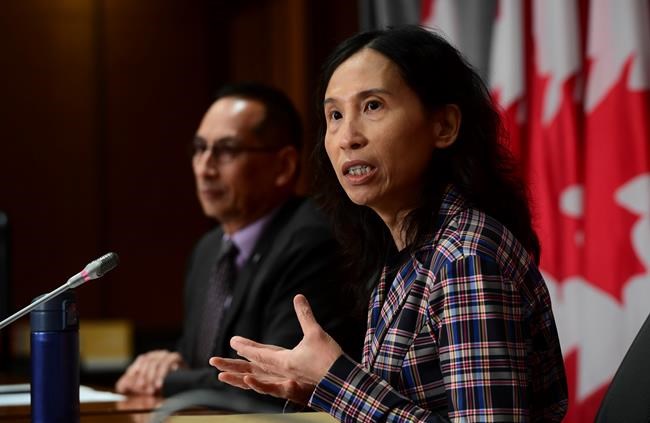
Chief Public Health Officer Dr. Theresa Tam and Dr. Howard Njoo, Deputy Chief Public Health Officer, hold a press conference in Ottawa on Friday, Aug. 28, 2020. THE CANADIAN PRESS/Sean Kilpatrick

“I do think that people should expect to come across cases in the school year, because this is inevitable,” Tam said.

“Schools need plans, and those plans must entail a very good discussion between school boards, teachers, parents and the local public health jurisdiction as well, to ensure a return to school that is as safe as possible.”

As thousands of Montreal-area students return to class, the Quebec government is facing criticism from some teachers, parents and school administrators, who say the province’s back-to-school directives are unclear — and sometimes contradictory.

In British Columbia, a group of COVID-19 modellers says the province should increase physical distancing measures to help it more safely reopen schools.

While Canada generally has quite low levels of COVID-19, families will still have lots of questions about children being back in a classroom, Tam acknowledged.

Parents face difficult decisions and carefully weighing the risks and benefits is paramount, she said.

Tam also urged an ongoing dialogue and careful consideration when a COVID-19 case does arise.

“I think that people should not have a massive knee-jerk reaction and just close everything but have local public health examine that situation and provide the advice of what to do in that instance,” she said.

“The key is to spot those cases quickly, manage those small clusters, don’t let them spread, and see if we can’t adapt our protocols and live with the virus.”

Efforts will be made to limit the impact on a school that has a case through cleaning and distancing measures that will be “as targeted, as precise and as surgical as they can in managing those circumstances.”

“So that requires a lot of discussion in those particular settings to make sure everybody is actually comfortable with those measures.”

It will also be helpful to systematically collect school-related data about COVID-19 transmission, Tam said.

“Right now the data suggests that schools are not a major driver for transmission in the community, but we have to actually get that data and see in the Canadian context.”

Data on schools where there are no outbreaks will be useful, too, she said. “Because you want to learn, well, what made that setting successful?”

This report by The Canadian Press was first published Aug. 28, 2020.

— With files from Jillian Kestler-D’Amours in Montreal and Amy Smart in Vancouver

Report Error Submit a Tip

More Stories

Cottage communities constrained by COVID

Cassandra Szklarski, The Canadian Press 6 minute read Preview

Cottage communities constrained by COVID

Cassandra Szklarski, The Canadian Press 6 minute read Friday, May. 1, 2020

TORONTO - A springtime trickle of Manitobans entering Ontario to visit their lakeside cottages alarmed Kenora Mayor Daniel Reynard a month ago.

Now that Manitoba is poised to restart some non-essential services Monday, Reynard fears an even bigger influx — this time sun-seekers expecting amenities that are simply unavailable.

The message in Ontario is still one of restraint: Avoid non-essential travel, and do not visit your cottage. Provincial travel is not prohibited, but vacationers and day-trippers will find little to do.

Restaurants are closed, as are all beaches, golf courses, parks, trails and marinas.

Read
Friday, May. 1, 2020

WRHA moves to cut growing echocardiogram wait list

Larry Kusch 6 minute read Preview

WRHA moves to cut growing echocardiogram wait list

Larry Kusch 6 minute read Tuesday, Aug. 21, 2018

Manitobans are waiting a year or more to receive a key test that detects and tracks heart disease.

As of June 15, there were about 6,500 Manitobans on the wait list for an echocardiogram, and the list is growing at a rate of about 265 per month.

Patients facing heart emergencies are receiving tests immediately, while most of those whose conditions are considered urgent or semi-urgent are getting them within established Canadian benchmark times -- about a week, officials say.

However, thousands of patients who are considered candidates for "elective" tests are waiting anywhere from 10 to 15 months, with a median wait of 12 months, according to the Winnipeg Regional Health Authority.

Read
Tuesday, Aug. 21, 2018

Manitoba’s First Nations and the Indian Act

Hersh Seth 6 minute read 2:00 AM EST

On Monday in Ottawa, Manitoba Premier Wab Kinew called for the Indian Act to be abolished. Prime Minister Mark Carney said he was open to working with First Nations to reform or repeal this law, calling it racist.

The act was created in 1876 and still controls Indian status, reserve lands and band governance. It’s understandable why many people want a better relationship.

But repealing a law and building a new relationship are not the same. What would replace the act’s protections? Who decides? How do governments ensure removing federal authority gives First Nations power while the Crown keeps its promises?

Manitoba has faced these questions before. In 1971, First Nations created a document called Wahbung: Our Tomorrows, in response to then-prime minister Pierre Trudeau’s white paper on assimilation. More than 45 years later, elders and knowledge keepers met at Turtle Lodge, north of Winnipeg, to continue the conversation. Manitobans Dave Courchene Sr. and his son, Dave Courchene Jr., are generational links to the broader movement, and their story should be part of this discussion.

Bob Saget, beloved TV dad of 'Full House,' dead at 65

Lynn Elber, The Associated Press 6 minute read Preview

Bob Saget, beloved TV dad of 'Full House,' dead at 65

Lynn Elber, The Associated Press 6 minute read Monday, Jan. 10, 2022

LOS ANGELES (AP) — Bob Saget, the actor-comedian known for his role as beloved single dad Danny Tanner on the sitcom “Full House” and as the wisecracking host of “America’s Funniest Home Videos,” died while on a stand-up tour. He was 65.

Deputies in Orange County, Florida, were called Sunday about an “unresponsive man” in a hotel room at the Ritz-Carlton in Orlando and found Saget dead, according to a sheriff’s statement on Twitter. Detectives found “no signs of foul play or drug use in this case.”

Saget was in Florida as part of his “I Don't Do Negative Comedy Tour.” After warm audience receptions to his gigs Friday in Orlando and Saturday in the Ponte Vedra Beach resort area, he celebrated online.

“I’m back in comedy like I was when I was 26. I guess I’m finding my new voice and loving every moment of it,” he posted Saturday on Instagram.

Read
Monday, Jan. 10, 2022

Province tables legislation to cover health-care system changes

Larry Kusch 4 minute read Preview

Province tables legislation to cover health-care system changes

Larry Kusch 4 minute read Wednesday, Mar. 6, 2019

The Pallister government has introduced broad legislation to support several of its key planned health-care reforms.

Health Minister Cameron Friesen said Wednesday that Bill 10 (The Regional Health Authorities Amendment Act) will provide the framework to simplify the administration of the health-care system and improve accountability.

All health services in Manitoba will be delivered through the five current regional health authorities, CancerCare Manitoba and a new provincial authority called Shared Health. The administrative changes are set to begin next month and will continue to be rolled out over the next two to three years.

The Health Department will cease to administer health services directly and focus its activities on planning, policy development, funding and oversight. It will set system-wide performance goals and track results.

Read
Wednesday, Mar. 6, 2019

The ‘Gang of Nine’ and business as usual at city hall

Editorial 4 minute read Preview

The ‘Gang of Nine’ and business as usual at city hall

Editorial 4 minute read 2:00 AM EST

In the early 1990s, after the province reduced the number of municipal wards in Winnipeg to 15, critics spoke at length of how a theoretical “Gang of Eight” could control all decision making at city hall. In subsequent years, there were various incarnations of a Gang of Eight, although it was never conclusively shown that eight members of city council could consistently stay on the same page long enough to dominate civic affairs.

That is an apt tale to consider now, as Winnipeg city hall welcomes nine rookie councillors, the largest number of non-incumbents elected in more than 30 years.

Theoretically, this new group of councillors could band together and push through various reforms. It’s a highly intriguing scenario for anyone who has watched the city, on occasion, shun riskier strategies in favor of status quo politics.

However, as was the case in the early 1990s, the chances of that happening begin to fall apart once you consider the work of building and sustaining a coalition of rookie councillors who come from a broad array of backgrounds.

Read
2:00 AM EST