COVID-19 vaccine efforts provide hope but no silver bullet to stop pandemic: Tam

Advertisement

Advertise with us

OTTAWA - Canada's top public health doctors warned Tuesday that vaccines in development for COVID-19 provide hope but will not mean an immediate end to the pandemic.

Read this article for free:


By clicking the button above, an account will be created and you will begin to receive some of our recommended newsletters. You may opt out of any newsletter by visiting your Email and Communication Preferences page or by clicking "unsubscribe" at the bottom of any email.

or

Already have an account? Log in here »

To continue reading, please subscribe:

Digital Subscription

One year of digital access for only $1.44 a week*

  • Enjoy unlimited reading on winnipegfreepress.com
  • Read the E-Edition, our digital replica newspaper
  • Access News Break, our award-winning app
  • Play interactive puzzles

*Billed as $5.77 plus GST every four weeks. After 52 weeks, price increases to the regular rate of $19.95 plus GST every four weeks. Offer available to new and qualified returning subscribers only. Cancel any time.

To continue reading, please subscribe:

Add Free Press access to your Brandon Sun subscription for only an additional

$1 for the first 4 weeks*

  • Enjoy unlimited reading on winnipegfreepress.com
  • Read the E-Edition, our digital replica newspaper
  • Access News Break, our award-winning app
  • Play interactive puzzles
Start now

*Your next Brandon Sun subscription payment will increase by $1.00 and you will be charged $17.95 plus GST for four weeks. After four weeks, your payment will increase to $24.95 plus GST every four weeks.

Hey there, time traveller!
This article was published 04/08/2020 (2278 days ago), so information in it may no longer be current.

OTTAWA – Canada’s top public health doctors warned Tuesday that vaccines in development for COVID-19 provide hope but will not mean an immediate end to the pandemic.

Dr. Theresa Tam said the Public Health Agency of Canada is planning to be responding to the pandemic for at least a year and more likely two or three.

“I would say that a vaccine is a very important aspect of the response going forward but we can’t, at this stage, put all of our focus in the hopes this is the silver-bullet solution,” Tam said at a national briefing on the COVID-19 situation in Canada.
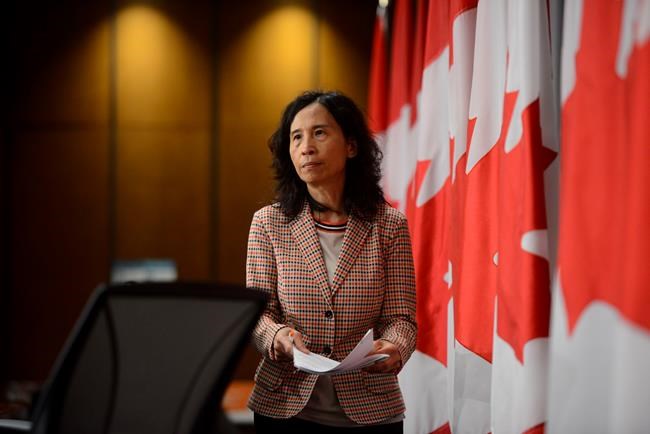
Chief Public Health Officer Dr. Theresa arrives to hold a press conference in Ottawa on Tuesday, Aug. 4, 2020. THE CANADIAN PRESS/Sean Kilpatrick

“It is a very important solution if we get a safe and effective vaccine but I would say the public health measures that we have in place, the personal daily measures that we take, is going to have to continue.”

There are more than two dozen vaccines for COVID-19 in clinical trials around the world, and in the best-case scenario, one or two might be approved for widespread use by the end of the year. But approval is only a step in the process, and it will take time to then produce, distribute and administer billions of doses of vaccine around the world.

Dr. Srinivas Murthy, a critical-care specialist and pandemic researcher at the University of British Columbia, says the world has never attempted a vaccine program at this speed or scale before.

“We have no idea how this is going to work,” he said.

He said once a vaccine is approved, then the questions become who gets it first, will people feel comfortable taking it, and how do you get it into them.

Volker Gerdts, CEO of the Vaccine and Infectious Disease Organization at the University of Saskatchewan, said he wants Canadians to know that even as the timeline for developing vaccines is accelerated, speed is not coming at the expense of safety. He said Health Canada will not approve a vaccine that is not safe or that cut safety corners to get through faster.

In 2009, when the H1N1 flu virus was declared a pandemic, there was a wide-scale vaccination effort but that illness did not have the same impact as COVID-19, and the development of the vaccine was different because flu vaccines are developed every year.

Murthy said the world knew it should have a specific coronavirus vaccine because a pandemic like this was predicted, but nobody ever got as far as making one, so the research was starting much further behind where H1N1 was when a pandemic was declared. COVID-19 is also wider-spread and more lethal than H1N1 was.

“The whole world wants this one at the exact same time and that is something that is going to require unprecedented amounts of co-ordination and collaboration across the world,” Murthy said.

The World Health Organization says vaccines must be effective in at least 50 per cent of the population for any chance of approval, and closer to 70 per cent is better. Once a vaccine developer declares a vaccine is both safe and effective, nations can begin the work to approve its use on their citizens.

Here that falls to Health Canada, which is already working with the provinces, through the National Advisory Committee on Immunization, to determine how approval, manufacture and distribution will work. The committee is expected to announce before the end of the summer which segments of the population will be prioritized for getting the vaccine.

During the H1N1 pandemic, which was found to affect children more and seniors less, priority groups included the very young, health workers, remote communities and people with chronic illnesses under the age of 65. This time the expectation is that older Canadians and front-line workers may be among the priority groups.

Statistics Canada reported that about two in five Canadians were vaccinated in the first six months the H1N1 vaccine was available. Supply of a COVID-19 vaccine may be more difficult, with such high demand. Canada is also, at the moment, limited in its ability to produce a vaccine at home and may rely on international manufacturers to help.

University of British Columbia pediatric infectious disease specialist Dr. Manish Sadarangani said people should see the goal as “controlling” the pandemic rather than “ending” it. He said realistically, a vaccine will only slow the spread of the novel coronavirus at first: it often takes years, if not decades, to eradicate a virus entirely.

Measles, mumps and polio all have vaccines, he notes, but they still exist and spread, often because of a lack of vaccinations.

However, he added, we don’t have to vaccinate everyone to control transmission because reducing the number of people who can get or spread the virus will cut down on the infection rate.

This report by The Canadian Press was first published Aug. 4, 2020.

Report Error Submit a Tip

More Stories

Kinew will listen to city request for new taxes — but no promises

Nicole Buffie 5 minute read Preview

Kinew will listen to city request for new taxes — but no promises

Nicole Buffie 5 minute read Friday, Nov. 1, 2024

Premier Wab Kinew remained coy about whether he would support a new municipal tax in Winnipeg as the city struggles to maintain services.

Kinew dodged questions on the matter Friday afternoon.

“We want to see services strong, we want to see roads getting fixed,” Kinew said. “Affordability is really top of mind … we got to keep life affordable for the average person out there.”

Some of the items being considered for a new tax are: alcohol, online deliveries, vehicle registration, vacant homes, commercial parking and land transfers with an exemption for first-time homebuyers.

Read
Friday, Nov. 1, 2024

Building healthier Canadians

Jason M. Sutherland 4 minute read 2:00 AM CDT

Ottawa is betting that billions of taxpayer dollars spent on steel, asphalt and concrete will secure Canada’s economic future and prosperity. Through the $51 billion Build Communities Strong fund, the federal government is paying for roads, bridges, water systems and transit to boost productivity and attract capital from Europe and Asia.

As the shovels hit the ground from Halifax to Vancouver, Canadians should be asking themselves: What good does it do to build a stronger country if we are not building healthier Canadians?

The fund’s $5 billion allocation for health infrastructure is welcome news, as many of our hospitals and long-term care homes across the country are showing severe signs of aging, and modern care centres are much needed. But pouring concrete for new facilities is not the same as building a healthy population.

A ribbon-cutting at a modern hospital does not guarantee you see a family doctor when you need one, keep a rural emergency department open overnight, or shorten the wait for a knee replacement keeping someone off the job or robbing a retiree of independence.

Must-see Folk Fest workshops

16 minute read Preview

Must-see Folk Fest workshops

16 minute read Thursday, Jul. 5, 2018

Workshops have always been an integral part of the Winnipeg Folk Festival.

They are magic-moment makers; a curated group of musicians — sometimes friends, sometimes strangers — on one stage playing together, supporting each other, creating something that will only exist for an hour or two. No one knows what will come out of the collaboration, but usually it’s something special.

When the Free Press spoke to Winnipeg Folk Festival artistic director Chris Frayer ahead of the lineup release in early March, he noted he would be paying some extra attention to workshops this year, as some of the special projects occurring during the past couple of festivals had pulled some of his attention away.

And with 37 workshops on the books, it would seem he followed through on his promise.

Read
Thursday, Jul. 5, 2018

Health officials ponder next steps as COVID cases surge in Southern Health region

Katie May 5 minute read Preview

Health officials ponder next steps as COVID cases surge in Southern Health region

Katie May 5 minute read Wednesday, Nov. 3, 2021

Public-health officials say they're trying to avoid ordering another lockdown in southern Manitoba, where COVID-19 infection rates are surging.

Deputy chief provincial public health officer Dr. Jazz Atwal told a news conference Wednesday he doesn't anticipate more lockdowns and suggested he will prioritize keeping schools open when considering future restrictions.

But he couldn't say what the next step will be in an area of the province where hospitalizations among unvaccinated residents are on the rise.

Average daily case counts in the southern part of the province are higher now than they were before lockdown measures went into effect last November, and officials are still figuring out what to do.

Read
Wednesday, Nov. 3, 2021

Neo-Nazi group members plotted to kill Free Press reporter

5 minute read Preview

Neo-Nazi group members plotted to kill Free Press reporter

5 minute read Wednesday, Aug. 10, 2022

Disturbing details of a plan to kill a Free Press reporter who had infiltrated a white nationalist hate group were revealed for the first time Wednesday.

Read
Wednesday, Aug. 10, 2022

Waiting for Cormier verdict the ‘calm before the storm’

Katie May 6 minute read Preview

Waiting for Cormier verdict the ‘calm before the storm’

Katie May 6 minute read Thursday, Feb. 22, 2018

As the jury room door closed behind the seven women and four men who are now deliberating on the evidence against Tina Fontaine’s accused killer, Thelma Favel rose from the chair she’s occupied for most of Raymond Cormier’s second-degree murder trial.

Almost every day over the past three weeks, Favel, the woman who raised 15-year-old Tina, has sat right up front, directly across from the jury box, listening, sobbing and soaking in disturbing details of the teen’s last days that have come to light over the course of Cormier’s second-degree murder trial.

On Wednesday afternoon, after Court of Queen’s Bench Chief Justice Glenn Joyal instructed the jury and sent them off to be sequestered until they decide whether 56-year-old Raymond Cormier is guilty of killing Tina, Favel got up and hugged Crown prosecutor Breta Passler. It was one of many moments, this one shielded from jurors, that have long since proven the emotional impact of the case and the lasting power of Tina’s legacy.

Tina’s death sparked a public outcry that renewed calls for a national inquiry into disproportionately high rates of missing and murdered Indigenous women and girls across Canada, and the criminal trial for the man accused of killing her hasn’t happened in a vacuum.

Read
Thursday, Feb. 22, 2018