Liberals detail changes to COVID-19 aid as they ask MPs to OK new spending

Advertisement

Advertise with us

OTTAWA - The Trudeau Liberals are detailing to parliamentarians a plan that would shift tens of billions in pandemic-related aid, sending more toward a key COVID-19 emergency benefit for workers after seeing demand skyrocket from original estimates.

Read this article for free:


By clicking the button above, an account will be created and you will begin to receive some of our recommended newsletters. You may opt out of any newsletter by visiting your Email and Communication Preferences page or by clicking "unsubscribe" at the bottom of any email.

or

Already have an account? Log in here »

To continue reading, please subscribe:

Digital Subscription

One year of digital access for only $1.44 a week*

  • Enjoy unlimited reading on winnipegfreepress.com
  • Read the E-Edition, our digital replica newspaper
  • Access News Break, our award-winning app
  • Play interactive puzzles

*Billed as $5.77 plus GST every four weeks. After 52 weeks, price increases to the regular rate of $19.95 plus GST every four weeks. Offer available to new and qualified returning subscribers only. Cancel any time.

To continue reading, please subscribe:

Add Free Press access to your Brandon Sun subscription for only an additional

$1 for the first 4 weeks*

  • Enjoy unlimited reading on winnipegfreepress.com
  • Read the E-Edition, our digital replica newspaper
  • Access News Break, our award-winning app
  • Play interactive puzzles
Start now

*Your next Brandon Sun subscription payment will increase by $1.00 and you will be charged $17.95 plus GST for four weeks. After four weeks, your payment will increase to $24.95 plus GST every four weeks.

Hey there, time traveller!
This article was published 02/06/2020 (2344 days ago), so information in it may no longer be current.

OTTAWA – The Trudeau Liberals are detailing to parliamentarians a plan that would shift tens of billions in pandemic-related aid, sending more toward a key COVID-19 emergency benefit for workers after seeing demand skyrocket from original estimates.

The Liberals had expected the Canada Emergency Response Benefit to cost the federal purse about $35 billion this fiscal year, but revised that estimate in recent days after realizing more workers than expected were applying for aid.

The most recent federal figures show that as of Monday, more than 8.3 million Canadians have applied for the relief program, which has paid out nearly $42.6 billion in combined benefits.
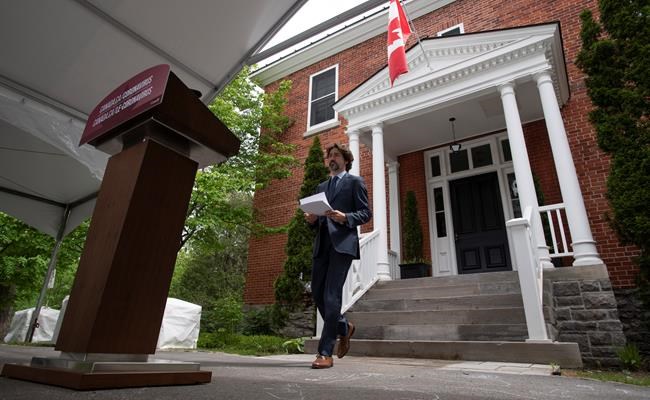
Prime Minister Justin Trudeau makes his way to the podium for a news conference outside Rideau Cottage in Ottawa, Tuesday June 2, 2020. THE CANADIAN PRESS/Adrian Wyld

The details in supplementary spending estimates released Tuesday are part of an overall package totalling $87 billion in additional measures unveiled since main spending estimates were released in February.

Parliamentarians only need to approve $6 billion in new money after granting the Liberals broad spending powers during the pandemic.

The supplementary estimates will only receive four hours of debate this month under a motion agreed to by a majority of parties to keep the House of Commons on an extended hiatus due to the pandemic.

Parliament’s spending watchdog said last week that those four hours would not give MPs enough time to properly scrutinize the government’s plans.

The Liberals’ overall spending plan to deliver help to provincial health-care systems, research into COVID-19 and emergency economic aid so far totals over $152.7 billion.

The CERB — a $2,000-a-month benefit to those who have lost work or earn no more than $1,000 a month due to the pandemic — now accounts for a larger share of spending than originally planned.

Experts have suggested the Liberals revamp the CERB to create an incentive for workers go back on the job, when it is safe to do so, but help others who max out the benefit before having a job to return to.

The Liberals are lowering the amount they expect to spend on a federal wage subsidy, to $45 billion from $73 billion, based on observed take-up. Figures posted Tuesday show 195,509 companies have been approved for $9.36 billion in aid.

The Finance Department is consulting on possible changes to the program that has been extended to the end of the summer.

Many small businesses haven’t applied for the wage subsidy because it arrived long after they had closed their doors and laid off workers, Dan Kelly, president of the Canadian Federation of Independent Business, told a Senate committee Tuesday afternoon.

Even with all the other help announced, it was likely that many workers would not be rehired and more small- and medium-sized businesses could close for good, he said.

“I can’t see any way that we are not going to see tens of thousands of business bankruptcies, business failures, by the end of this and that’s an optimistic scenario based on full utilization of all the government support programs.”

The majority of the spending in the supplementary estimates is driven by the government’s response to the COVID-19 pandemic, but also includes $481.2 million for the Indian Day Schools settlement and $585.8 million for two new naval support ships.

There is also $14.8 million set aside for Via Rail’s proposed high-frequency rail service between Toronto and Quebec City, $24.4 million for an IT upgrade for the asylum system, and almost $13.8 million for measures in response to the national inquiry on missing and murdered Indigenous women and girls.

This report by The Canadian Press was first published June 2, 2020.

Note to readers: This is a corrected story. A previous version said the main estimates were released in March.

Report Error Submit a Tip

More Stories

US rolls to women's hoops gold medal in Bird's last Olympics

Doug Feinberg, The Associated Press 6 minute read Preview

US rolls to women's hoops gold medal in Bird's last Olympics

Doug Feinberg, The Associated Press 6 minute read Sunday, Aug. 8, 2021

SAITAMA, Japan (AP) — Sue Bird and Diana Taurasi walked off the basketball court together, arm-in-arm, one last time at the Tokyo Games.

They started their journey together five Olympics ago and ended it in the same fashion as always — with gold medals hanging around their necks.

“All of what we’ve done for USA Basketball, we’ve done together. It’s fitting,” Bird said after the 90-75 win over Japan on Sunday.

And now it's over — at least for the 40-year-old Bird.

Read
Sunday, Aug. 8, 2021

Finance minister has impossible choice as federal budget looms

Dan Lett 5 minute read Preview

Finance minister has impossible choice as federal budget looms

Dan Lett 5 minute read 3:24 PM EST

It’s federal budget week, and that means every newspaper columnist, self-proclaimed think tank subject matter expert and opposition critic has suggestions for what Ottawa “must” do.

In no particular order: Finance Minister François-Philippe Champagne “must” provide tax cuts for small business to survive, provide tax cuts for big business to become bigger and wealthier, massively increase transfer payments to the provinces, make life more affordable for average people and undertake enormous, strategic investments in the economy to make Canada less reliant on the United States.

If you’re wondering how any finance minster can do all of that, all at once, the answer is they can’t. But that’s the nature of pre-budget submissions: do what we want, even if it makes it impossible for you to do the things that other people think must be done.

That is not to say all budget submissions are worthless. It’s just that you can’t cut government taxes and levies on businesses while also providing more robust investment in industries, infrastructure and people — and still have any hope of containing the debt.

Read
3:24 PM EST

Why are Manitoba's school immunization programs so far from achieving herd immunity?

Maggie Macintosh  26 minute read Preview

Why are Manitoba's school immunization programs so far from achieving herd immunity?

Maggie Macintosh  26 minute read Saturday, May. 1, 2021

Sometimes, neither a lollipop nor a dinosaur sticker is enough to convince someone to get a needle.

Dr. Michele Feierstein, a pediatrician for more than 35 years, knows that all too well.

Feierstein has given thousands of immunizations to young patients throughout her career, but she has also had her fair share of difficult conversations with parents who are vaccine-hesitant or outright anti-vaxxers.

She does not bar families who have lukewarm feelings about or adamant views against immunization, whether they be rooted in misinformation, distrust, religious belief, or any other reason, from her practice at the Manitoba Clinic.

Read
Saturday, May. 1, 2021

WRHA moves to cut growing echocardiogram wait list

Larry Kusch 6 minute read Preview

WRHA moves to cut growing echocardiogram wait list

Larry Kusch 6 minute read Tuesday, Aug. 21, 2018

Manitobans are waiting a year or more to receive a key test that detects and tracks heart disease.

As of June 15, there were about 6,500 Manitobans on the wait list for an echocardiogram, and the list is growing at a rate of about 265 per month.

Patients facing heart emergencies are receiving tests immediately, while most of those whose conditions are considered urgent or semi-urgent are getting them within established Canadian benchmark times -- about a week, officials say.

However, thousands of patients who are considered candidates for "elective" tests are waiting anywhere from 10 to 15 months, with a median wait of 12 months, according to the Winnipeg Regional Health Authority.

Read
Tuesday, Aug. 21, 2018

Manitoba’s First Nations and the Indian Act

Hersh Seth 6 minute read 2:00 AM EST

On Monday in Ottawa, Manitoba Premier Wab Kinew called for the Indian Act to be abolished. Prime Minister Mark Carney said he was open to working with First Nations to reform or repeal this law, calling it racist.

The act was created in 1876 and still controls Indian status, reserve lands and band governance. It’s understandable why many people want a better relationship.

But repealing a law and building a new relationship are not the same. What would replace the act’s protections? Who decides? How do governments ensure removing federal authority gives First Nations power while the Crown keeps its promises?

Manitoba has faced these questions before. In 1971, First Nations created a document called Wahbung: Our Tomorrows, in response to then-prime minister Pierre Trudeau’s white paper on assimilation. More than 45 years later, elders and knowledge keepers met at Turtle Lodge, north of Winnipeg, to continue the conversation. Manitobans Dave Courchene Sr. and his son, Dave Courchene Jr., are generational links to the broader movement, and their story should be part of this discussion.

iPhone started fire, Winnipegger says

Kevin Rollason 3 minute read Preview

iPhone started fire, Winnipegger says

Kevin Rollason 3 minute read Tuesday, Nov. 26, 2019

The iPhone has long been a hot item, but for one Winnipeg family, it got too hot.

Wally Hill says earlier this month, he, along with his wife and daughter, were watching television, with his daughter's iPhone 6 sitting unplugged on the cushion between them, when the smartphone set the couch on fire.

"It was frightening," Hill said. "It didn't explode... it fizzled and popped open at the back, and then smoke and flames came out the back. It then ignited the cushion."

Hill said he quickly picked up the entire couch cushion, with the burning phone still on it, to move the device to a tile floor in his residence.

Read
Tuesday, Nov. 26, 2019