Mourners struggle to grieve N.S. mass-murder victims during pandemic
Advertisement
Read this article for free:
or
Already have an account? Log in here »
To continue reading, please subscribe:

Digital Subscription
One year of digital access for only $205*
- Enjoy unlimited reading on winnipegfreepress.com
- Read the E-Edition, our digital replica newspaper
- Access News Break, our award-winning app
- Play interactive puzzles
*First annual payment billed as $205.00 + GST for one year. This annual subscription will automatically renew at $233.00 + GST every 52 weeks (10% off the regular annual price of $259.35). Offer available to new and qualified returning subscribers only. Cancel any time.
To continue reading, please subscribe:
Add Free Press access to your Brandon Sun subscription for only an additional
$1 for the first 4 weeks*
- Enjoy unlimited reading on winnipegfreepress.com
- Read the E-Edition, our digital replica newspaper
- Access News Break, our award-winning app
- Play interactive puzzles
*Your next Brandon Sun subscription payment will increase by $1.00 and you will be charged $17.95 plus GST for four weeks. After four weeks, your payment will increase to $24.95 plus GST every four weeks.
Read unlimited articles for free today:
or
Already have an account? Log in here »
Hey there, time traveller!
This article was published 21/04/2020 (2359 days ago), so information in it may no longer be current.
The death toll from a massacre that stretched across rural Nova Scotia last weekend rose to 23 Tuesday as families grappled with the heart-wrenching question of how to mourn during a pandemic that is forcing people to stay apart.
Tammy Oliver-McCurdie, whose sister Jolene Oliver, brother-in-law Aaron Tuck and niece Emily Tuck were among the dead, was struggling with how to plan funerals. The victims have loved ones in both Nova Scotia and Alberta, where the sisters grew up, and the pandemic makes travel difficult.
“I don’t know what I’m going to do with this whole COVID thing. It’s just so, so much,” an emotional Oliver-McCurdie said from Red Deer Monday. “I know she’s got people who love her here and people who love her there.”
Justin Zahl in Halifax was still searching for answers about his parents’ fate days after seeing images of their Portapique, N.S., home’s burnt remains, all while separated from his younger brother who’s in Albuquerque, N.M. He has no relatives in the province, and the Canada-U.S. border closure is keeping the brothers apart.
“I don’t know how I’m going to get my sibling up here,” Zahl said in an interview.
Premier Stephen McNeil called the rampage that began Saturday night in the quiet community of Portapique and ended at a gas station in Enfield on Sunday “one of the most senseless acts of violence in our province’s history.”
But officials reminded Nova Scotians that the community would have to mourn together from a distance to stop the coronavirus from spreading, as cases and deaths from the illness also climbed.
Dr. Robert Strang, the province’s chief medical officer of health, acknowledged at his daily news COVID-19 news conference Monday that it would be “hard for people to hear” reminders about the need for physical distancing in the aftermath of the killings.
“COVID-19 is not going to pause because of our pain — we cannot let our guard down,” Strang said.
Simon Sherry, a professor in the department of psychology and neuroscience at Dalhousie University in Halifax, said while social and ritualized aspects of grief are important, they represent only one part of coping with death and dying.
“At an individual level, people can still make meaning and reach acceptance, even amid a pandemic and the heavy weight of a mass shooting,” he said in an interview Tuesday.
On Monday night, people across Nova Scotia were asked to express their grief by stepping outside at 8:30 p.m. to light a candle or shine some kind of light.
Others have displayed solidarity by posting photos of sunsets across the province. Toronto-based singing group Choir! Choir! Choir! announced a Facebook live performance of Leonard Cohen’s ‘Hallelujah’ scheduled for Thursday. A virtual vigil is planned for Friday evening, which Prime Minister Justin Trudeau said he would attend.
Sherry said that kind of new ritual can be an important gesture of solidarity.
“When your community, when your province is suffering through grief like this, it’s important to emphasize a connection to community …. It’s important to refocus on community.”
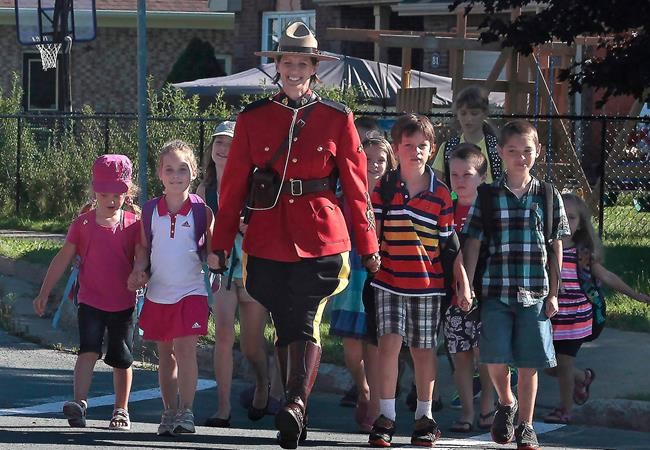
A memorial with flowers and tributes sprung up outside the RCMP headquarters in Dartmouth this week to honour Const. Heidi Stevenson, who was killed in the line of duty.
But Stevenson’s funeral will look different from those held for slain officers at other points in Canadian history — like the regimental funeral for Fredericton police constables Robb Costello and Sara Burns in August 2018 that was attended by hundreds of police officers and first responders from across the continent.
“It’s going to require some out-of-the-box thinking. I really don’t know where they’re even going to begin,” said Brian Sauve, president of the union representing RCMP officers.
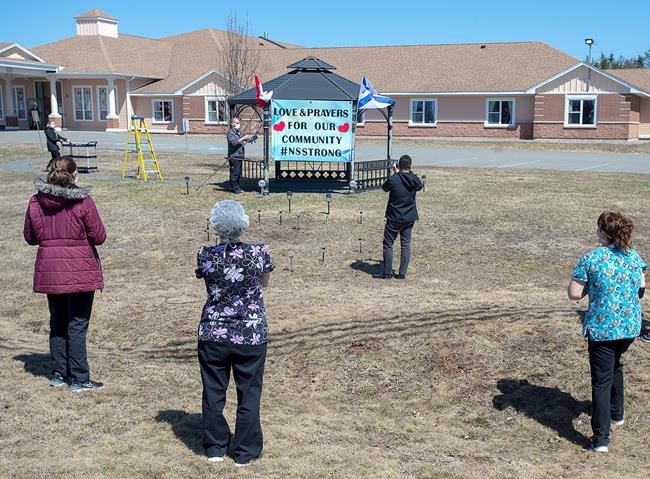
He said such events are always uniquely tragic and challenging, but there are possibilities available during the pandemic, such as livestreaming and inviting guests to park along roadways.
“There are ways in today’s day and age to honour the fallen,” he said. “It’s just in a different format.”
Quentrel Provo, an anti-violence and gun control activist who founded Stop the Violence, Spread the Love in Halifax, led a virtual candlelight vigil Monday night, opening with a prayer, a moment of silence and a reading of victims’ names during a livestream on Facebook.
Provo said it was emotionally tough to lead the event, which he set up to offer some hope as Nova Scotians feel overwhelmed by the pandemic and the violence of the weekend.
“A lot of tears have been shed. I know myself, I’ve cried a lot in the last few days,” he said in a telephone interview Tuesday.
“If we’re hurting, it’s unimaginable the pain the families are going through right now, but we’re trying to come together and be strong and show them support during this time.”

Provo said he plans to pay tribute to the victims by lighting a candle each night for the next 20 days, and he said people should continue to support each other and the families into the future.
Sherry said people should be careful not to suppress their grief during the pandemic — and it’s important to recognize that people will deal with grief in their own way.
“There is no one, particular timeline or course that someone needs to follow as they move through grief, loss and trauma,” he said.
This report by The Canadian Press was first published April 21, 2020.
— With files from Michael MacDonald in Halifax.
Related Articles
RCMP defends N.S. shooting response


Advertisement Advertise With Us
Advertisement Advertise With Us