Ottawa rolls out help for charities hit hard by COVID-19 slowdown

Advertisement

Advertise with us

OTTAWA - The federal government signalled Sunday it is shifting the focus of its COVID-19 aid towards Canada's most vulnerable as public health experts expressed cautious optimism the nation's physical distancing experiment could be working.

Read this article for free:


By clicking the button above, an account will be created and you will begin to receive some of our recommended newsletters. You may opt out of any newsletter by visiting your Email and Communication Preferences page or by clicking "unsubscribe" at the bottom of any email.

or

Already have an account? Log in here »

To continue reading, please subscribe:

Digital Subscription

One year of digital access for only $1.44 a week*

  • Enjoy unlimited reading on winnipegfreepress.com
  • Read the E-Edition, our digital replica newspaper
  • Access News Break, our award-winning app
  • Play interactive puzzles

*Billed as $5.77 plus GST every four weeks. After 52 weeks, price increases to the regular rate of $19.95 plus GST every four weeks. Offer available to new and qualified returning subscribers only. Cancel any time.

To continue reading, please subscribe:

Add Free Press access to your Brandon Sun subscription for only an additional

$1 for the first 4 weeks*

  • Enjoy unlimited reading on winnipegfreepress.com
  • Read the E-Edition, our digital replica newspaper
  • Access News Break, our award-winning app
  • Play interactive puzzles
Start now

*Your next Brandon Sun subscription payment will increase by $1.00 and you will be charged $17.95 plus GST for four weeks. After four weeks, your payment will increase to $24.95 plus GST every four weeks.

Hey there, time traveller!
This article was published 29/03/2020 (2406 days ago), so information in it may no longer be current.

OTTAWA – The federal government signalled Sunday it is shifting the focus of its COVID-19 aid towards Canada’s most vulnerable as public health experts expressed cautious optimism the nation’s physical distancing experiment could be working.

Most Canadians are entering the third week of a COVID-19 slowdown that has them keeping their distance from all but immediate family members, and some provinces are starting to report a slowdown in the rate of new infections.

On Friday British Columbia said its early modelling was suggesting social distancing had cut the spread of the novel coronavirus in half. On Sunday, Quebec Premier Francois Legault said the daily increase in positive cases “seems to be stabilizing.”
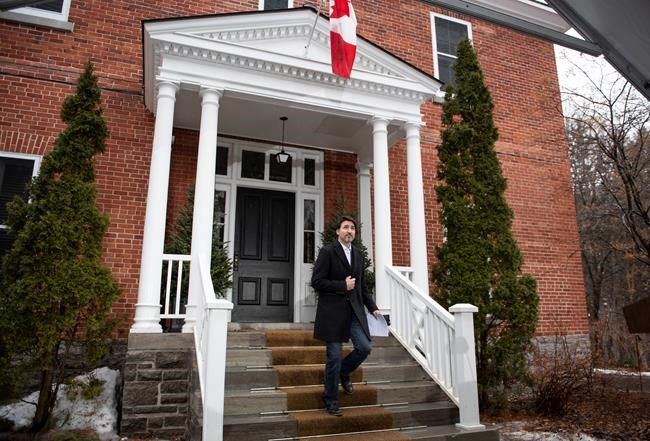
Prime Minister Justin Trudeau looks up at the falling rain as he arrives for his daily press conference on COVID-19 in front of his residence at Rideau Cottage, on the grounds of Rideau Hall in Ottawa, on Sunday, March 29, 2020. THE CANADIAN PRESS/Justin Tang

Dr. Theresa Tam, Canada’s chief public health officer, said Sunday it’s still too early to know what the impact of closing schools and offices and restricting retail services has been on the virus’s spread.

“But next week will be very, very important, for me anyways, in terms of looking at those trends,” she said.

A little more than six per cent of cases so far have required hospitalization, and three per cent are in critical condition. About one-tenth of the hospitalizations occurred in people under the age of 40, a statistic Tam said she cites so people understand that younger Canadians can get very ill from COVID-19.

She urged Canadians not to let up their efforts to physically distance themselves from others, with a particular message for those about to celebrate some of the biggest religious observances on the calendar, including Passover, Easter and Ramadan. Tam said all will have to be adapted for the “two-metre bubble” of social distancing, and she is asking religious leaders for help to make sure that happens.

Trudeau said Sunday the crisis is taking a toll on all Canadians but noted that staying home is particularly hard for Canadians who were already struggling — and it’s impossible for those who don’t have a safe home to go to.

“Tough times fall first and hardest on the most vulnerable in our communities,” Trudeau said, at his regular Sunday briefing outside his Ottawa home, where he remains in self-isolation.

Ottawa is adding a $7.5 million contribution to Kids Help Phone so the national charity can hire more counsellors and seek out additional volunteers to assist more young people calling and texting for support.

Another $9 million was announced for United Way Canada to deliver services to seniors who need practical help with such everyday chores as grocery shopping, filling their prescriptions or getting meals delivered.

United Way and Kids Help Phone were among a coalition of Canadian charities that asked for help last week, warning they were going to collapse as COVID-19 wreaked economic havoc on their donors and volunteers.

Much like private sector businesses, charities report having to lay off employees as grant programs are cancelled and donations dry up. The group says there are more than 1.4 million Canadians employed in the charitable sector, which accounts for eight per cent of Canada’s economic activity.

Trudeau said there will be additional help for charities announced in the coming days, but he also appealed to Canadians who are able to donate money or time.

“Not only are organizations in the charitable sector and the non-profit sector doing incredibly important work during difficult times, they’re also in many cases seeing their donations dry up and are very worried about their capacity to continue to do the work they’re doing,” he said.
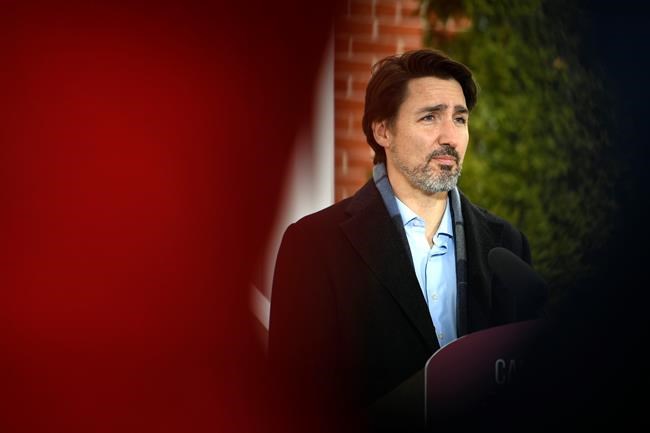
Prime Minister Justin Trudeau speaks during his daily press conference on COVID-19, in front of his residence at Rideau Cottage, on the grounds of Rideau Hall in Ottawa, on Saturday, March 28, 2020. THE CANADIAN PRESS/Justin Tang

The government already announced $157.5 million for homeless shelters and up to $50 million for women’s shelters as part of their massive federal aid package made public March 18, mainly to help the organizations buy protective gear for workers and find ways to keep clients isolated as necessary.

While details of the funding are expected this week, Families Minister Ahmed Hussen said Sunday $15 million in emergency funding has already gone out and is having an impact, allowing shelters to get hotel rooms for clients who need to be quarantined or isolated and to buy emergency supplies to protect frontline staff.

Trudeau said Sunday he intends to stay in isolation at his home for almost two more weeks even though his wife, Sophie Gregoire Trudeau, has fully recovered from COVID-19.

Gregoire Trudeau was diagnosed March 13 after a trip to England, and was quarantined at the couple’s home until her doctor and Ottawa Public Health gave her the medical all-clear a couple of days ago. She is now at the prime minister’s cottage residence in Quebec with their three children, while Trudeau stays at Rideau Cottage in Ottawa to continue to work.

He said they were careful to stay apart during his wife’s quarantine, but because he was sharing a home with someone who had COVID-19 he will stay isolated to follow the best advice of medical staff.

“I have to continue in isolation in order to be sure that we’re following all the protocols and the recommendations by Health Canada,” he said.

Neither he nor their children, Xavier, 12, Ella-Grace, 11, and Hadrien, 6, have shown symptoms of the illness.

Trudeau was the first major world leader to go into isolation because of COVID-19, and his role as both the head of a G7 nation and the only parent at home able to care for the couple’s three children garnered him headlines around the world.

This report by The Canadian Press was first published March 29, 2020.

Report Error Submit a Tip

More Stories

Brian Bowman wins mayoral battle

Aldo Santin and Mary Agnes Welch 6 minute read Preview

Brian Bowman wins mayoral battle

Aldo Santin and Mary Agnes Welch 6 minute read Thursday, Oct. 23, 2014

In the end, it wasn’t even close.

A mayoral race that was supposed to be a head-to-head battle between privacy lawyer Brian Bowman and former NDP MP and MLA Judy Wasylycia-Leis turned into a rout on election night. Wasylycia-Leis, the experienced politician, had held what looked like an unassailable lead for months, but Bowman, the outsider who promised Winnipeggers a better, prosperous future, chipped doggedly away at it.

“I’m excited to tell you that positive change is coming to city hall,” Bowman told roaring supporters at the Inn At The Forks after making his way into the small ballroom accompanied by his wife and two young sons.

He said he hadn’t expecting such a landslide victory, but had believed that the campaign was building momentum.

Read
Thursday, Oct. 23, 2014

Today’s horoscope

Georgia Nicols 4 minute read Preview

Today’s horoscope

Georgia Nicols 4 minute read 2:00 AM CDT

MOON ALERT: There are no restrictions to shopping or important decisions today. The moon is in Cancer.

ARIES (March 21-April 19)

Avoid heated discussions regarding kids, social plans, shared expenses or dealing with authority figures. (This covers a wide swath.) People are touchy! Pull in your reins and tread carefully. You don’t have to be right. You don’t even have to be wrong.

TAURUS (April 20-May 20)

Read
2:00 AM CDT

Fact Check

1 minute read Thursday, Nov. 30, 2023

Fact Check

Having problems with the form?Contact Us Directly |

Manitoba family adopts Ukrainian children just before Russian invasion

Chris Kitching 7 minute read Preview

Manitoba family adopts Ukrainian children just before Russian invasion

Chris Kitching 7 minute read Wednesday, Mar. 30, 2022

When Trish Braun sees horrific images of Russia’s attack on Ukraine, the Manitoba mother is thankful she had enough time to flee from the country with her three adopted children.

Other Canadian families weren’t as fortunate, as Ukraine halted intercountry adoptions due to the Kremlin’s unprovoked invasion and war.

“I’m so thankful we were able to get out, but lots (of Ukrainians) don’t have the option of getting to leave,” said Braun, who lives in Grunthal, about 50 kilometres southeast of Winnipeg. “It’s hard to adjust to life here while our hearts are over there.”

Just days before Russia began its assault, Braun was staying in the Odesa region with the three Ukrainian children — siblings Daniel, 16, Lewis, 10, and Paige, 6 — that she and her husband, Mike, 43, had adopted from an orphanage.

Read
Wednesday, Mar. 30, 2022

Is Canada headed for time chaos this weekend?

Michelle Bastian 5 minute read 2:00 AM CDT

When Manitoba Premier Wab Kinew declared Sept. 17 that the province would remain on permanent daylight time, he suggested it was a historical moment people would share with their “great-great-grandkids.” But, while Sunday, Nov. 1 has been heralded as the date many Canadians will stop changing their clocks, there are rumblings behind the scenes suggesting this will actually cause more trouble than ever before.

There are, of course, the warnings from chrono-biologists and sleep scientists about the damage permanent daylight time will do. The lighter evenings will mean many more dark mornings. But there is another set of problems in the offing in the critical infrastructure that underpins our digital lives.

While it used to be common to spend the Sunday morning after a time change going around our homes updating the clocks, we now wake up to devices that have already adjusted to the new time. These automatic updates occur regularly for daylight time, as well as when we travel to new time zones.

Our clocks are able to change by themselves owing to the hard work of a group of volunteers who were recently named in a list of the people who hold up the internet. This group, led by Paul Eggert, a computer scientist at UCLA, maintains a little-known tool called the Time Zone Database. Since the 1980s, it has kept track of regional, national and international debates about clock time and provided an up-to-date table of what time it should be on our walls.

A fond farewell to the Hercules

Editorial 4 minute read Preview

A fond farewell to the Hercules

Editorial 4 minute read 2:00 AM CDT

Fans at the NHL’s outdoor Heritage Classic game last weekend were no doubt thrilled by the sight and sound of two CF-18 Hornet fighter jets conducting a flyover at Princess Auto Stadium shortly before the puck was dropped for the much-anticipated Winnipeg Jets/Montreal Canadiens matchup.

Flyovers such as these always create a spectacular scene, as the speed and power of the jets are on full display for the brief moments they’re in view above the stadium bowl. But fans who maintained their skyward gaze for a few seconds after the Hornets’ blink-and-you’ll-miss-it appearance were treated to a much more poignant aeronautical exhibition, as a CC-130H Hercules aircraft passed over the stadium in the fighter jets’ wake.

Compared to the supersonic CF-18s, the massive, propeller-driven transport plane probably seemed to be doing more of a “crawl-over”; what most folks at the outdoor game probably didn’t realize, however, was that this was almost certainly the last time they’ll see one of these ubiquitous Canadian Forces aircraft in the sky.

The CC-130H is being retired after more than half a century as the RCAF’s combat, rescue and transport workhorse. The “Herc” will be replaced by more modern aircraft, including the smaller and more nimble CC-295 Kingfisher, which will be used for search-and-rescue missions out of 17 Wing Winnipeg, beginning next month.

Read
2:00 AM CDT