Get out of jail? Inmates fearful of virus argue for release
Advertisement
Read this article for free:
or
Already have an account? Log in here »
To continue reading, please subscribe:
Digital Subscription
One year of digital access for only $1.44 a week*
- Enjoy unlimited reading on winnipegfreepress.com
- Read the E-Edition, our digital replica newspaper
- Access News Break, our award-winning app
- Play interactive puzzles
*Billed as $5.77 plus GST every four weeks. After 52 weeks, price increases to the regular rate of $19.95 plus GST every four weeks. Offer available to new and qualified returning subscribers only. Cancel any time.
To continue reading, please subscribe:
Add Free Press access to your Brandon Sun subscription for only an additional
$1 for the first 4 weeks*
- Enjoy unlimited reading on winnipegfreepress.com
- Read the E-Edition, our digital replica newspaper
- Access News Break, our award-winning app
- Play interactive puzzles
*Your next Brandon Sun subscription payment will increase by $1.00 and you will be charged $17.95 plus GST for four weeks. After four weeks, your payment will increase to $24.95 plus GST every four weeks.
Read unlimited articles for free today:
or
Already have an account? Log in here »
Hey there, time traveller!
This article was published 18/03/2020 (2419 days ago), so information in it may no longer be current.
NEW YORK – Coronavirus has become a “get out of jail” card for hundreds of low-level inmates across the country, and even hard-timers are seeking their freedom with the argument that it’s not a matter of if but when the deadly illness sweeps through tightly packed populations behind bars.
Among those pleading for compassionate release or home detention are the former head of the Cali drug cartel, President Donald Trump’s former personal attorney Michael Cohen, Ponzi schemer Bernard Madoff and dozens of inmates at New York City’s Rikers Island, part of a jail system that lost an employee to the virus this week.
“He is in poor health. He is 81 years old,” David Oscar Markus, the attorney for cocaine kingpin Gilberto Rodriguez-Orejuela, wrote in emergency court papers this week seeking his release after serving about half of a 30-year drug-trafficking sentence. “When (not if) COVID-19 hits his prison, he will not have much of a chance.”
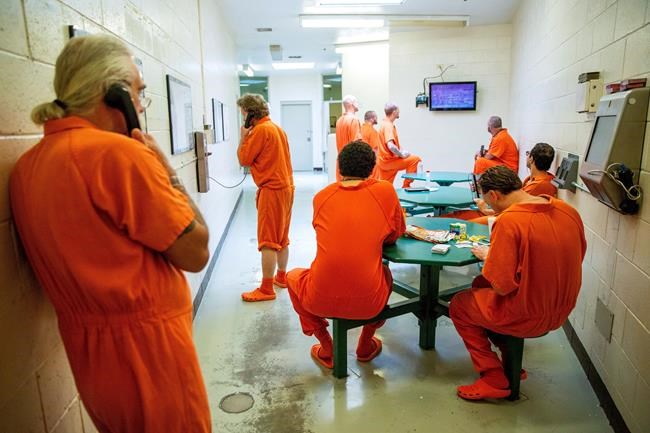
While widespread outbreaks of coronavirus behind bars have yet to happen, the frenzy of legal activity underscores a crude reality that’s only beginning to sink in: America’s nearly 7,000 jails, prisons and correction facilities are an ideal breeding ground for the virus, as dangerous as nursing homes and cruise ships but far less sanitary.
Stepped-up cleanings and a temporary halt to visitations at many lockups across the country in the midst of the crisis can’t make up for the fact that ventilation behind bars is often poor, inmates sleep in close quarters and share a small number of bathrooms.
“Simply put, it’s impossible to do social distancing,” said David S. Weinstein, a former federal prosecutor in Miami.
The 81-year-old Madoff, who is serving a 150-year sentence for bilking thousands of investors in a $17.5 billion Ponzi scheme, had just asked last month to be released early in light of his terminal kidney disease. Now his attorney is calling on all at-risk federal prisoners to be released for their own safety because of the coronavirus.
“The federal prison system has consistently shown an inability to respond to major crises,” Madoff attorney Brandon Sample told The Associated Press. “My concerns are even more amplified for prisoners at federal medical centres and those who are aged.”
As of Wednesday, two federal Bureau of Prisons staff members have tested positive for coronavirus, a person familiar with the matter told the AP. One of the staffers works in a correctional facility in Berlin, New Hampshire, and the other works in an office in Grand Prairie, Texas, but there were still no confirmed cases among any of the 175,000 inmates in the BOP system, the person said. The person, who wasn’t authorized to discuss the matter publicly and spoke to the AP on condition of anonymity, would not say how many inmates, if any, have been tested for coronavirus.
Michael Avenatti, the once high-flying lawyer who was recently convicted of trying to extort Nike, asked a judge Wednesday to release him to home confinement. A court motion said Avenatti was particularly vulnerable to the coronavirus in part because his cellmate in Manhattan’s Metropolitan Correctional Center was removed from his cell due to flu-like symptoms.
“He is part of the general population incarcerated under unsanitary and disease-prone conditions,” attorney H. Dean Steward wrote in the court filing. “He also had pneumonia six months ago.”
It’s not just attorneys for the wealthy and powerful seeking release.
In New York, public defenders asked judges to release older and at-risk inmates from the city’s beleaguered federal jails, saying pretrial confinement “creates the ideal environment for the transmission of contagious disease.” The motions cite a provision of the Bail Reform Act allowing for the temporary release of pretrial inmates under “compelling” circumstances.
Mayor Bill de Blasio said Wednesday that over the next 48 hours the city will identify any inmates held in minor charges it thinks should be released because of their health. He said it’s a balance of “public safety with the very real concern about health in the jails.”
“I truly believe the jails are ticking time bombs,” said David Patton, executive director of the Federal Defenders of New York. “They’re overcrowded and unsanitary in the best of times. They don’t provide appropriate medical care in the best of times, and these certainly are not the best of times.”
Some authorities around the nation appear to agree. Police departments are incarcerating fewer people, prosecutors are letting non-violent offenders out early and judges are postponing or finding alternatives to jail sentences.
In Los Angeles, the nation’s largest jail system has trimmed its population by more than 600 since Feb. 28, allowing many inmates with fewer than 30 days left on their sentences to be released early. In Cleveland, judges held a special session over the weekend to settle cases with guilty pleas and release more than 200 low-level, non-violent inmates. And in Miami, the top state attorney has urged the release of all non-violent felons and those being held on misdemeanours.
“No judge wants to have a dead prisoner on his conscience,” said Bill Barzee, a Miami defence attorney.
New York City’s Board of Correction this week called for the immediate release of all high-risk inmates after an an investigator assigned to the jail system died over the weekend of the coronavirus. The 56-year-old man was said to have a pre-existing health condition and only limited contact with inmates. The city’s jail system has about 8,000 inmates, most at notorious Rikers Island.
However, accommodating the surge of requests poses its own challenge. Courts around the country are shutting down, with only a skeletal staff working. The chief federal judge in Brooklyn on Monday postponed indefinitely all criminal and civil jury trials, encouraging judges to conduct court business via telephone or video conferencing when possible, and to delay in-person proceedings.
Prosecutors said in court filings that the Federal Bureau of Prisons has been planning for the outbreak since January, including by establishing a task force with experts at the Centers for Disease Control and Prevention. The BOP last week suspended visitation for all federal inmates, facility transfers, staff travel and training for 30 days. Newly arriving inmates are being screened for COVID-19, and even asymptomatic inmates deemed to be at risk are being quarantined. Immigration and Customs Enforcement announced that they would take similar steps.
Public health officials stress that older people and those with existing health problems are most at risk from coronavirus but that the vast majority of people will only suffer mild or moderate symptoms, such as fever and cough, with recovery in a matter of weeks.

But such assurances are small solace for inmates.
The Twitter account of Michael Cohen, Trump’s former attorney who is serving a three-year sentence for crimes including tax evasion and campaign finance violations, shared over the weekend an online petition seeking the transfer of non-violent federal prisoners to home confinement. Addressed specifically to Trump, it argues the move would “give the prison facilities additional (and much needed) medical triage and logistic space for those who will become infected.”
“Without your intervention, scores of non-violent offenders are at risk of death,” it reads, “and these people were not given a death sentence.”
___
Goodman reported from Miami. Michael Balsamo in Washington, Stefanie Dazio in Los Angeles and Michael R. Sisak in New York contributed to this report.