Experts weigh in on protecting against new coronavirus

Advertisement

Advertise with us

TORONTO - As Canadian health officials treat Canada's first diagnosed case of a new type of coronavirus spreading around the world, doctors are repeatedly stressing the fact that the risk of further transmission is quite low. Yet members of the public may find themselves wondering if they should be taking extra steps to limit any potential exposure, including buying face masks. A few doctors weigh in:

Read this article for free:


or

Already have an account? Log in here »

To continue reading, please subscribe:

Subscribe and receive a limited-edition Free Press branded hat or tote.

Digital Subscription

One year of digital access for only $205*

  • Enjoy unlimited reading on winnipegfreepress.com
  • Read the E-Edition, our digital replica newspaper
  • Access News Break, our award-winning app
  • Play interactive puzzles

*First annual payment billed as $205.00 + GST for one year. This annual subscription will automatically renew at $233.00 + GST every 52 weeks (10% off the regular annual price of $259.35). Offer available to new and qualified returning subscribers only. Cancel any time.

To continue reading, please subscribe:

Add Free Press access to your Brandon Sun subscription for only an additional

$1 for the first 4 weeks*

  • Enjoy unlimited reading on winnipegfreepress.com
  • Read the E-Edition, our digital replica newspaper
  • Access News Break, our award-winning app
  • Play interactive puzzles
Start now

*Your next Brandon Sun subscription payment will increase by $1.00 and you will be charged $17.95 plus GST for four weeks. After four weeks, your payment will increase to $24.95 plus GST every four weeks.

Hey there, time traveller!
This article was published 27/01/2020 (2447 days ago), so information in it may no longer be current.

TORONTO – As Canadian health officials treat Canada’s first diagnosed case of a new type of coronavirus spreading around the world, doctors are repeatedly stressing the fact that the risk of further transmission is quite low. Yet members of the public may find themselves wondering if they should be taking extra steps to limit any potential exposure, including buying face masks. A few doctors weigh in:

Do masks help?

In a hospital setting, absolutely. Dr. Isaac Bogoch, an infectious diseases specialist at the Toronto General Hospital, says proper equipment is an essential part of all infection protection and control measures among staff at health-care facilities. Masks, coupled with proper gowns, gloves and treatment rooms, help limit the spread of an airborne illness within a hospital setting and go a long way towards ensuring the virus does not follow uninfected patients home. At a Sunday afternoon news conference, staff at the Toronto hospital where the lone Canadian patient is being treated said the facility is following all possible protection protocols and remains safe for all patients.
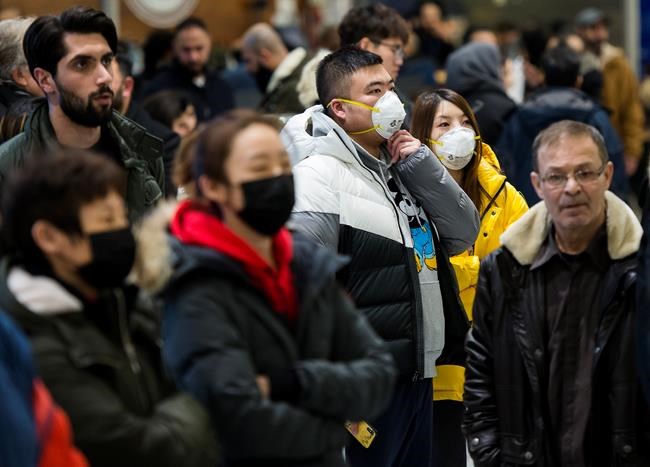
People wear masks as a precaution due to the coronavirus outbreak as they wait for the arrivals at the International terminal at Toronto Pearson International Airport in Toronto on Saturday, January 25, 2020. Canadian health officials announced a first presumed case in Ontario after the illness has sickened more than 1,200 people and killed at least 41 in China, the epicentre of the outbreak. THE CANADIAN PRESS/Nathan Denette

Does this mean I should run out and buy a mask?

No. Bogoch said the benefits of proper masks worn by hospital staff are largely lost when applied to the sort widely available for purchase at local drug stores. Bogoch said such masks may offer an additional layer of protection if worn by someone who is already infected, but has more limited value for healthy members of the public.

“Is it time to start wearing masks in public places in Toronto? Absolutely not,” Bogoch said, referencing the city where the first Canadian coronavirus case was diagnosed and treated.

Dr. Sohail Gandhi, president of the Ontario Medical Association, agrees, noting early data on the new form of virus suggests masks won’t be especially effective.

So is there anything I can do to protect myself?

Gandhi says that while masks may have helped ward off the spread of SARS during the deadly 2003 outbreak, preliminary research indicates the same won’t be true of the current virus.

“Handwashing is more effective than face masks with this particular virus, particularly if you’re not infected,” he said.

Toronto Medical Officer of Health Dr. Eileen de Villa echoed a call for increased handwashing, but noted that the arrival of coronavirus is not the main reason behind the advice. Both she and Bogoch said washing hands with soap and water, plus limiting contact with one’s face, makes sense during the Canadian flu season currently in full swing.

De Villa also urged one other measure known to limit the spread of all airborne diseases.

“We do encourage people that when they’re sick with a respiratory illness, best to stay home and limit transmission,” she said. “It also gives one a chance to recover.”

This report by the Canadian Press was first published Jan. 27, 2020.

Report Error Submit a Tip

More Stories

Canadian Mennonite University students, staff victims of cyberattack

Free Press staff 3 minute read Preview

Canadian Mennonite University students, staff victims of cyberattack

Free Press staff 3 minute read Wednesday, Oct. 7, 2026

Canadian Mennonite University fell victim to a cyberattack that compromised the data of current and former students and employees last month.

School officials became aware of the cybersecurity incident, in which an “unknown third party” accessed its information technology systems without authorization, on Sept. 18, university president Cheryl Pauls said in a recent statement.

The university has since confirmed the third party used that access to steal information from its systems.

“We immediately initiated our incident response plan, retained expert assistance, and informed the university community whose workflows were affected as soon as we became aware of the incident,” Pauls said. “We also reported this incident to law enforcement and will be filing a report with the Office of the Privacy Commissioner of Canada.”

Read
Wednesday, Oct. 7, 2026

Letters, Oct. 9

7 minute read 2:01 AM CDT

Manitoba Hydro at it again

As a former resident of Windsor Park, I often ride my bicycle through the neighbourhood or walk the shaded pathway from Elizabeth Road to Cottonwood Drive. It’s a favourite walkway for residents with dogs as well. While passing the pathway at Elizabeth Road the other day I was dismayed to see crews clear-cutting the mature trees between the pathway and the CPKC tracks that stretch the length of Archibald Street.

At first I thought that the crews were clearing out the dense bushes and trees at the start of the pathway. I made a note to return to see if that was all that was going to be done. (When) I drove by the trees had been clear-cut to the end of the first street and access point to it, much to my dismay and horror. I parked my car and went to speak with a worker doing the tree removal.

I was informed that it was a Hydro corridor and that the work would clear-cut every tree between Elizabeth Road and Cottonwood Road. Perhaps the plan is to continue on through Southdale and Island Lakes. At a time of diminishing tree canopies around Winnipeg and the drive to plant a million trees, this decision is outrageous and lacks respect for our current climate situation and neighbourhood esthetics.

Manitoba pharmacists push for increased role in administration of vaccines

Chris Kitching 6 minute read Preview

Manitoba pharmacists push for increased role in administration of vaccines

Chris Kitching 6 minute read Yesterday at 6:39 PM CDT

Manitoba’s public health officials are preparing for influenza season to peak earlier than usual amid concerns about declining uptake for flu and COVID-19 vaccinations.

While the season started early in some provinces, including Ontario and B.C., Dr. Brent Roussin, Manitoba’s chief public health officer, said it’s too soon to conclusively say if the same will happen here.

“But certainly seeing what’s around us and seeing an uptick (in cases) here, it’s making a concern it might be an early year,” he told the Free Press on Thursday.

Manitoba’s flu season usually peaks in late December, with the vaccination campaign continuing into the new year.

Read
Yesterday at 6:39 PM CDT

Fraser Institute report places Manitoba near bottom of all provinces, states in productivity, income advancement

Gabrielle Piché 5 minute read Preview

Fraser Institute report places Manitoba near bottom of all provinces, states in productivity, income advancement

Gabrielle Piché 5 minute read Yesterday at 8:01 PM CDT

Manitoba trails behind most Canadian provinces and American states in economic well-being, according to a new study.

The Fraser Institute, a right-leaning think tank, compared provinces’ and U.S. states’ GDP per person, among other economic measures, in a report released Thursday.

It places Manitoba 56th of 60 jurisdictions. Most provinces and every state except Mississippi had a higher GDP per person in 2024 than Manitoba, the Fraser Institute calculated.

It used data from Statistics Canada and the United States Census Bureau.

Read
Yesterday at 8:01 PM CDT

Can’t cut your way to being a better city

Molly McCracken 5 minute read 2:00 AM CDT

The powers that be in Winnipeg have pushed for cheap property taxes for decades. As a result, the city doesn’t have enough money to balance the books, let alone maintain infrastructure, deliver services and respond to challenges like homelessness and the toxic drug crisis.

Winnipeg’s fiscal problem stems from decades of keeping property-tax increases below inflation and relying on inadequate revenues to fund a growing city. The result? Today, Winnipeg spends less money per person on city services than it did in 2001.

A look at the books at city hall is stark. Winnipeg has run a deficit almost every year since the COVID-19 pandemic because of climate-change-driven heavy ice and snowstorms, higher fuel costs and increased policing overtime. During this time, city council tried to cut and freeze public service spending where it could; as a result, community services have been cut to the bone.

Departments responsible for what makes a city a good place to live have been squeezed. Since 1999, community services — responsible for libraries, recreation, swimming lessons and aspects of Winnipeg’s poverty-reduction work — has 149 fewer staff positions, an 18 per cent reduction, even as the city’s population has grown 35 per cent, or by 220,000 people.

Experts weigh in on protecting against coronavirus

The Canadian Press 3 minute read Preview

Experts weigh in on protecting against coronavirus

The Canadian Press 3 minute read Monday, Jan. 27, 2020

TORONTO - As Canadian health officials treat Canada's first diagnosed case of a new type of coronavirus spreading around the world, doctors are repeatedly stressing the fact that the risk of further transmission is quite low. Yet members of the public may find themselves wondering if they should be taking extra steps to limit any potential exposure, including buying face masks. A few doctors weigh in:

Do masks help?

In a hospital setting, absolutely. Dr. Isaac Bogoch, an infectious diseases specialist at the Toronto General Hospital, says proper equipment is an essential part of all infection protection and control measures among staff at health-care facilities. Masks, coupled with proper gowns, gloves and treatment rooms, help limit the spread of an airborne illness within a hospital setting and go a long way towards ensuring the virus does not follow uninfected patients home. At a Sunday afternoon news conference, staff at the Toronto hospital where the lone Canadian patient is being treated said the facility is following all possible protection protocols and remains safe for all patients.

Does this mean I should run out and buy a mask?

Read
Monday, Jan. 27, 2020