False vaccine claims spread online by bots, trolls: top public-health doc

Advertisement

Advertise with us

OTTAWA - Canada's chief public health officer says the fight against vaccine-related misinformation on social media is being further complicated by the emergence of online bots designed to sow mistrust.

Read this article for free:


or

Already have an account? Log in here »

To continue reading, please subscribe:

Subscribe and receive a limited-edition Free Press branded hat or tote.

Digital Subscription

One year of digital access for only $205*

  • Enjoy unlimited reading on winnipegfreepress.com
  • Read the E-Edition, our digital replica newspaper
  • Access News Break, our award-winning app
  • Play interactive puzzles

*First annual payment billed as $205.00 + GST for one year. This annual subscription will automatically renew at $233.00 + GST every 52 weeks (10% off the regular annual price of $259.35). Offer available to new and qualified returning subscribers only. Cancel any time.

To continue reading, please subscribe:

Add Free Press access to your Brandon Sun subscription for only an additional

$1 for the first 4 weeks*

  • Enjoy unlimited reading on winnipegfreepress.com
  • Read the E-Edition, our digital replica newspaper
  • Access News Break, our award-winning app
  • Play interactive puzzles
Start now

*Your next Brandon Sun subscription payment will increase by $1.00 and you will be charged $17.95 plus GST for four weeks. After four weeks, your payment will increase to $24.95 plus GST every four weeks.

Hey there, time traveller!
This article was published 26/04/2019 (2718 days ago), so information in it may no longer be current.

OTTAWA – Canada’s chief public health officer says the fight against vaccine-related misinformation on social media is being further complicated by the emergence of online bots designed to sow mistrust.

Dr. Theresa Tam said Friday in Ottawa that bots have been spreading false claims about vaccinations and increasing tensions on the issue. The misinformation on social media, she added, is at least partly to blame for the 300-per-cent global increase this year in measles.

“They are at play, for sure,” Tam said of bots after taking part in a panel discussion about the spread of false information on social-media platforms.
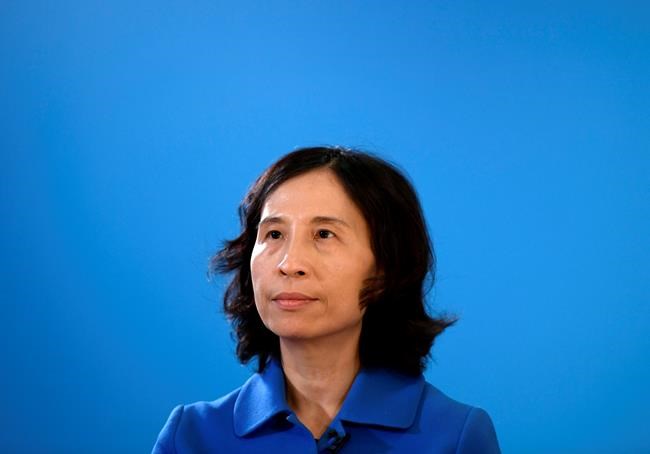
Dr. Theresa Tam, Canada's Chief Public Health Officer, participates in a panel discussion by the Public Policy Forum on the spread of misinformation about vaccinations on social media, in Ottawa on Friday, April 26, 2019. THE CANADIAN PRESS/Justin Tang

“Some of them can be very divisive in terms of increasing mistrust, trying to … amplify the fact that there is an actual debate when there is no debate.”

Tam didn’t specify where she believes this sort of thing originates, but U.S. authorities have accused Russian “troll farms” of using similar tactics to crank up tensions in the lead-up to the 2016 presidential election, polluting political discussions with false information and sowing discord.

Tam warned that bad actors online can be very effective at planting doubts in the minds of parents, and she stressed that any parent is potentially susceptible.

She said she’s concerned Canada’s vaccine coverage could slide from its current level, which she described as not high enough but “not terrible.”

“What we know is that people who outright refuse vaccines are a very small group,” she said. “But we might be talking about a significant percentage of parents that have questions about vaccines — and we need to answer them. We need to give them the scientifically based, credible answer.”

She said about 20 to 30 per cent of parents have questions about vaccines.

Public-health officials in Canada have been talking with social-media companies — including Facebook, Twitter and Google — to see how they can collaborate to prevent the circulation of misinformation about vaccines.

She was joined on the panel by Kevin Chan of Facebook Canada. He said the social-media giant has been working with global health authorities to help it pick out misinformation about vaccines.

“We’re looking for things that have clearly been identified by the scientific community as being misinformation,” said Chan, who is Facebook Canada’s head of public policy.

“What we want to be careful about is not over-rotating and actually making calls on people’s opinions. That’s very important. Facebook is a platform for all voices and we do want to make sure we preserve people’s ability to have opinions and to share their opinions.

“What we’re going after is scientifically debunked information that could lead to real-world harm.”

Chan said the company will remove the false information from search returns on Facebook and Instagram (a photo-oriented site Facebook also owns) and block or disable ads containing false claims on the platforms.

—Follow @AndyBlatchford on Twitter

Report Error Submit a Tip

More Stories

China sentences Canadian to death, raises diplomatic tension

The Associated Press 2 minute read Monday, Jan. 14, 2019

BEIJING - A Chinese court sentenced a Canadian man to death Monday in a sudden retrial in a drug smuggling case that is likely to escalate tensions between the countries over the arrest of a top Chinese technology executive.

The court in northeastern Liaoning province announced that it had given Robert Lloyd Schellenberg the death penalty after rejecting his plea of innocence and convicting him of being an accessory to drug smuggling. It gave no indication that the penalty could be commuted, but Schellenberg's fate could become intertwined in diplomatic negotiations over China's demand for the top executive's release.

Schellenberg was detained more than four years ago and initially sentenced to 15 years in prison in 2016. But suddenly last month, an appeals court agreed with prosecutors who said the sentence was too lenient, and scheduled Monday's retrial with just four days' notice.

The Chinese press began publicizing Schellenberg's case in December after Canada detained Meng Wanzhou, chief financial officer of the Chinese telecommunications giant Huawei, on Dec. 1 at the request of the United States.

Manitoba marks end of sending simple workplace problems to doctor’s office

Tory McNally 7 minute read Preview

Manitoba marks end of sending simple workplace problems to doctor’s office

Tory McNally 7 minute read 2:01 AM CDT

There are some changes in the workplace that make you think: “Well, it’s about time.”

This is one of them.

Starting Oct. 1, Manitoba changed the rules around sick notes. I think it is going to be a wonderful change — not just for doctors and patients, but for employers, employees and the way we think about accountability at work.

The change comes from Bill 11, the Employment Standards Code Amendment Act (Sick Notes for Employee Absences), which received royal assent on June 1 and came into force Thursday. Under the new rules, employers generally cannot require a sick note for an illness or injury unless the employee is away for more than one week or has been absent because of illness or injury for more than 10 scheduled workdays in the calendar year.

Read
2:01 AM CDT

Letters, Oct. 2

6 minute read Yesterday at 2:00 AM CDT

Are clinical psychologists next?

Re: Province hires 17 psychiatrists to work in Winnipeg, Selkirk (Sept. 25)

Manitoba’s government has shown that it knows how to solve a specialist staffing crisis in health care. Clinical psychologists are still left to wonder when it will be their turn.

The Manitoba Psychological Society (MPS) welcomes the recent announcement of 17 new psychiatrists in the public system. Any investment in mental health deserves to be celebrated, especially in light of the Canadian Alliance on Mental Illness and Mental Health’s report card that was released in August 2026. Manitoba received overall grades of F and D for mental health and substance use health, respectively. Although disappointing, this is not surprising given that Manitoba spends five to six per cent of its health budget on mental health and addictions, about half the recommended rate of 12 per cent.

Tibial tray connected to aerospace sector …

Aaron Epp 6 minute read Preview

Tibial tray connected to aerospace sector …

Aaron Epp 6 minute read Monday, May. 4, 2026

There are thousands — perhaps tens of thousands — of people in the United States who are walking around with Manitoba-made metal parts in their bodies.

After Winnipeg-based manufacturing solutions provider Precision ADM Inc. got started in 2015, one of its first jobs was fabricating U.S. Food and Drug Administration-approved tibial trays — a critical component for knee replacement surgery that transmits loads from the femur to the tibia, ensuring stability, alignment and durability over millions of cycles of use.

Manufacturing the tibial trays for a client in the U.S. stands out as a vivid memory for Martin Petrak, the company’s co-founder and president.

“We made something that could go into a human, that should be there for the rest of their life,” he says. “We thought, we’ve finally done something significant here as an organization, as a company, with staff that believed that we could do this.”

Read
Monday, May. 4, 2026

Einarson gets world curling redo in Prince George

Donna Spencer, The Canadian Press 5 minute read Preview

Einarson gets world curling redo in Prince George

Donna Spencer, The Canadian Press 5 minute read Thursday, Mar. 17, 2022

Kerri Einarson and Prince George, B.C., are about to get a women's world curling championship do-over.

Einarson, third Val Sweeting, second Shannon Birchard and lead Brianne Meilleur had just arrived in that city two years ago fresh off their first Canadian championship as a team and ready to curl for a world title.

The 2020 women's championship was among the early international sporting events engulfed by the first wave of the COVID-19 pandemic.

The Canadians and the rest of the international teams quickly headed home when it was cancelled and the sporting world went dark.

Read
Thursday, Mar. 17, 2022

Broadening prediction-market gambling a bad idea

Editorial 4 minute read Preview

Broadening prediction-market gambling a bad idea

Editorial 4 minute read 2:01 AM CDT

Let’s make a prediction: sooner or later, when Canadian governments find a way to take their own cut of the action, prediction-contract gambling on everything from sports to entertainment to political decisions is going to come to Canada.

And that’s a horrible, dangerous, pernicious idea.

Unless you have particular access to information — either inside information or strategic information based on skills or education — you’re not likely to make money at it. In fact, structurally, you’re likely to lose. In prediction markets, you basically pay an amount, plus fees from the company involved, to bet on whether something will or will not happen within a certain time frame. The amount you pay for your contract depends on how other people are also betting.

As Wealthsimple describes it, “You buy whichever side you think is right. Prices move with demand, so if the market leans towards one outcome, the more that side costs. If a lot of people are backing the TSX to finish above 38,000, yes gets more expensive and no gets cheaper.”

Read
2:01 AM CDT