Canada commits $800 million to support Indigenous-led conservation projects

Advertisement

Advertise with us

MONTREAL - Ottawa will spend up to $800 million to support four major Indigenous-led conservation projects across the country covering nearly one million square kilometres of land and water, Prime Minister Justin Trudeau announced Wednesday.

Read this article for free:


or

Already have an account? Log in here »

To continue reading, please subscribe:

Subscribe and receive a limited-edition Free Press branded hat or tote.

Digital Subscription

One year of digital access for only $205*

  • Enjoy unlimited reading on winnipegfreepress.com
  • Read the E-Edition, our digital replica newspaper
  • Access News Break, our award-winning app
  • Play interactive puzzles

*First annual payment billed as $205.00 + GST for one year. This annual subscription will automatically renew at $233.00 + GST every 52 weeks (10% off the regular annual price of $259.35). Offer available to new and qualified returning subscribers only. Cancel any time.

To continue reading, please subscribe:

Add Free Press access to your Brandon Sun subscription for only an additional

$1 for the first 4 weeks*

  • Enjoy unlimited reading on winnipegfreepress.com
  • Read the E-Edition, our digital replica newspaper
  • Access News Break, our award-winning app
  • Play interactive puzzles
Start now

*Your next Brandon Sun subscription payment will increase by $1.00 and you will be charged $17.95 plus GST for four weeks. After four weeks, your payment will increase to $24.95 plus GST every four weeks.

Hey there, time traveller!
This article was published 07/12/2022 (1382 days ago), so information in it may no longer be current.

MONTREAL – Ottawa will spend up to $800 million to support four major Indigenous-led conservation projects across the country covering nearly one million square kilometres of land and water, Prime Minister Justin Trudeau announced Wednesday.

Trudeau made the announcement at the Biosphere environment museum in Montreal accompanied by Indigenous leaders and federal Environment Minister Steven Guilbeault as a UN meeting on global biodiversity, known as COP15, takes place in the city.

Trudeau said the four projects — which will be located in British Columbia, the Northwest Territories, northern Ontario and Nunavut — will be developed in partnership with the communities in question.
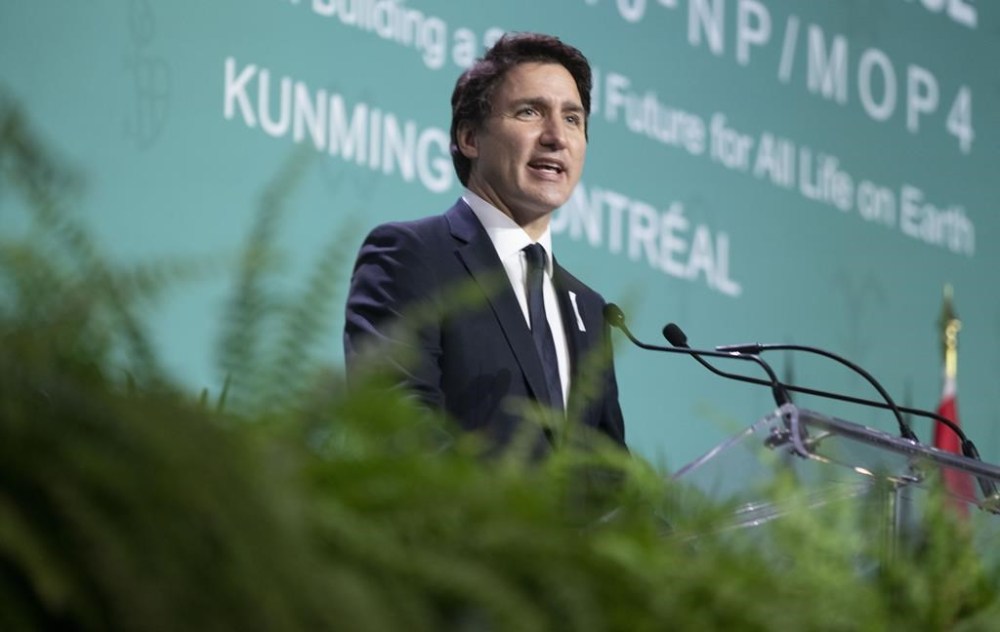
Prime Minister Justin Trudeau delivers remarks during the opening ceremony of the COP15 UN conference on biodiversity in Montreal on Tuesday, December 6, 2022. THE CANADIAN PRESS/Paul Chiasson

“Each of these projects is different, because each of these projects is being designed by communities, for communities,” he said.

Chief Jackson Lafferty, of the Tlicho government in the Northwest Territories, said Indigenous groups have long been working to protect their lands and water but have lacked resources and tools to fully do so.

Lafferty, who attended the announcement, called the funding “a significant step forward on a path to reconciliation across Canada.”

Among the projects to be funded is a marine conservation and sustainability initiative in the Great Bear Sea along British Columbia’s north coast, championed by 17 First Nations in the area.

Another project includes protection for boreal forests, rivers and lands across the Northwest Territories, spearheaded by 30 Indigenous governments.

Funds will also go to an Inuit-led project involving waters and land in Nunavut’s Qikiqtani region and to a project in western James Bay to protect the world’s third largest wetland, led by the Omushkego Cree in Ontario.

Trudeau told reporters that the exact details of the agreements have yet to be worked out — including which portions of the lands will be shielded from resource extraction.

The Indigenous partners, he said, will be able to decide which lands need to be completely protected and where there can be “responsible, targeted development.”

“We know we need jobs, we know we need protected areas, we know we need economic development,” he said. “And nobody knows that, and the importance of that balance, better than Indigenous communities themselves that have been left out of this equation, not just in Canada but around the world, for too long.”

Dallas Smith, president of Nanwakolas Council, said the B.C. funding to help protect the Great Bear Sea would allow Indigenous groups to build on previous agreements to protect the terrestrial lands of Great Bear Rainforest, which were announced about 15 years ago.
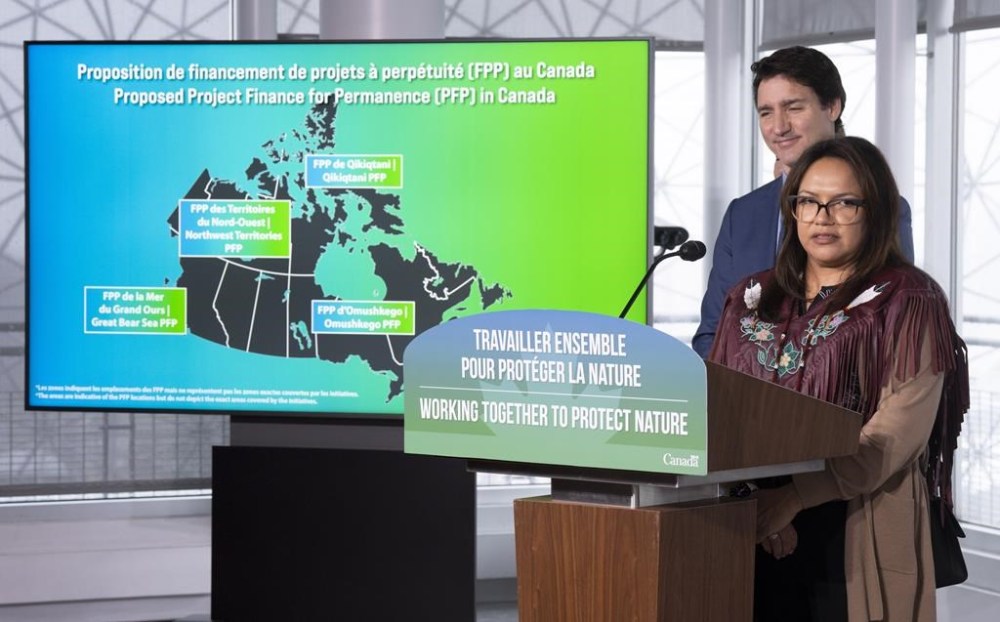
Grand Chief Alison Linklater delivers remarks as Prime Minister Justin Trudeau looks on during a news conference in Montreal on Wednesday, December 7, 2022. THE CANADIAN PRESS/Paul Chiasson

“I did media all over the world, and I got home and my elder said, ‘Don’t sprain your arm patting yourself on the back, because until you do the marine component, it doesn’t mean anything,'” he said.

Grand Chief Alison Linklater of the Mushkegowuk Council, which represents seven Cree communities in northern Ontario, said their traditional territory includes ancient peatlands that store “billions of tons” of carbon, as well as wetlands that are home to many migratory birds and fish, and 1,200 kilometres of coastline.

She said caring for the lands is one of her sacred duties as grand chief and one of the main concerns of the people she represents.

“Without our lands and waters we do not exist,” she told the news conference.

In a statement, the federal government said the program would employ a “unique funding model” bringing together government, Indigenous Peoples, philanthropic partners and other investors to secure long-term financing for community-led conservation projects.

The government did not specify how much of the funding would be allocated for each project.

This report by The Canadian Press was first published Dec. 7, 2022.
Report Error Submit a Tip

More Stories

Literary imprint led by Winnipeg author Wong

Ben Sigurdson 4 minute read 2:01 AM CDT

A new imprint from Arsenal Pulp Press is being spearheaded by Winnipeg author and professor Lindsay Wong (Villain Hitting for Vicious Little Nobodies).

The aim of the 9-Tailed Fox imprint is to publish “literary adult fiction and non-fiction titles by BIPOC Canadian writers that are innovative and unconventional in form and content,” according to a Sept. 4 news release. The first book to be released as a 9-Tailed Fox title will be Phoenix Poon’s coming-of-age novel Fox Fox Flux, which will be published in fall 2027.

● ● ●

Winnipeg Swampy Cree author David A. Robertson and B.C. illustrator Maya McKibbin have won the Sheila Barry Best Canadian Picturebook of the Year Award for Little Shoes, published in July 2025 by Tundra Books.

Winnipeg’s failing grade starting point, not final word: CFIB

Aaron Epp 4 minute read Wednesday, Sep. 16, 2026

Winnipeg is one of nearly 40 municipalities to receive a failing grade from the Canadian Federation of Independent Business in the organization’s inaugural “municipal report card.”

The Manitoba capital ranked 33rd amongst the 66 municipalities assessed, earning an F, with an overall score of 4.84 out of 10.

The report, which the CFIB released on Tuesday, evaluated cost burden, regulatory burden and small-business friendliness using 11 indicators and data collected up to Dec. 31, 2025.

Winnipeg’s grade is a starting point and not the final word, said Brianna Solberg, CFIB’s director for the Prairies and northern Canada.

The end of the road

Terry Doerksen 9 minute read Preview

The end of the road

Terry Doerksen 9 minute read Saturday, Aug. 6, 2022

St. Louis and the end of the trade route

Read
Saturday, Aug. 6, 2022

Selkirk Avenue resident misses sound of silence

Zoe Pierce 4 minute read Preview

Selkirk Avenue resident misses sound of silence

Zoe Pierce 4 minute read Wednesday, Aug. 5, 2026

Selkirk Avenue resident Gail Allard sits on her front steps, looking at a row of tree stumps.

Until last fall, Allard would have opened her front door to a lush canopy of mature trees. Now, she has an unobstructed view of a freight terminal — the Canadian Pacific Kansas City Ltd. intermodal yard.

Although the residential street is quiet on this August afternoon, the steady beeping of machinery moving shipping containers carries throughout the neighbourhood.

It’s the first summer since Manitoba Hydro cut down 262 mature trees — most of them Siberian elms — along Selkirk Avenue between Keewatin and Railway streets.

Read
Wednesday, Aug. 5, 2026

Family account spiced with magic realism, geopolitical intrigue and a ghost story

Reviewed by Zilla Jones 4 minute read Preview

Family account spiced with magic realism, geopolitical intrigue and a ghost story

Reviewed by Zilla Jones 4 minute read 2:01 AM CDT

Tom Lin’s second novel Babylon, South Dakota moves beyond a historical account of an immigrant family’s struggle, delightfully blending and bending genres.

Lin is a Chinese-born novelist whose family emigrated to the U.S. when he was four years old. His debut novel, The Thousand Crimes of Ming Tsu, won the 2022 Andrew Carnegie Medal for Excellence in Fiction, making him the youngest ever recipient of that award. He earned a PhD in English from the University of California Davis and is currently an assistant professor of English and creative writing at the University of Iowa.

Babylon, South Dakota takes place in an unspecified time period that can be understood to be during the Mao era — likely the 1950s or ’60s. A young Chinese couple, the Hsuis, immigrate to the rural community that gives the book its title. They take the names Saul and Mei and settle on a 160-acre homestead left to them by a distant relative.

Saul’s dream is to breed and sell chrysanthemums from seeds he brought from China, while Mei wants to raise livestock. They speak no English, know nothing of life in the United States, are unprepared for the harshness of winter and the isolation of the farm and bring nothing with them except some gold, which Mei hides around the house for emergencies. Their only link to the outside world is a discarded and marginally functioning TV set, which Saul rescues and rigs up.

Read
2:01 AM CDT

Biden says 'we have to act' after Texas school shooting

Zeke Miller And Chris Megerian, The Associated Press 7 minute read Preview

Biden says 'we have to act' after Texas school shooting

Zeke Miller And Chris Megerian, The Associated Press 7 minute read Tuesday, May. 24, 2022

WASHINGTON (AP) — Lamenting a uniquely American tragedy, an anguished and angry President Joe Biden delivered an urgent call for new restrictions on firearms Tuesday night after a gunman shot and killed 19 children at a Texas elementary school.

Biden spoke from the White House barely an hour after returning from a five-day trip to Asia that was bracketed by mass shootings in the U.S. He pleaded for action to address gun violence after years of failure — and bitterly blamed firearm manufacturers and their supporters for blocking legislation in Washington.

'“When in God’s name are we going to stand up to the gun lobby?" Biden said with emotion. “Why are we willing to live with this carnage? Why do we keep letting this happen?"

With first lady Jill Biden standing by his side in the Roosevelt Room, the president, who has suffered the loss of two of his own children, though not to gun violence, spoke in visceral terms about the grief of the loved ones of the victims and the pain that will endure for the students who survived.

Read
Tuesday, May. 24, 2022