Mi’kmaq First Nation, environmental group work on creating zero-emission lobster boat

Advertisement

Advertise with us

HALIFAX - An environmental charity and the Membertou First Nation in Cape Breton are partnering to create electric lobster boats on the East Coast, saying it's the way of the future if Canada is to meet its zero-emission targets.

Read this article for free:


or

Already have an account? Log in here »

To continue reading, please subscribe:

Subscribe and receive a limited-edition Free Press branded hat or tote.

Digital Subscription

One year of digital access for only $205*

  • Enjoy unlimited reading on winnipegfreepress.com
  • Read the E-Edition, our digital replica newspaper
  • Access News Break, our award-winning app
  • Play interactive puzzles

*First annual payment billed as $205.00 + GST for one year. This annual subscription will automatically renew at $233.00 + GST every 52 weeks (10% off the regular annual price of $259.35). Offer available to new and qualified returning subscribers only. Cancel any time.

To continue reading, please subscribe:

Add Free Press access to your Brandon Sun subscription for only an additional

$1 for the first 4 weeks*

  • Enjoy unlimited reading on winnipegfreepress.com
  • Read the E-Edition, our digital replica newspaper
  • Access News Break, our award-winning app
  • Play interactive puzzles
Start now

*Your next Brandon Sun subscription payment will increase by $1.00 and you will be charged $17.95 plus GST for four weeks. After four weeks, your payment will increase to $24.95 plus GST every four weeks.

Hey there, time traveller!
This article was published 02/12/2022 (1358 days ago), so information in it may no longer be current.

HALIFAX – An environmental charity and the Membertou First Nation in Cape Breton are partnering to create electric lobster boats on the East Coast, saying it’s the way of the future if Canada is to meet its zero-emission targets.

Oceans North announced Thursday it is working on the project with the Mi’kmaq community’s fisheries and boatbuilding corporations, based in Sydney, N.S.

Hubert Nicholas, the director of fisheries at Membertou, said in an interview the new boats will likely be costlier than diesel-powered vessels at first, but he said it’s expected there will be savings in maintenance and fuel costs.
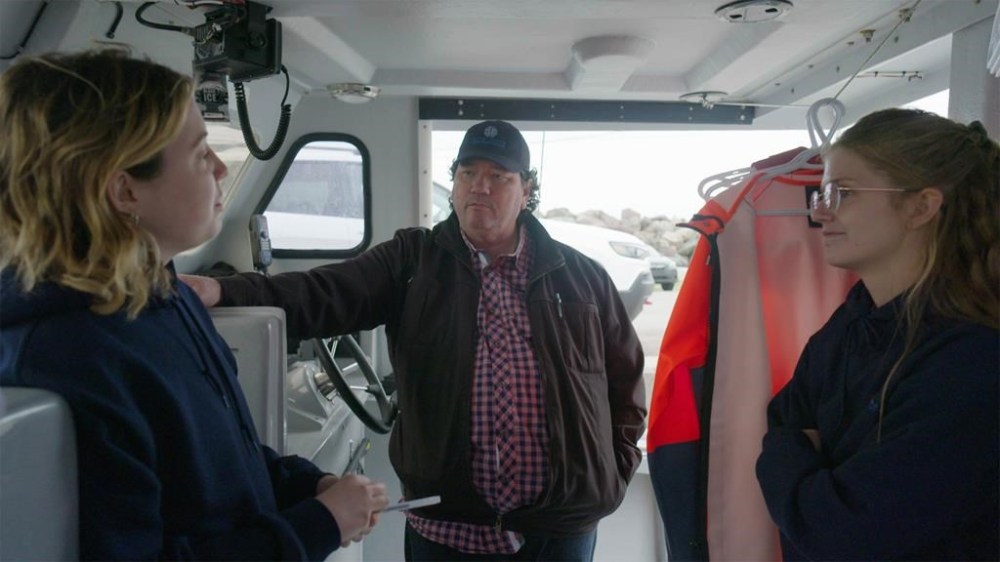
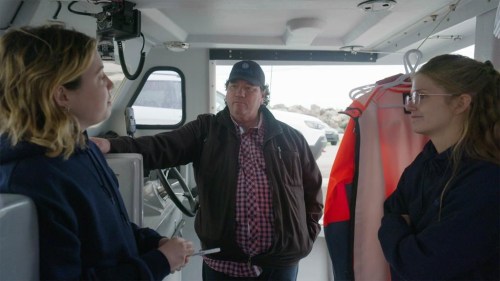
Hubert Nicholas, director of Fisheries at Membertou First Nation speaks with engineers Erica Pineo, left, and Marissa Campbell in a 2022 handout photo. An environmental charity and Membertou First Nation in Nova Scotia are partnering to develop the first generation of electric lobster fishing boats on Canada's east coast. THE CANADIAN PRESS/HO-Ocean North, *MANDATORY CREDIT*

“Right now, the cost is high … but we anticipate that as battery-powered boats become more accepted and more are built, the price will drop dramatically,” he said.

Nicholas estimated the cost of lobster boats is about $600,000 to $700,000, adding that an electrical boat would have higher, yet-to-be-determined costs for its engine and other components.

However, Nicholas said that the band’s boat-building firm sees it as the way forward, and he said he believes the industry will soon follow the pattern of car and truck industries in a shift away from emission-belching diesel motors.

“We’re seeing this as an opportunity to be ahead of the game. We want to be pioneers in this area,” he said.

The federal government has set a goal that one in five automobiles sold in the country by 2026 will be zero-emissions and 60 per cent of them will be by 2030. By 2035 Canada intends to ban the sale of new internal-combustion engines in passenger vehicles.

Brent Dancey, director of marine climate action at Oceans North, said the fishing sector also needs alternatives to fossil fuels, as society shifts toward zero-emission targets. In 2020, the federal government announced that Canada has the goal of cutting net carbon emissions to zero by 2050.

Dancey said the inshore fleet is an obvious first area for electrification in the marine sector. The project estimated that 70 per cent of the inshore lobster fleet travels within 20 kilometres from shore and can be powered by battery electric systems. As well, he said his team estimates the decarbonization of the inshore lobster fleet could displace 82 million kilograms of carbon dioxide — the equivalent of 20,000 cars.

Nicholas said he’s already seeing the potential for increased safety because fuel cells and electric engines are established technologies with fewer breakdowns than aging diesel engines, which are based on “100-year-old technologies.”

Rimot Inc. — a Halifax-based technology firm specializing in marine electrification — provided assistance to Membertou in the early stage of the project, studying how a conventional lobster boat uses energy in the course of a typical fishing trip. This data has been gathered as a baseline that naval architects and other experts can use in the next stage of the project, as hull designs are chosen, fuel cells are sourced, and electrical engine sizes are specified.

The first stage of the project has received $750,000 in funding, with $500,000 contributed by Google.org, the search engine’s philanthropic division, and about $250,000 from RBC.

Dancey said that after the feasibility study is complete, the project team will seek further funding to finish the design and construct the first boat at Membertou’s boatyard. He suggested he would look to governments for part of that funding.

“There are electric ferries working around the world. So, we want to take this technology that’s working in a bunch of vehicles and put it into a lobster vessel,” he said during an interview.

Nicholas estimated it will take two to three years to build the first electric vessel.

Andrew Boswell, the chief executive of Rimot Inc., said in an interview Thursday that one of the related areas of study involves how to set up in harbours charging systems to power boats and allow vessels to transfer unused energy back into the grid.

“You’ll start to see chargers on wharfs across the province. … And if we go at it in an unintelligent way, we’ll load up the grid at times of greatest need,” he said.

“But if we apply intelligence to this, we’ll help the grid in its efforts to achieve net zero by tapping into the storage of energy on the vessels at key times.”

This report by The Canadian Press was first published Dec. 2, 2022.

Report Error Submit a Tip

More Stories

Today’s horoscope

Georgia Nicols 4 minute read Preview

Today’s horoscope

Georgia Nicols 4 minute read 2:00 AM CDT

MOON ALERT: There are no restrictions to shopping or important decisions today. The moon is in Sagittarius.

ARIES (March 21-April 19)

You want adventure and stimulation — something interesting! You might also make practical plans related to the law, medicine, higher education or publishing. Yet, you feel playful, even though relations with someone close to you might be strained.

TAURUS (April 20-May 20)

Read
2:00 AM CDT

Private governance or public good

David Nutbean 5 minute read 2:00 AM CDT

The Manitoba government recently held public forums to discuss regulations for Bill 51, the Public Sector Artificial Intelligence and Cybersecurity Governance Act. I was able to participate in the meeting in Brandon and there was also a session in Winnipeg.

I was a bit fired up, ready to rail about data centres and phone terms and conditions and generally give it to big tech. The discussion, however, was focused on what the public sector responses should be regarding cybersecurity, data and privacy protections, and AI usage in government.

With all the recent attention on social media bans, the harms of AI, misinformation and the like, I was somewhat disappointed that these would not be tackled directly in this meeting. Those issues may be discussed at future forums.

At this event, as focus groups developed responses, the discussion between private companies and public governance kept getting mixed in, pointing out the reliance of government services on private companies in running their digital operations. As government operations become more dependent on digital infrastructure and towards AI agency and control, rethinking how technology is implemented may be crucial to our democracy.

Doctor speaks out, raises alarm over gas plant expansion plans

Rylee Gerrard 4 minute read Preview

Doctor speaks out, raises alarm over gas plant expansion plans

Rylee Gerrard 4 minute read 2:00 AM CDT

BRANDON — A retired doctor is raising red flags on Manitoba Hydro’s proposed gas plant expansion in Brandon and the health-related consequences of climate change.

Dr. Scott Blyth, a former family physician who practised medicine for more than 40 years, said there are health risks associated with long-term exposure to gas.

“A simple answer, the plant should not be built because of the potential health risks,” Blyth said Thursday.

Blyth is a member of the Canadian Association of Physicians for the Environment — a doctor-led organization with 80 members in Manitoba that works on the intersection between health and the environment.

Read
2:00 AM CDT

Fun-filled, far-out Falcon Lake

Gord Mackintosh 6 minute read Preview

Fun-filled, far-out Falcon Lake

Gord Mackintosh 6 minute read Saturday, Jul. 18, 2026

Hotels might loan bicycles, umbrellas, even fishing gear — but never fish. However, this is mirthful Manitoba and The Hotel at Falcon Lake appoints willing young guests as “fish-sitters.”

The front desk loans fishbowls of betta fish that require daily pinches of flaky food.

I asked staff, “Do fish ever return dead?”

The reply: “One died, but at the front desk. We held a service out front for Bubbles.”

Read
Saturday, Jul. 18, 2026

Mi’kmaq First Nation, environmental group work on creating zero-emission lobster boat

Michael Tutton, The Canadian Press 5 minute read Preview

Mi’kmaq First Nation, environmental group work on creating zero-emission lobster boat

Michael Tutton, The Canadian Press 5 minute read Friday, Dec. 2, 2022

HALIFAX - An environmental charity and the Membertou First Nation in Cape Breton are partnering to create electric lobster boats on the East Coast, saying it's the way of the future if Canada is to meet its zero-emission targets.

Oceans North announced Thursday it is working on the project with the Mi'kmaq community's fisheries and boatbuilding corporations, based in Sydney, N.S.

Hubert Nicholas, the director of fisheries at Membertou, said in an interview the new boats will likely be costlier than diesel-powered vessels at first, but he said it's expected there will be savings in maintenance and fuel costs.

"Right now, the cost is high ... but we anticipate that as battery-powered boats become more accepted and more are built, the price will drop dramatically," he said.

Read
Friday, Dec. 2, 2022

Educated people vote

John R. Wiens 5 minute read 2:00 AM CDT

I add my voice to Erna Buffie’s Think Tank piece “Democracy is a civic election issue” (Aug. 13) by asserting that democracy is a public education issue. Put another way, this fall’s municipal and school board elections are a test of public education — educating democratic citizens who appreciate our democratic inheritance enough to take responsibility for renewing it.

Voter turnouts for elections in Canada are abysmal. Where there should be 100 per cent participation, it often approaches 50 per cent federally and provincially, 25 per cent in local elections. The explanations given seem insufficient and unsatisfying, as are the reasons given by those who decide not to bother.

Some say they feel disempowered and alienated from the political process, feeling they have no say in governmental decisions which rule their lives.

Others appear resigned to the fact that, if they were to speak, they would simply be passed over or ignored, choosing not to vote because their votes, like their voices, make no difference and count for nothing. Still others say they’re too busy or just don’t care.