EXPLAINER: How will UN climate deal on loss and damage work?

Advertisement

Advertise with us

SHARM el-SHEIKH, Egypt (AP) — The decision Sunday by nations around the world to establish a fund to help poor countries hit hard by a warming planet was one of the most significant since U.N. climate talks began 30 years ago.

Read this article for free:


or

Already have an account? Log in here »

To continue reading, please subscribe:

Subscribe and receive a limited-edition Free Press branded hat or tote.

Digital Subscription

One year of digital access for only $205*

  • Enjoy unlimited reading on winnipegfreepress.com
  • Read the E-Edition, our digital replica newspaper
  • Access News Break, our award-winning app
  • Play interactive puzzles

*First annual payment billed as $205.00 + GST for one year. This annual subscription will automatically renew at $233.00 + GST every 52 weeks (10% off the regular annual price of $259.35). Offer available to new and qualified returning subscribers only. Cancel any time.

To continue reading, please subscribe:

Add Free Press access to your Brandon Sun subscription for only an additional

$1 for the first 4 weeks*

  • Enjoy unlimited reading on winnipegfreepress.com
  • Read the E-Edition, our digital replica newspaper
  • Access News Break, our award-winning app
  • Play interactive puzzles
Start now

*Your next Brandon Sun subscription payment will increase by $1.00 and you will be charged $17.95 plus GST for four weeks. After four weeks, your payment will increase to $24.95 plus GST every four weeks.

Hey there, time traveller!
This article was published 20/11/2022 (1369 days ago), so information in it may no longer be current.

SHARM el-SHEIKH, Egypt (AP) — The decision Sunday by nations around the world to establish a fund to help poor countries hit hard by a warming planet was one of the most significant since U.N. climate talks began 30 years ago.

It was an unequivocal confirmation that poor countries, with limited resources, are being most impacted by extreme weather events like floods, heat waves and storms and, at least at some level, industrialized nations that have done the most to contribute to climate change have a responsibility to help.

While government leaders, environmentalists and activists celebrated plans for such a fund, there are many outstanding questions, ranging from how it will work to long-term repercussions. Here is a look at the development of the idea of “loss and damage,” the term it’s given in climate negotiations, and what we know about the fund.
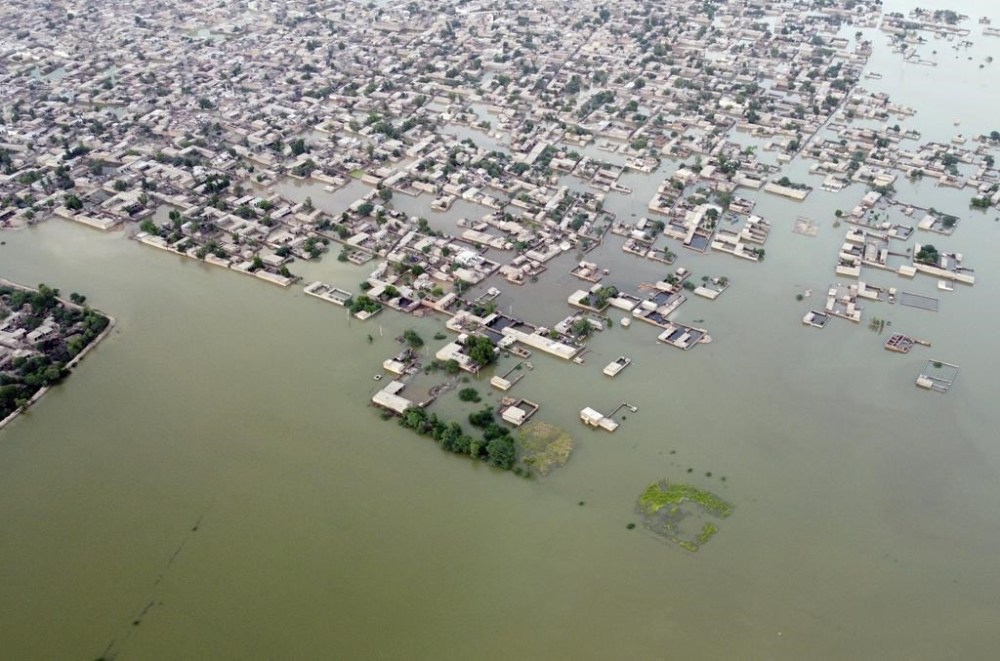
FILE -Homes are surrounded by floodwaters in Jaffarabad, a district of Pakistan's southwestern Baluchistan province, Sept. 1, 2022. (AP Photo/Zahid Hussain, File)

HISTORY

In the early 1990s, the Alliance of Small Island States, a group of low-lying coastal and small island countries, began calling for the establishment of a loss and damage fund as the United Nations was creating a framework to deal with climate change on an international level.

Since then, the idea has always been a part of annual U.N. climate summits. However, it was often talked about on the margins of negotiations, something developing nations and activists would push for while many rich nations used their weight to squash the idea. For the first time, at this year’s COP27 it was included in the agenda and became the centerpiece of discussions.

WHO WILL FUND IT?

The fund will initially draw on contributions from developed countries and other private and public sources, such as international financial institutions, with an option for other major economies to join down the line.

The final text points to “identifying and expanding sources of funding,” something the EU, the U.S. and others had pushed for during negotiations, suggesting that nations that are both high-polluting and considered developing under the criteria, should also pay into the fund.

During the talks, China said money for the new fund should come from developed countries, not them. But there’s precedence for China to voluntarily pay into climate funds, if the U.S. does too.

When the Obama administration pledged $3 billion to the Green Climate Fund in 2014, China also paid $3.1 billion for the fund.

More details of who pays will be decided by a committee that plans to get the fund going within a year.

WHO WILL GET MONEY?

The deal says the fund will assist “developing countries that are particularly vulnerable to the adverse effects of climate change,” though there will be room for middle-income countries that are severely affected by climate disasters to also get paid.

Pakistan, which was devastated by flooding that put a third of the country underwater, or Cuba, recently battered by Hurricane Ian, could be eligible.

How the loss and damage fund will fit in with “other institutions, agencies that are out there doing humanitarian work, helping people rebuild, dealing with migration and refugee crises, dealing with food security, water security” will need to be worked out, said David Waskow, the World Resources Institute international climate director.

Those details will also be hammered out by the committee in the coming year.

REBUILDING TRUST

Beyond just financial help, setting up the fund is seen as a huge step forward, but how it’s ultimately viewed will depend in part on how fast it can be set up.

In the closing session Sunday, Antigua’s Lia Nicholson said the transitional committee should be set up immediately and given clear mandates.

“This loss and damage fund must become the lifeboat that we need it to be,” she said.

There is a credibility gap because of past broken promises.

In 2009, rich nations agreed to provide $100 billion a year to help developing countries transition to green energy systems and adapt to climate change. However, to date, that initiative has never been fully funded.

REPERCUSSIONS

One of the main reasons that rich nations long opposed such a loss and damage fund was the fear that it would open then up to long-term liability. Despite passage, that concern is very much still at play, as evidence by how negotiators made sure the language of the fund didn’t say “liability” and that contributions were voluntary.

Despite those caveats, the establishment of such a fund could have repercussions, both legal and symbolic, in climate circles and beyond. For example, several Pacific Island nations have been pushing for the International Court of Justice to consider climate change. They argue that international laws must be strengthened to protect their rights in the case that their lands are engulfed by rising seas. The establishment of a loss and damage fund could bolster those arguments.

___

Associated Press writers Frank Jordans and Seth Borenstein contributed to this report.

____

Associated Press climate and environmental coverage receives support from several private foundations. See more about AP’s climate initiative here. The AP is solely responsible for all content.

Report Error Submit a Tip

More Stories

Kinew pledges temporary ER in Dauphin by Labour Day

Free Press staff 2 minute read Yesterday at 2:01 AM CDT

Dauphin’s 8,400 residents, ravaged by floodwaters from unprecedented rainfall in June that has left the city without its hospital for the entire summer, will have a temporary but functioning ER shortly, Premier Wab Kinew promised Monday.

“We’ve heard you loud and clear Dauphin,” Kinew said in a post on X on Monday. “You need these services close to home, you’ll have an emergency department working by Labour Day.”

Dauphin Mayor David Bosiak was elated after hearing the news. “We’re tickled in town,” Bosiak said, adding he has faith the premier will deliver.

Kinew is expected to provide further details Tuesday.

‘Frustrated’ Selkirk nurses plead for help

Morgan Modjeski 3 minute read Preview

‘Frustrated’ Selkirk nurses plead for help

Morgan Modjeski 3 minute read 5:21 PM CDT

The province must take immediate action to increase low staffing levels that are putting Selkirk emergency room nurses at risk, a letter sent to the premier and health minister says.

The letter, sent by the Manitoba Nurses Union and signed by 35 ER nurses, detailed multiple recent incidents at the Selkirk Regional Health Centre. In one case, a nurse was stabbed with a pen by a patient who had been waiting 24 hours for care. In another case, a nurse was bitten by a patient.

“Nurses in that emergency department are extremely frustrated,” said Manitoba Nurses Union president Darlene Jackson. “This is not something that happened in the last month — or overnight — these are problems that have been growing.”

The five-page letter was sent Tuesday to Premier Wab Kinew, Health Minister Uzoma Asagwara and leaders of the Interlake-Eastern Regional Health Authority. It contained 10 requests to improve safety inside the emergency department, including establishing safer nurse-to-patient staffing levels, eliminating the practice of “single physician coverage” in the emergency department and implementing an institutional safety officer around the clock.

Read
5:21 PM CDT

Elections Alberta asks Elections Manitoba staffers to help during referendum

Carol Sanders 3 minute read Preview

Elections Alberta asks Elections Manitoba staffers to help during referendum

Carol Sanders 3 minute read 3:11 PM CDT

Manitoba’s non-partisan elections management agency could play a role in Alberta’s fall referendum.

“Elections Alberta has asked Elections Manitoba to send staff to assist with the referendum taking place there in October,” said Tessa Vanderhart, a spokesperson with the office of the Chief Electoral Officer of Manitoba.

The Oct. 19 referendum will ask Albertans 10 questions, including “Should Alberta remain a province of Canada, or should the Government of Alberta commence the legal process required under the Canadian Constitution to hold a binding provincial referendum on whether or not Alberta should separate from Canada?”

Each of the referendum questions will be on separate numbered and colour-coded ballots. They will be counted by hand, the Elections Alberta website says. With an estimated 2,966,192 voters in the province — registered as of May 2025 — there could be as many as 30 million ballots to count.

Read
3:11 PM CDT

A young Canadian women’s soccer team should have continued success, but for how long?

Laura Armstrong - Staff Reporter, Toronto Star 5 minute read Preview

A young Canadian women’s soccer team should have continued success, but for how long?

Laura Armstrong - Staff Reporter, Toronto Star 5 minute read Saturday, Aug. 7, 2021

Canada is the only country currently ranked among FIFA’s top 10 that does not have its own women’s league.

Read
Saturday, Aug. 7, 2021

Canada being side-swiped by Trump’s Cuba policy

Peter McKenna 5 minute read Preview

Canada being side-swiped by Trump’s Cuba policy

Peter McKenna 5 minute read Saturday, Jun. 27, 2026

Canada’s decades-long relationship with revolutionary Cuba has always been a three-country affair — with the United States frequently settling for the spurned third-wheel.

Since the early 1960s, successive U.S. governments have strenuously objected to Canadian trade and commercial engagement with the island. Officials in Washington have always believed that the Canadians were trying to make a “quick buck” at America’s expense, while simultaneously seeking to undermine the U.S. blockade of Cuba.

For almost 70 years now, Canada has had to negotiate the thorny issue of the U.S. trade embargo. Added to that was the anti-Cuba Cuban Democracy Act of 1992 and the still active 1996 Helms-Burton Law. Complicating matters further for Ottawa have been the various additions and subtractions to the unrelenting U.S. efforts to strangle the Cuban economy — particularly during the presidency of Barack Obama.

In January, U.S. President Donald Trump imposed a near-ironclad (some Russian oil is getting through), illegal fuel embargo against Cuba, using American naval vessels and U.S. Coast Guard ships. Additionally, he signed an executive order in early May to expand U.S. economic warfare, or what some call “secondary sanctions,” against those materially assisting the Cuban government.

Read
Saturday, Jun. 27, 2026

Max youth sentence for boy in liquor store robbery

Dean Pritchard 5 minute read Preview

Max youth sentence for boy in liquor store robbery

Dean Pritchard 5 minute read Tuesday, May. 26, 2020

A 15-year-old boy has been handed a maximum youth sentence of three years custody and community supervision for a violent liquor store robbery a judge says impacted not only the people he attacked, but the entire city.

“This is the type of incident likely to cause some Winnipeg residents to pose the question to themselves whether the city is as safe as they thought it was, or, if this could happen in the middle of the afternoon in a busy shopping mall, is anybody safe anywhere in the city?” provincial court Judge Dale Schille said Tuesday.

“The impact of these offences is not restricted to the individuals involved, it has impacted the community in a broader way,” he said.

The boy previously pleaded guilty to five counts of robbery, three counts of assault, and one count each of mischief and uttering threats in connection to the robbery last November at the Tyndall Market mall Liquor Mart and the mayhem that followed.

Read
Tuesday, May. 26, 2020