Fall budget update promises tax credits for clean electricity and hydrogen production

Advertisement

Advertise with us

OTTAWA - Finance Minister Chrystia Freeland’s fall economic update creates two new federal tax credits for clean technology and low-emitting hydrogen production, with the caveat that companies that pay fair wages and train apprentices will get a bigger credit than those that do not.

Read this article for free:


or

Already have an account? Log in here »

To continue reading, please subscribe:

Subscribe and receive a limited-edition Free Press branded hat or tote.

Digital Subscription

One year of digital access for only $205*

  • Enjoy unlimited reading on winnipegfreepress.com
  • Read the E-Edition, our digital replica newspaper
  • Access News Break, our award-winning app
  • Play interactive puzzles

*First annual payment billed as $205.00 + GST for one year. This annual subscription will automatically renew at $233.00 + GST every 52 weeks (10% off the regular annual price of $259.35). Offer available to new and qualified returning subscribers only. Cancel any time.

To continue reading, please subscribe:

Add Free Press access to your Brandon Sun subscription for only an additional

$1 for the first 4 weeks*

  • Enjoy unlimited reading on winnipegfreepress.com
  • Read the E-Edition, our digital replica newspaper
  • Access News Break, our award-winning app
  • Play interactive puzzles
Start now

*Your next Brandon Sun subscription payment will increase by $1.00 and you will be charged $17.95 plus GST for four weeks. After four weeks, your payment will increase to $24.95 plus GST every four weeks.

Hey there, time traveller!
This article was published 03/11/2022 (1433 days ago), so information in it may no longer be current.

OTTAWA – Finance Minister Chrystia Freeland’s fall economic update creates two new federal tax credits for clean technology and low-emitting hydrogen production, with the caveat that companies that pay fair wages and train apprentices will get a bigger credit than those that do not.

The statement tabled in the House of Commons on Thursday is Freeland’s first big push to keep Canada in the clean-tech economy race in the shadow of the massive Inflation Reduction Act south of the border, and move Canada’s transition to a green economy further along.

“The green transition is the most significant economic transformation since the Industrial Revolution,” Freeland said.
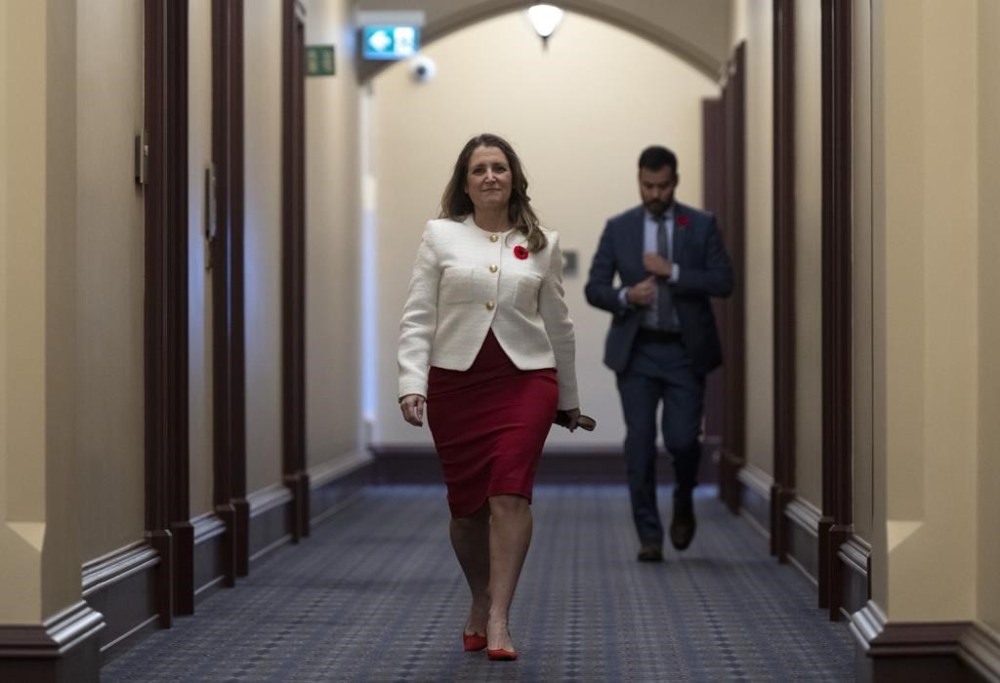
Deputy Prime Minister and Finance Minister Chrystia Freeland makes her way to a cabinet meeting on Parliament Hill, In Ottawa, Thursday, Nov. 3, 2022. THE CANADIAN PRESS/Adrian Wyld

The Inflation Reduction Act, signed into law in August by U.S. President Joe Biden, invests nearly US$400 billion in everything from critical minerals to battery manufacturing, electric vehicles, and clean electricity, including hydrogen.

Experts and industry associations have been warning ever since that Canada would be shoved aside in the global competition for investment, skilled workers and materials if it did not step up and do more to match the U.S. investments.

Freeland said the fall update is just the “down payment on the work that lies ahead to respond to the inflation Reduction Act.”

Most of the heavy lifting to respond will need to wait until the Liberals introduce the next federal budget, expected in spring 2023.

But Freeland outlined in Thursday’s mini-budget the broad strokes of some of it, including launching consultations to design an investment program for electric vehicle and battery manufacturing and plans to create a new tax credit for companies that start producing low-carbon hydrogen.

That credit is being carved away from the clean-tech investment tax credit she said last April would be ready in time for this fall update.

Freeland made good on that promise, introducing an investment tax credit of up to 30 per cent for renewable electricity systems, industrial electric vehicles, energy storage systems and heat pumps. The credit will kick in the day the 2023 budget is tabled and Freeland expects it to cost almost $6.7 billion over the next five years.

The credit will be phased out starting in 2032 and end entirely in 2035.

Hydrogen was going to be included in that program but that is no longer the case. It will get its own tax credit of up to 40 per cent of the investments made to produce low-emitting or zero-emissions hydrogen. The size of the credit will be tied to the size of emissions from a production facility, with the final details worked out in time for the spring budget.

Mark Zacharias, the CEO of Clean Energy Canada, a renewable energy think tank at Simon Fraser University in Burnaby, B.C., said splitting the hydrogen credit out is a smart move because it mirrors what the U.S. did in the Inflation Reduction Act.

He said Canada’s tax credit isn’t identical, but along with clean tech credit, it will keep Canada competitive with the U.S.

“This (update) does help close the gap between the Inflation Reduction Act in the U.S. and make Canada a little bit more competitive in the clean technology space,” he said.

“I think it’ll catalyze climate spending in Canada, both public and private.”

Both tax credits will, for the first time, include labour conditions that make them more lucrative for companies that pay fair market wages and include apprenticeship training for young workers.

The idea was taken from the U.S. Inflation Reduction Act and Freeland said it is one of the most noteworthy policies in her economic statement.

“Our basic view is if the government is investing in businesses, encouraging them to do things that we need done … it is entirely reasonable, in fact, I would say long overdue, for us to say ‘and as you’re doing it, you need to be creating good paying jobs for Canadian workers.'”

Government officials indicated Thursday that if the labour conditions are successful in this initial context they likely will become a common part of any future government investment programs.

Freeland also used the update to release more details of the new Clean Growth Fund she promised in last spring’s budget, and says it will launch before the end of the year with $15 billion in startup capital.

The Liberals are hoping the fund will ease the risks of investing in emerging clean technologies and attract “substantial private sector investment.”

The update also includes some movement on the government’s promise to help retrain workers to succeed in clean technology companies, with $250 million over the next five years to create two new sustainable job training programs.

One would build a new training centre that could retrain 15,000 workers in low-carbon economy jobs, and the other would fund apprenticeship training through an existing union training program.

This report by The Canadian Press was first published Nov. 3, 2022.

Report Error Submit a Tip

More Stories

Hydro’s planned outages turn out the lights for thousands across province

Nicole Buffie 4 minute read Preview

Hydro’s planned outages turn out the lights for thousands across province

Nicole Buffie 4 minute read Wednesday, Jul. 15, 2026

Business owners in the East Beaches area of Lake Winnipeg hauled out generators Wednesday after a planned Manitoba Hydro outage left thousands of residents and cottagers without power.

Lise Bourassa, who runs several stores in Grand Beach, had to rent generators to accommodate the eight-hour blackout, which affected the area from Beaconia to Victoria Beach as well as Sagkeeng First Nation, while Hydro crews fixed a pole that was damaged by fire in May .

Despite the spare power source, she was only able to open one of her stores during the outage and said it came at a bad time.

“I understand the importance of what Manitoba Hydro is doing, the problem all the businesses in this area are having is that our season is very short and to be shut down for a full day has a fairly big impact, plus they added cost of getting generators,” she wrote in a message to the Free Press. “We also had less than one week to make arrangements, find electricians and generators to be able to keep all the food safe.”

Read
Wednesday, Jul. 15, 2026

Magic number for marathon man

Eric Willemsen 5 minute read Sunday, Oct. 13, 2019

VIENNA — Roger Bannister, 1954. Eliud Kipchoge, 2019?

Like the sub-four-minute mile, running a marathon in less than two hours had seemed impossible — until Saturday. But this time, there’s an asterisk: Olympic champion Kipchoge performed his feat under conditions so tightly controlled to maximize his success that it won’t appear in the record books.

The 34-year-old Kenyan completed the 42.195 kilometres (26.2 miles) in one hour, 59 minutes, 40.2 seconds at the INEOS 1:59 Challenge, an event set up for the attempt.

Ahead of the event, Kipchoge even compared the feat to being “like the first man on the moon.”

Province aims to keep cannabis workers safe

Carol Sanders 5 minute read Updated: 7:10 PM CDT

New legislation introduced Monday will allow cannabis stores to remove window coverings in an effort to improve safety for employees.

Bill 56 would amend the Liquor, Gaming and Cannabis Control Act to eliminate the mandatory requirement that prevents underage passersby from seeing the interior of the age-restricted stores.

“At its core, what this bill is about is keeping workers safe,” Justice Minister Matt Wiebe told reporters outside the chamber, flanked by labour representatives and Labour Minister Malaya Marcelino.

The bill would also give the Liquor, Gaming and Cannabis Authority of Manitoba power to establish mandatory minimum staffing levels during specified hours, to ensure workers are not alone during periods when there may be a higher risk of violence.

Estate of woman who died from local anesthetic injected into blood vessel sues Morden dentist, his business, clinic

Erik Pindera 4 minute read Preview

Estate of woman who died from local anesthetic injected into blood vessel sues Morden dentist, his business, clinic

Erik Pindera 4 minute read 4:08 PM CDT

The estate of a 23-year-old woman who died after receiving a local anesthetic during a wisdom tooth extraction at a Morden dental clinic has filed a lawsuit over her death.

Virginia Blatz never returned home after she went to Boundary Trails Dental Centre to have her wisdom teeth removed on Nov. 27, 2024. An autopsy later confirmed she died from local anesthetic systemic toxicity caused by an inadvertent injection into a blood vessel, her family has previously said.

Her father, Dulaney Blatz, filed a lawsuit in the Court of King’s Bench on behalf of her estate late last month, naming Ronald David Janz — the dentist who performed the procedure — his dental corporation and the dental corporation that operates the clinic as defendants.

None of the defendants have filed statements of defence in response to the claim, which has not yet been heard in court.

Read
4:08 PM CDT

Mayoral candidates Klein, Vogiatzakis continue to snipe over inducement allegations

Chris Kitching and Joyanne Pursaga 7 minute read Preview

Mayoral candidates Klein, Vogiatzakis continue to snipe over inducement allegations

Chris Kitching and Joyanne Pursaga 7 minute read Updated: 5:50 PM CDT

Winnipeg mayoral candidate Mike Vogiatzakis told reporters Monday he will contact the city clerk to report his allegation that rival Kevin Klein offered him a job to drop out of the race.

Vogiatzakis and Klein both doubled down a day after accusing each other of offering the other a position at city hall, if they were victorious in the Oct. 28 election, in exchange for a withdrawal.

“Do I want to get him charged? Not really. I don’t want to destroy anybody’s life,” Vogiatzakis told reporters.

“Kevin’s a good guy. I thought he was a friend of mine, but he’s not. Kevin uses leverage to get ahead, and he tried to use me as leverage.”

Read
Updated: 5:50 PM CDT

All-Japan committee meets to promote Sapporo Olympic bid

Stephen Wade And Yuri Kageyama, The Associated Press 4 minute read Preview

All-Japan committee meets to promote Sapporo Olympic bid

Stephen Wade And Yuri Kageyama, The Associated Press 4 minute read Tuesday, May. 10, 2022

TOKYO (AP) — Yasuhiro Yamashita, the head of the Japanese Olympic Committee, acknowledged the biggest stumbling block to holding the Olympics is the billions in costs.

However, in another breath on Tuesday at a so-called “All Japan” meeting to promote Sapporo's bid for the 2030 Winter Olympics, he said that if the northern Japanese city lands the Games, little new construction will be needed — a major expense for every Olympics.

“From both inside and outside our country, there are many views about hosting the Olympic and Paralympic Games,” Yamashista said, among politicians and business leaders online — and in Sapporo — talking up the bid. “I realize there are also concerns about the huge costs involved.”

The official cost for last year's delayed Tokyo Olympics was $13.6 billion, although government audits suggest it may have been much more. At least 60% was public money.

Read
Tuesday, May. 10, 2022